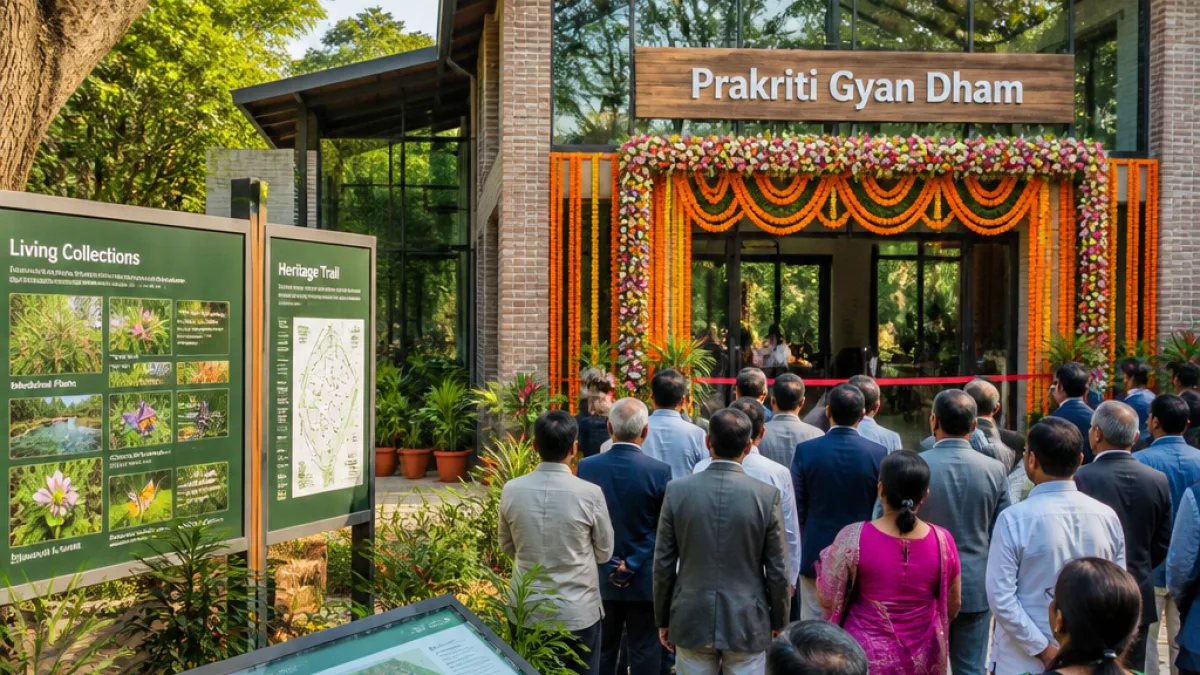
New eco-educational hub at CSIR-NBRI in Banthra
The CSIR-National Botanical Research Institute (CSIR-NBRI) on Monday opened Prakriti Gyan Dham, an eco-educational hub at the Maharishi Parashar Bioresource Centre in Banthra, Lucknow, aimed at making botanical research and conservation more accessible to the public.
The facility was dedicated to the nation by Union Minister of State for Science and Technology Dr Jitendra Singh, who described the hub as a model for taking scientific knowledge beyond laboratory walls and institutional campuses. According to CSIR-NBRI, Prakriti Gyan Dham has been conceived to engage students, researchers, educators, nature enthusiasts and members of the public through living collections, heritage trails, digital interpretation and interactive experiences.
"Scientific institutions must make their technologies, innovations and achievements more accessible to farmers, entrepreneurs, students, industry and the wider public," Dr Jitendra Singh said at the inauguration.
CSIR-NBRI officials said the hub will function as a living repository of India’s botanical and cultural heritage and will use hands-on displays and digital tools to explain plant diversity, ecological regions and conservation practices. The initiative is presented as part of a broader effort to connect scientific institutions with society and to demonstrate how research can contribute to education, environmental awareness, livelihoods and sustainable development.
- Location: Maharishi Parashar Bioresource Centre, Banthra, Lucknow.
- Target audiences: students, researchers, educators, farmers, industry and the public.
- Features: living collections, heritage trails, digital interpretation, interactive experiences.
Policy intent and expected outcomes
At the inauguration, Dr Jitendra Singh emphasised enhanced coordination among government departments, ministries and scientific institutions to increase the social impact of research. He urged greater use of digital and social media platforms to communicate scientific developments and to showcase technologies with potential to generate livelihood opportunities, according to CSIR-NBRI statements.
CSIR-NBRI presented Prakriti Gyan Dham as an accessible environment where botanical knowledge is not confined to conventional displays but experienced directly through living plants and interpretive programmes. The institute said this format aims to strengthen public understanding of biodiversity conservation and to inspire practical applications in agriculture, horticulture and allied livelihoods.
Features and learning opportunities
Officials described the hub’s principal elements as:
| Feature | Purpose |
|---|---|
| Living collections | Showcase plant diversity and regional flora |
| Heritage trails | Connect botanical and cultural history |
| Digital interpretation | Enhance engagement through multimedia and information access |
| Interactive experiences | Provide hands-on learning for students and visitors |
CSIR-NBRI framed the hub as part of its mission to bridge research, conservation and public engagement. The institute said Prakriti Gyan Dham will also serve as a platform for demonstrating technologies and practices that could be adopted by farmers, entrepreneurs and community groups, thereby linking scientific outputs to livelihood enhancement.
Local implications for Lucknow
For Lucknow, the new hub adds a civic and educational resource at a time when urban residents and schools are seeking experiential learning spaces. It complements existing botanical, zoological and environmental facilities in the city by emphasising applied plant science and conservation. The hub’s emphasis on digital outreach may also extend CSIR-NBRI’s impact beyond its physical gates, the institute said.
CSIR-NBRI indicated the project intends to foster collaborations with educational institutions and local stakeholders, though details on visiting hours, fee structures or scheduled programmes were not provided in the institute’s announcement. Officials said further information on operational aspects and public programmes would be shared in due course.
Prakriti Gyan Dham represents CSIR-NBRI’s effort to convert scientific collections and expertise into an accessible learning environment, signalling a push to make botanical science more visible and useful to Lucknow’s residents, students and practitioners.