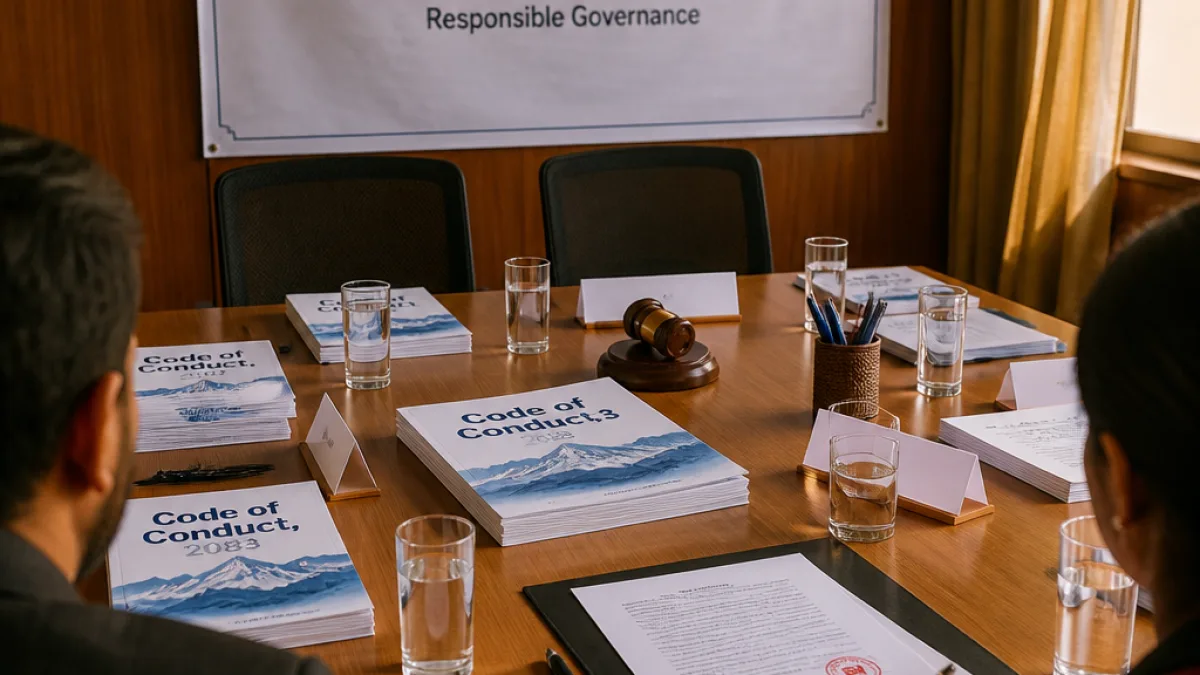
Kathmandu — An organisation called Agra gami Morcha has adopted the "Agra gami Morcha Code of Conduct, 2083" to regulate internal discipline, the conduct of leaders and members, and public-facing behaviour, the group said in a statement issued from Kathmandu.
Objectives and core commitments
The Morcha said the code was introduced to ensure constituent parties and their representatives adhere to democratic values, social justice and shared political aims. The document, the statement added, obliges members to protect:
- Democracy and the sovereign rights of the people;
- The federal democratic republic and secularism;
- Inclusivity and the rule of law.
The code makes it the responsibility of members to uphold national independence and safeguard people’s livelihoods while opposing social discrimination. It directs members to place common political goals above personal interests.
Internal dispute resolution and meeting discipline
To manage internal frictions, the code prescribes resolving disagreements through dialogue, facts and logic, and it mandates adherence to decisions reached collectively. On procedural conduct, the Morcha has issued strictures aimed at maintaining mutual respect in meetings and among participating parties and leaders.
Members are required to ensure full attendance at meetings, take part in constructive discussion, and limit their remarks to allotted time without interrupting others, the statement said.
Restrictions on public statements and digital behaviour
The new rules place particular emphasis on public expressions and social media use. The Morcha's statement said the following actions are prohibited:
- Character assassination in public and making insulting or discriminatory remarks based on caste, religion, language or gender.
- Issuing misleading statements at odds with official Morcha decisions.
- Disseminating unverified or false information on digital platforms.
- Operating fake accounts, organising troll campaigns, or mounting coordinated digital attacks against fellow leaders or parties.
Members are also cautioned against unauthorised disclosure of internal confidential documents, meeting photographs or contentious internal matters, the statement added.
Election-related safeguards and responsibilities
The code forbids pressuring or attempting to coerce candidates, and bars inducements intended to prevent healthy competition during elections. The Morcha emphasised the importance of maintaining a clean, dignified and responsible political environment, according to the statement.
"The code of conduct has been implemented to make the constituent parties and their representatives committed to democratic values, social justice, and common political objectives," the Morcha said.
| Area | Key measures |
|---|---|
| Core commitments | Democracy, secularism, inclusivity, rule of law |
| Dispute resolution | Dialogue, facts, mandatory adherence to collective decisions |
| Public conduct | No character assassination, no discriminatory remarks |
| Digital conduct | Ban on fake accounts, organised digital attacks, and dissemination of false/unverified news |
| Election conduct | No coercion or inducement of candidates |
The announcement did not specify enforcement mechanisms, penalties for breaches, or the membership size and organisational structure of the Morcha. It also did not give a timeline for implementation or indicate whether the code had been adopted unanimously by constituent groups.
While the statement originated from Kathmandu, the adoption of a code named after Agra may attract attention among the city's political and civic actors because of the explicit commitments to democratic norms and digital conduct. Observers often regard such formal codes as an attempt to standardise behaviour among diverse groups and to reduce public intra-group conflict, but the practical impact depends on transparency of enforcement and internal acceptance.
The Agra gami Morcha said it expects members to abide by the code and to prioritise collective objectives over individual interests. Beyond the provisions set out in the statement, further details on monitoring and compliance were not provided.