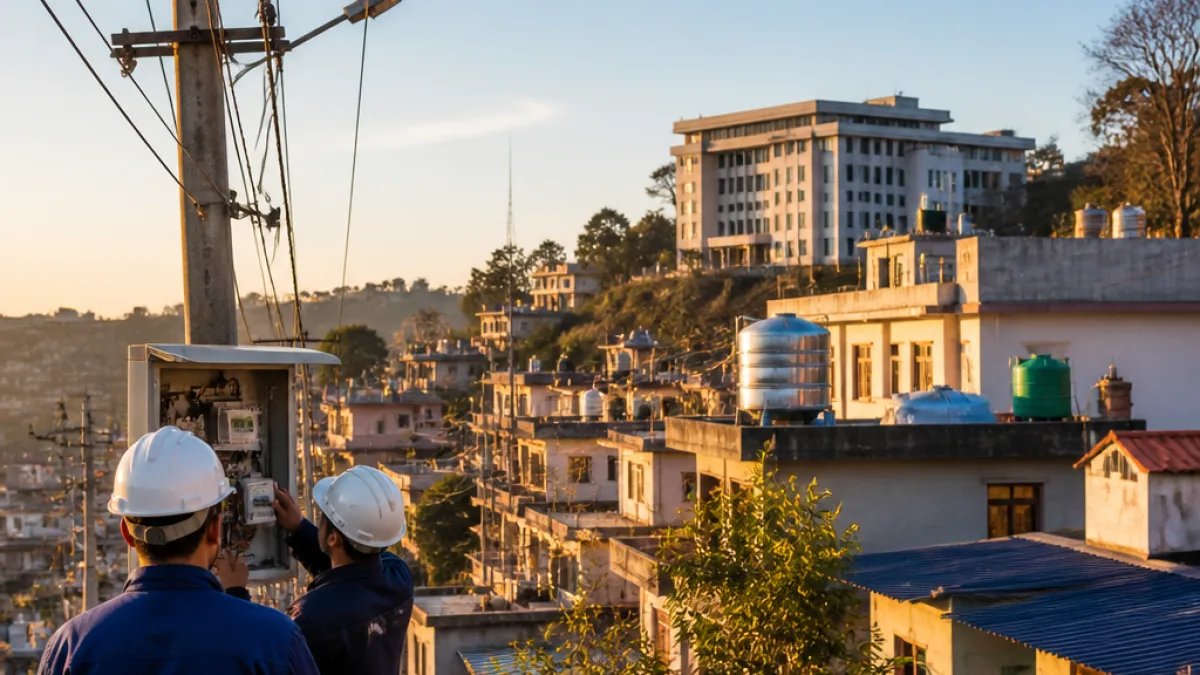
Itanagar: Arunachal Pradesh has achieved complete household electrification and full tap-water connectivity, Chief Minister Pema Khandu said on Saturday, citing comparative state figures for 2016 and 2026 and asserting that his government seeks to ensure scheme benefits reach every home.
State figures show large gains in a decade
In a post on X, the Chief Minister said that in 2016 about 1.48 lakh homes in the state had electricity, representing roughly 49 per cent of households. He said that by 2026 the number had risen to 3.02 lakh, which he characterised as 100 per cent home electrification.
He described the expansion of household access to functional tap water as even more dramatic. In 2016, only 22,796 homes had tap connections—about 9.9 per cent—whereas in 2026 the figure had reached 2,28,566 homes, which the Chief Minister said amounted to 100 per cent coverage and a 903 per cent rise over the decade.
“Over the past 10 years, Arunachal Pradesh has made a big difference in two basic needs, electricity and drinking water,” Khandu wrote.
The Chief Minister framed the progress as part of the government’s wider effort to ensure that the benefits of centrally and state-sponsored schemes reach every household in the state. He contrasted the situation a decade ago with the current picture to underscore the change.
Numbers at a glance
| Service | 2016 (homes) | 2016 (coverage) | 2026 (homes) | 2026 (coverage) |
|---|---|---|---|---|
| Household electricity | 1,48,000 | 49% | 3,02,000 | 100% |
| Functional tap connections | 22,796 | 9.9% | 2,28,566 | 100% |
The figures were provided in the Chief Minister’s post; the office of the Chief Minister described them as the outcome of a ten-year push to expand basic infrastructure across the state, particularly in remote and hilly areas where delivery has been challenging.
Implications and immediate questions
Full household coverage for electricity and piped water, if corroborated by independent audits and service-level measurements, would represent a major improvement in living standards and public health. Electrification supports lighting, education and small enterprises, while reliable tap-water connections reduce dependence on unsafe sources and the burden of collecting water.
- State claims are based on household counts and connection registers released by the Chief Minister.
- Independent verification—through third-party audits or official national datasets—would clarify service reliability and hours of electricity and water supply.
- Operational matters such as sustainability of distribution, maintenance funding and last-mile service quality remain critical for continued access.
Officials have in past years emphasised that counting a household as electrified or as having a tap connection does not automatically imply 24x7 supply or continuous potable water availability; service-level indicators and grievance redressal metrics are used to monitor ongoing performance.
The Chief Minister’s post did not provide details on distribution losses, average hours of electricity supply, quality of drinking water or the specific programmes and budgetary allocations responsible for the gains. Those operational details are typically found in department releases, audit reports and programme evaluations.
State authorities have previously implemented electrification drives under central schemes as well as state programmes to extend grid and off-grid connections to remote habitations. Drinking water expansion has similarly proceeded through mission-mode interventions combining surface and groundwater schemes, local pipeline networks and household-level tap installations.
For citizens, the immediate relevance will be whether the new connections translate into dependable, safe services in their neighbourhoods. The Chief Minister’s announcement is likely to be followed by calls from civil society and oversight bodies for detailed data and independent assessments, to confirm both the coverage and the quality of supply cited in the release.
Itanagar remains the focal point for state reporting, and the numbers were shared publicly from the Chief Minister’s office on Saturday.