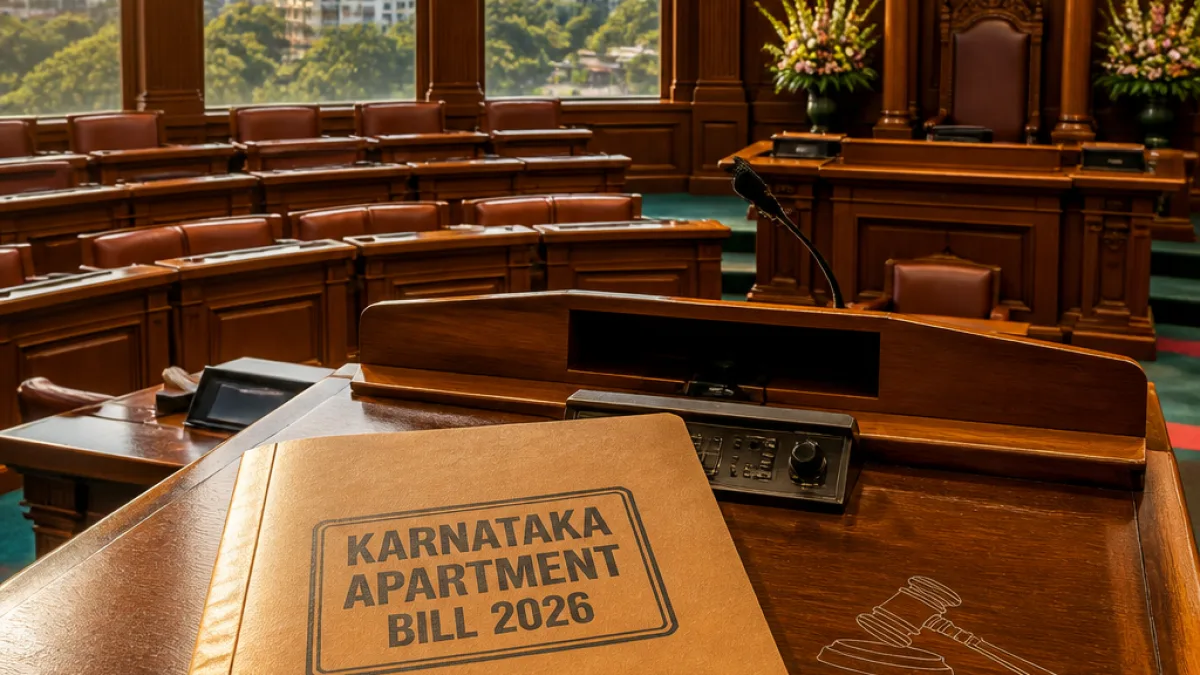
Bengaluru: The Karnataka Assembly on Friday passed the Karnataka Apartment (Ownership and Management) Bill 2026, a statute the state government describes as a comprehensive attempt to consolidate laws governing ownership, management and reconstruction of apartments in Karnataka.
Consolidation of old laws and new governance mechanisms
Bengaluru Development Minister Krishna Byre Gowda introduced the measure and said the Bill was drafted after consultations with various stakeholders. The legislation seeks to unify existing provisions relating to individual apartment ownership and to make such apartments heritable and transferable, while also establishing mechanisms to govern common areas and facilities in apartment complexes.
"We have framed the Bill after taking various stakeholders into confidence. We cannot say all issues concerning apartments will be resolved. But if any changes are required, we are ready to adopt. This is a good beginning," the minister said in the Assembly.
The Bill aims to address gaps left by earlier laws and by regulatory frameworks such as RERA. The minister noted that the existing Karnataka Ownership of Flats Act, 1972 and the Karnataka Apartment Ownership Act, 1972 have not been updated to reflect current realities, and various apartment associations remain registered under different authorities.
Key provisions and owners' rights
Under the Bill, apartment owners will have explicit rights to:
- Transfer, mortgage, lease or gift their individual apartments along with their undivided share in the land and common areas;
- Exercise those rights independently, with limitations on division of such rights without approval;
- Seek reconstruction of old buildings subject to a written consent threshold and compensation arrangements for dissenting owners.
The measure requires promoters to disclose any mortgages on the property. It also allows owners to mortgage their apartments independently "without affecting others," the minister said. In addition, the Bill proposes that apartment associations will be restricted from creating mortgages or encumbrances on common property.
Reconstruction, consent and compensation
One of the more consequential provisions relates to reconstruction of ageing apartment buildings. The Bill sets a threshold of written consent from at least 75% of apartment owners to proceed with reconstruction. For owners who do not agree to the redevelopment, the Bill provides for compensation, according to the minister's statement in the Assembly.
As Bengaluru and other urban centres expand and face land scarcity, the Bill seeks to create a clearer legal route for redeveloping old apartment blocks while protecting the legal and financial interests of individual owners.
Local authorities and dispute resolution
The Bill envisages the creation of a competent authority within panchayats and urban local bodies (ULBs) to oversee apartment-related matters. Apartment owners will be able to approach these local statutory authorities in the event of disputes, the minister said, aiming to reduce multiplicity of registrations and conflicting jurisdictional claims.
| Existing law | Year | Issue addressed by Bill |
|---|---|---|
| Karnataka Ownership of Flats Act | 1972 | Superseded/unified into consolidated framework |
| Karnataka Apartment Ownership Act | 1972 | Updated governance, ownership transfer and reconstruction provisions |
What this means for residents and developers
For residents of apartment complexes, the Bill aims to streamline ownership records, clarify rights to sell or mortgage flats and provide an institutional route for resolving conflicts over common areas such as roads, clubhouses and other shared facilities. For developers and promoters, mandatory disclosure norms for mortgages and limits on associations' power to encumber common property are likely to change transactional practices.
The minister acknowledged that the Bill may not resolve every issue, and indicated the government is open to further changes if needed after implementation. Lawmakers and stakeholder groups will now watch how the competent authorities at panchayat and ULB level implement the new scheme and manage disputes arising from conversion of older apartment statutes into the consolidated Bill.
The Bill was passed in the Assembly on Friday after the presentation by the Bengaluru Development Minister. Detailed rules and implementation timelines will be framed subsequently by the state government, as is customary for new legislation of this kind.