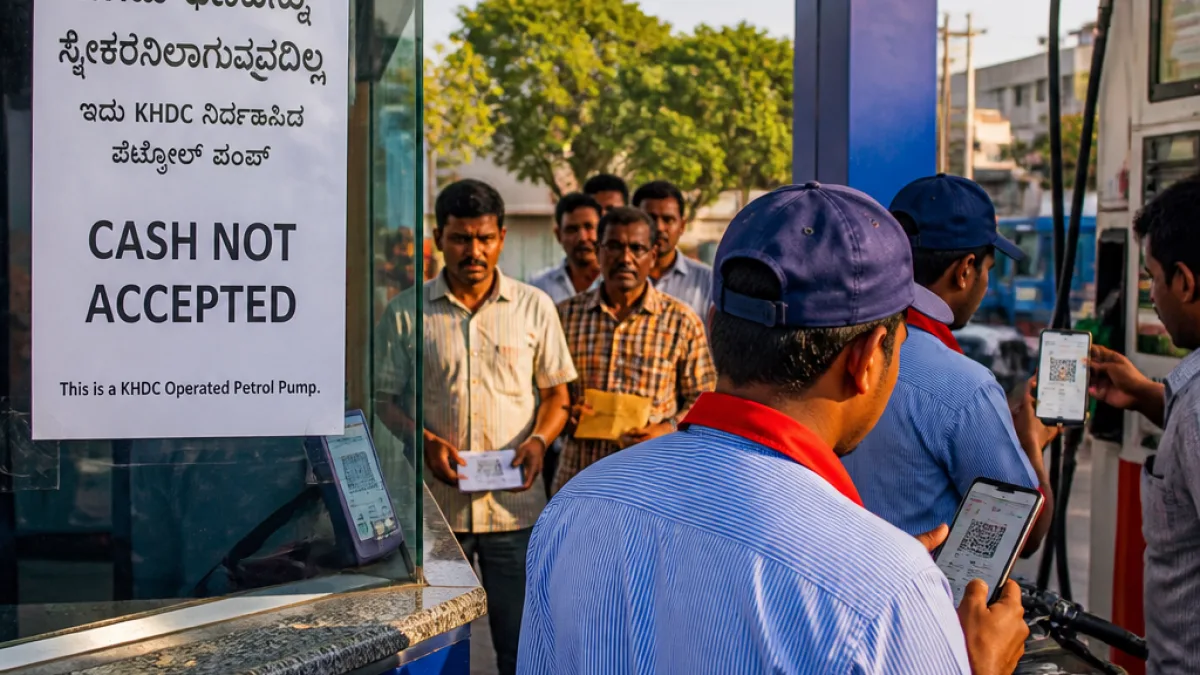
State-run Hubballi pump phases out cash payments; consumers question legality
Hubballi — A petrol station in Hubballi operated by the Karnataka Handloom Development Corporation (KHDC) under the Indian Oil Corporation (IOC) has stopped accepting cash for fuel purchases from 9 September, creating a payment row that has drawn complaints from customers and comments from consumer-rights advocates.
The circular, attributed to KHDC managing director Garima Panwar and dated 9 September, directs pump staff to decline cash and to accept payment through approved digital channels. According to reporting by the Times of India, pump employees have been turning away customers who insist on paying in cash.
"Consumers can use UPI/QR code, debit card, credit card, bank transfer or other approved digital modes available at the bunk. Staff are strictly instructed not to accept cash," the circular stated, as reported.
Consumers and activists question authority for a cash ban
Local consumers and legal activists say no central or state notification permits mandatory cashless transactions at petrol pumps. Advocate and activist KH Patil was quoted as saying there is no government or IOC order backing the KHDC directive, and that compelling customers to use digital methods could be illegal.
Patil highlighted the practical difficulties for segments of the population — including daily-wage labourers, autorickshaw drivers and elderly citizens — who may lack cards, UPI facility, or sufficient balances, and for whom cash remains essential for everyday purchases.
Complaints filed, IOC response absent
One customer, identified as Mayur (name changed), told the Times of India he lodged a grievance on the IOC website on 23 September, but had received no response. The report notes that IOC had not issued any public notification endorsing a cash ban at its retail outlets.
IT entrepreneur Veeru Uppin said encouraging digital payments is reasonable to avoid change-related issues, but making them compulsory is problematic because not all customers are digitally adept or able to use such modes at all times.
What the circular lists as acceptable payment methods
| Allowed payment modes (as per circular) |
|---|
| UPI / QR code |
| Debit card |
| Credit card |
| Bank transfer and other approved digital modes |
Local implications and wider questions
The move at the Hubballi pump raises several practical and policy questions for civic authorities and state-run enterprises. While digital payments reduce cash-handling risks and can improve transparency, an imposed ban could inadvertently exclude cash-dependent populations from access to essential fuel supplies.
- Access: Many customers in Hubballi rely on cash for daily transactions; refusal of cash could disrupt livelihoods, particularly for unbanked or intermittently banked workers.
- Legality: Legal experts point out that absent a statutory order, traders cannot legally deny cash where currency remains legal tender.
- Enforcement: The lack of a clear policy from IOC or the government leaves local management to enforce measures that may lead to grievances and reputational risks.
So far, there is no publicly available statement from IOC addressing the KHDC circular or guiding franchisees and lessees on mandatory cash restrictions. The KHDC managing director named in the circular has since been transferred, the report adds.
For Hubballi residents, the incident underscores the friction between digital-first service models and on-the-ground realities. City consumers and commuter groups will be watching for any clarification from IOC or the state government that balances encouragement of digital payments with the legal right to tender cash.
Further developments, including any official direction from IOC or the Karnataka government, will determine whether the Hubballi circular becomes an isolated experiment or a precedent with wider implications for retail fuel outlets across the state.