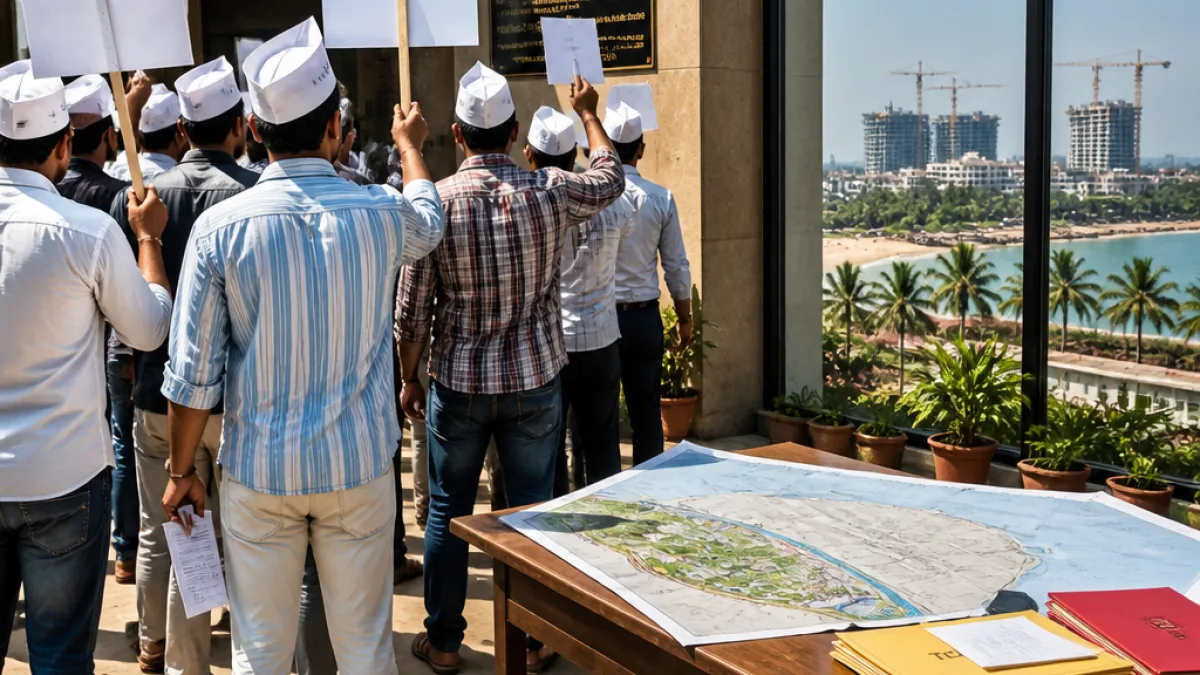
Party says cabinet announcements in Mangaluru recycle unfinished work, call for public consultation
The Dakshina Kannada unit of the Aam Aadmi Party (AAP) has challenged the state government’s recent tourism allocations announced at the cabinet meeting held in Mangaluru on September 18, saying the proposals largely concern unfinished projects and lack fresh initiatives that would benefit local youth and coastal communities.
Addressing a press conference, AAP state vice-president Vivekananda Salins criticised the use of public funds for large-scale tourism ventures and urged the government to open a dialogue with the district minister and stakeholders before proceeding. The party also welcomed the decision to make Tulu the second official language in Dakshina Kannada and Udupi districts, but said the Centre should take steps to include Tulu in the Eighth Schedule of the Constitution.
“The announcements made during the state cabinet meeting in Mangaluru on September 18 largely concern unfinished projects. There is nothing substantially new,”
Salins warned that major capital allocations for hotels, riverfronts and entertainment projects would not necessarily translate into meaningful employment for local youth, particularly those in traditional occupations such as fishing. He also flagged environmental risks from proposed construction on ecologically sensitive islands across Dakshina Kannada, Udupi and Uttara Kannada districts.
- AAP questioned the economic viability and employment potential of big-ticket tourism projects.
- The party expressed concern about ecological impact of multi-storey structures and bridges on sensitive islands.
- AAP urged improved safety measures at beaches, including appointment of trained lifeguards, and stronger support for adventure tourism activities such as kayaking, scuba diving and surfing.
Specific allocations cited by the party include riverside restoration, glamping and hotel projects. The AAP highlighted both the size of investments and the type of projects, suggesting some may favour private developers rather than local labour and micro-entrepreneurs.
| Project | Allocation (as cited by AAP) |
|---|---|
| Three-star hotel near Lighthouse | ₹60.3 crore |
| Gurupura river and its islands | ₹125.3 crore |
| Kodikal riverfront | ₹73 crore |
| Tannirbhavi Beach glamping and ocean experience centre | ₹53 crore |
| Adventure entertainment project at Maravanthe Beach | ₹48 crore |
| Resort in Chikkamagaluru | ₹64 crore |
Salins drew attention to proposals for development on 12 islands in the coastal districts, warning that construction of multi-storey buildings and bridges could damage fragile ecosystems. He urged the government to carry out thorough environmental impact assessments and to consult coastal communities, fisherfolk and local panchayats before moving ahead.
On public safety, AAP recalled recurring drowning incidents at coastal tourist spots and demanded the appointment of trained lifeguards and greater investment in beach safety infrastructure. The party also called for promotion and regulatory support for low-impact adventure tourism — including kayaking, scuba diving and surfing — which it said could be scaled with local participation and generate year-round livelihoods.
In its critique, AAP urged the state to prioritise:
- Transparent consultation with local stakeholders and district administration before project execution;
- Policies that favour local employment and micro-enterprises rather than exclusively large investors;
- Robust environmental safeguards and scientific assessments for island and riverfront projects.
The AAP statement underlines a wider debate in Karnataka over balancing coastal development, ecological protection and livelihood security. The party has called for a formal meeting with the district minister to discuss the projects and for public disclosure of detailed project reports and environmental clearances. The state government’s response to these concerns was not included in the party’s release.
Local residents, coastal activists and members of the fishing community are likely to watch closely as these allocations proceed to tendering and implementation stages, given the region’s sensitivity to both environmental change and shifts in tourism patterns that affect traditional livelihoods.