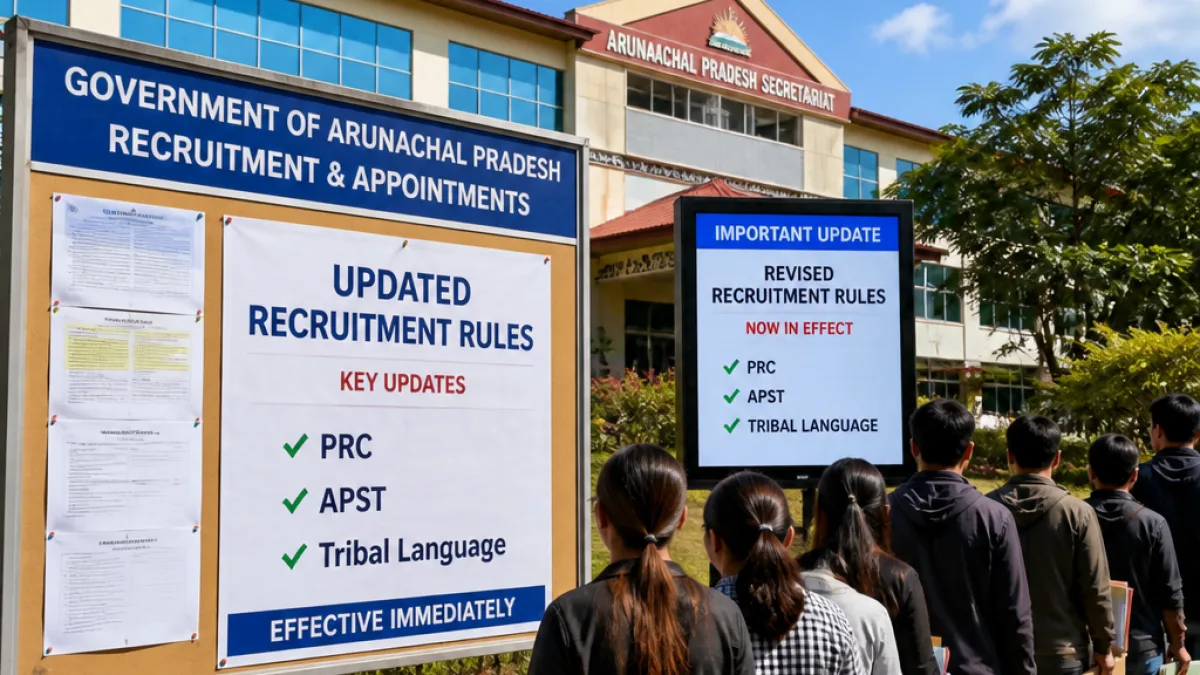
The Arunachal Pradesh Cabinet on Friday approved a major overhaul of state recruitment rules, doing away with the three-decade-old 80:20 reservation arrangement and instituting uniform eligibility criteria for direct recruitment to all services and posts.
What has changed
The Cabinet, which accepted the recommendations of the High Power Committee (HPC) on recruitment eligibility, has replaced the earlier quota formula with a set of mandatory conditions for candidates seeking state government employment.
- Permanent Residence Certificate (PRC) — valid PRC required;
- Arunachal Pradesh Scheduled Tribe (APST) status — candidate must hold APST status;
- Language proficiency — demonstrable proficiency in at least one indigenous tribal language from a notified list.
The Cabinet directed the Arunachal Pradesh Public Service Commission (APPSC) and the Arunachal Pradesh Staff Selection Board (APSSB) to incorporate these clauses into future recruitment advertisements and rules. A post-joining language test will also be introduced as part of the recruitment framework, officials said.
Scope and immediate effect
Officials said the provisions will take effect immediately and will apply to recruitment rules and service rules covering Group A, B and C posts and their equivalents. The move replaces an arrangement introduced in 1991 that earmarked 80% of state government posts for APST candidates and kept the remaining 20% open to other eligible applicants.
| Aspect | Earlier (80:20) | Now (Uniform eligibility) |
|---|---|---|
| Preference in appointments | 80% reserved for APST; 20% open | No 80:20 split; mandatory PRC, APST and language proficiency |
| Language requirement | None mandated | Proficiency in at least one indigenous tribal language mandatory; post-joining test planned |
| Applicability | State government posts under reservation policy | Direct recruitment to all services and posts (Group A, B, C and equivalents) |
Government rationale
In a post on the social media platform X, Chief Minister Pema Khandu said the requirement for language proficiency stems from the expectation that public servants should be able to communicate with the people they serve. He wrote that those who serve the State should know at least one local dialect and welcomed the Cabinet decision making language competency, along with ST/PRC eligibility, mandatory for direct recruitment.
"If you are going to serve the people of Arunachal, you should be able to speak at least one of the dialects of its people. The State Cabinet has approved that proficiency in at least one indigenous language of Arunachal Pradesh, along with ST/PRC eligibility, will be mandatory for direct recruitment to Government services," the Chief Minister said on X.
Administrative steps and agencies involved
The Cabinet has instructed the APPSC and the APSSB to update recruitment notices and service rules to reflect the new clauses. Officials emphasised that the changes follow HPC recommendations and form part of the state’s recruitment policy going forward.
Context and implications
The 80:20 arrangement was introduced in 1991 with the stated aim of prioritising the indigenous tribal population of Arunachal Pradesh in government employment. Under the new framework, while APST status and PRC remain compulsory, the removal of the numeric quota alters the allocation mechanism for posts. The addition of a mandatory tribal language requirement formalises linguistic competency as a selection criterion for public service roles.
Officials said details such as the notified list of indigenous languages, the syllabus and format of the post-joining language test, and transitional arrangements for ongoing recruitment processes will be finalised and issued by the state government and the recruiting agencies.
What candidates and stakeholders should expect
- Future recruitment advertisements issued by APPSC and APSSB will include the new eligibility clauses.
- Candidates will need to ensure they possess a valid PRC and APST certification to be considered.
- Proficiency in one notified indigenous tribal language will be assessed; a post-joining test will be part of the framework.
State officials said the government will publish the notified language list and additional implementation guidelines in due course.