Women’s self-help groups in Prayagraj scale up eco-friendly rakhi production
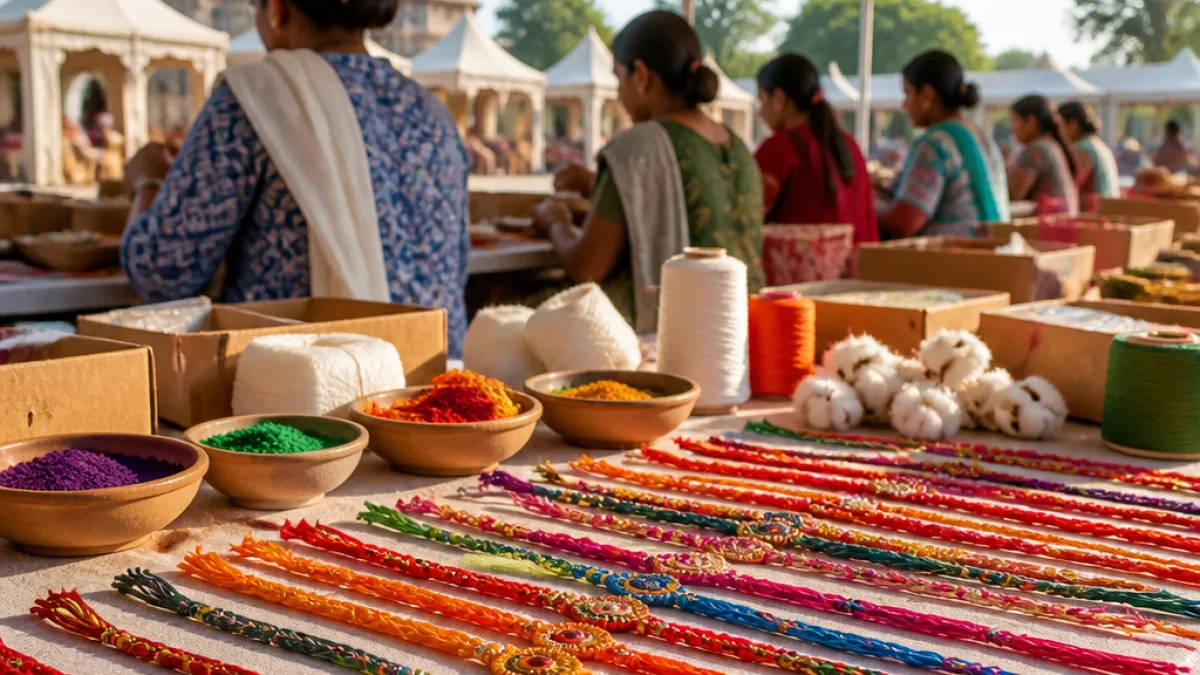
Prayagraj — Nearly 300 women affiliated to self-help groups (SHGs) in the rural pockets of the Sangam city have prepared more than one lakh eco-friendly rakhis made from cotton thread and natural dyes, the District Urban Development Agency (DUDA) said on Tuesday. The rakhis will be sold in prominent city markets as well as temporary stalls across Prayagraj and adjoining districts ahead of Rakshabandhan.
DUDA officials described the initiative as part of the state-backed SHG programme that aims to provide sustainable income opportunities for homemakers and differently-abled women. According to the agency, the city presently has 298 women self-help groups comprising over 3,000 women, many of whom are engaged in craft and small-scale production activities.
“All the women in my group are busy preparing rakhis for the upcoming festival,”
said Poonam Singh of the Bhavini self-help group, which is among the units producing cotton rakhis without chemical colours or skin-harmful materials.
DUDA Project Officer Pratibha Srivastava provided the district-level figures and highlighted the agency’s role in training members and facilitating sales. The agency has also supplied canopy facilities to enable SHG members to display and sell their products in organised spaces ahead of the festival.
Local employment, market access and prior gains
SHG members said the current rakhi drive follows a high-volume assignment during Independence Day, when women’s groups produced Tirangas (national flags). That earlier effort yielded production of over 3.8 lakh Tirangas, for which the workers were reportedly paid ₹20 per flag and together earned ₹80 lakh. The DUDA statement noted that the focus has now shifted to Rakshabandhan to maintain income streams for SHG members.
| Metric | Figure |
|---|---|
| Women SHGs in Prayagraj | 298 |
| Total SHG members (approx.) | 3,000+ |
| Rakhis produced for Rakshabandhan | 1,00,000+ |
| Tirangas produced for Independence Day | 3,80,000+ |
| Earnings from Tiranga drive | ₹80 lakh |
The production model used by the SHGs emphasises indigenous materials and low-cost inputs: rakhis are crafted from cotton thread and coloured using dyes derived from flowers and leaves. Some of the groups include women with disabilities, who are reportedly active participants in the making and marketing of the rakhis.
- Sales channels include prominent markets within Prayagraj and temporary stalls in the city and neighbouring districts.
- DUDA has provided training, canopy facilities and market linkages to SHG members.
- Women who participated in earlier flag production received remuneration per unit, illustrating direct cash income from contract work.
Members of other, non-SHG women's groups in the district are also reported to be engaged in rakhi-making, indicating wider community participation. Tanu Saroj of Kaudihar block, who is associated with the Grihini self-help group, said her group has been making cotton rakhis daily since Independence Day after receiving local market orders.
Officials said the initiative serves multiple objectives: it promotes eco-friendly festival goods, provides steady short-term employment ahead of seasonal demand, and strengthens market exposure for women-run micro-enterprises. For many households participating in the SHG network, these activities supplement family incomes and build experience in production, quality control and retailing.
Local authorities will monitor sales and logistics as the festival approaches, while DUDA continues to coordinate training and stall allocations. The success of the Tiranga assignment has encouraged officials and SHG leaders to pursue similar bulk-production opportunities tied to national and regional demand, with an eye on sustaining livelihoods for women across urban and rural pockets of Prayagraj.