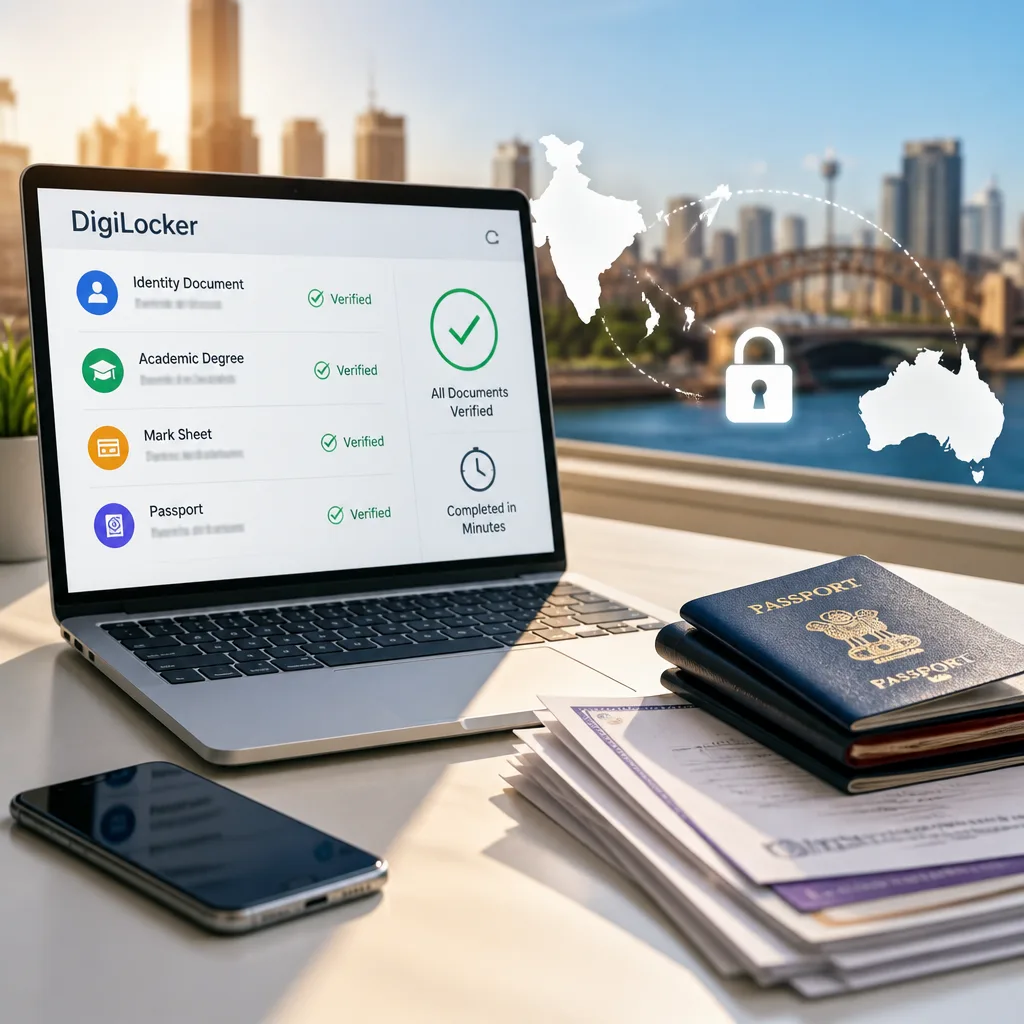
New Delhi, 12 August: A digital verification service launched to streamline checks on Indian student applications to Australia uses India’s Digital Public Infrastructure to let authorised Australian universities and education agents confirm identity, academic and financial records in minutes, developers and organisers said.
What the platform does
The platform, branded AAERI Verify, has been developed by the Association of Australian Education Representatives in India (AAERI) in collaboration with India’s National e‑Governance Division (NeGD) under the Ministry of Electronics and Information Technology (MeitY) and technology firm Zupple Labs, according to the project announcement.
AAERI Verify links directly to government-backed sources such as DigiLocker and other elements of the Digital Public Infrastructure to perform consent‑based authentication of documents before they proceed through the Australian admission and visa channels. The system is intended to reduce reliance on manual checks and cut the scope for document fraud, a concern that has figured in recent Australian parliamentary debate over international student migration.
Speed and scope
AAERI has emphasised speed gains. Checks that traditionally took several days can now be completed digitally in a matter of minutes, the announcement said.
| Traditional timeline | AAERI Verify timeline |
|---|---|
| 5–9 days | 2–4 minutes |
The platform covers:
- identity and address documents,
- academic marksheets, and
- financial sponsorship records.
Once a verification report is produced it is cryptographically anchored, providing an audit trail intended to increase confidence for receiving institutions and migration authorities.
Why it matters for Indian students and institutions
For Indian applicants, faster and more reliable verification can reduce delays in admissions and visa processing, and limit the need to share physical or scanned documents repeatedly. For education agents and universities, direct source authentication aims to address a central problem: not merely identifying fake paperwork but confirming whether a presented document actually matches the record issued by the originating authority.
Using government‑backed repositories such as DigiLocker means institutions are checking against primary sources rather than intermediary uploads. For Australian universities that receive large numbers of applications from India, that could make the admissions pipeline both quicker and more robust against fraud.
Benefits and potential caveats
The platform’s proponents highlight several advantages:
- Faster processing times, reducing administrative backlog;
- Lower risk of fraud through direct source verification;
- Consent‑driven checks that place the applicant at the centre of data sharing.
At the same time, implementation will require operational alignment between Indian and Australian stakeholders, including authorised access controls for agents and institutions, and clarity on data protection, retention and cross‑border transfer rules. The announcement does not provide technical details on data residency, retention schedules or the specific consent flows presented to applicants, matters that will be scrutinised by both regulators and privacy advocates.
Adoption will also depend on how widely Indian issuing authorities and educational boards participate in DigiLocker and related systems, and on the degree to which Australian institutions choose to integrate AAERI Verify into existing admissions and visa workflows.
Next steps
AAERI, NeGD and Zupple Labs have positioned the platform as a solution that addresses a pressing operational problem in international education and migration. If widely adopted, it could become a model for other destination countries seeking to speed up and harden document checks by leveraging India’s digital infrastructure. Observers will watch how quickly universities and agents enrol as authorised users and whether legal and technical safeguards keep pace with scale.
This initiative underscores how government‑backed digital systems such as DigiLocker are being used beyond domestic public services to support cross‑border flows—an important development for India’s role in global digital public infrastructure.