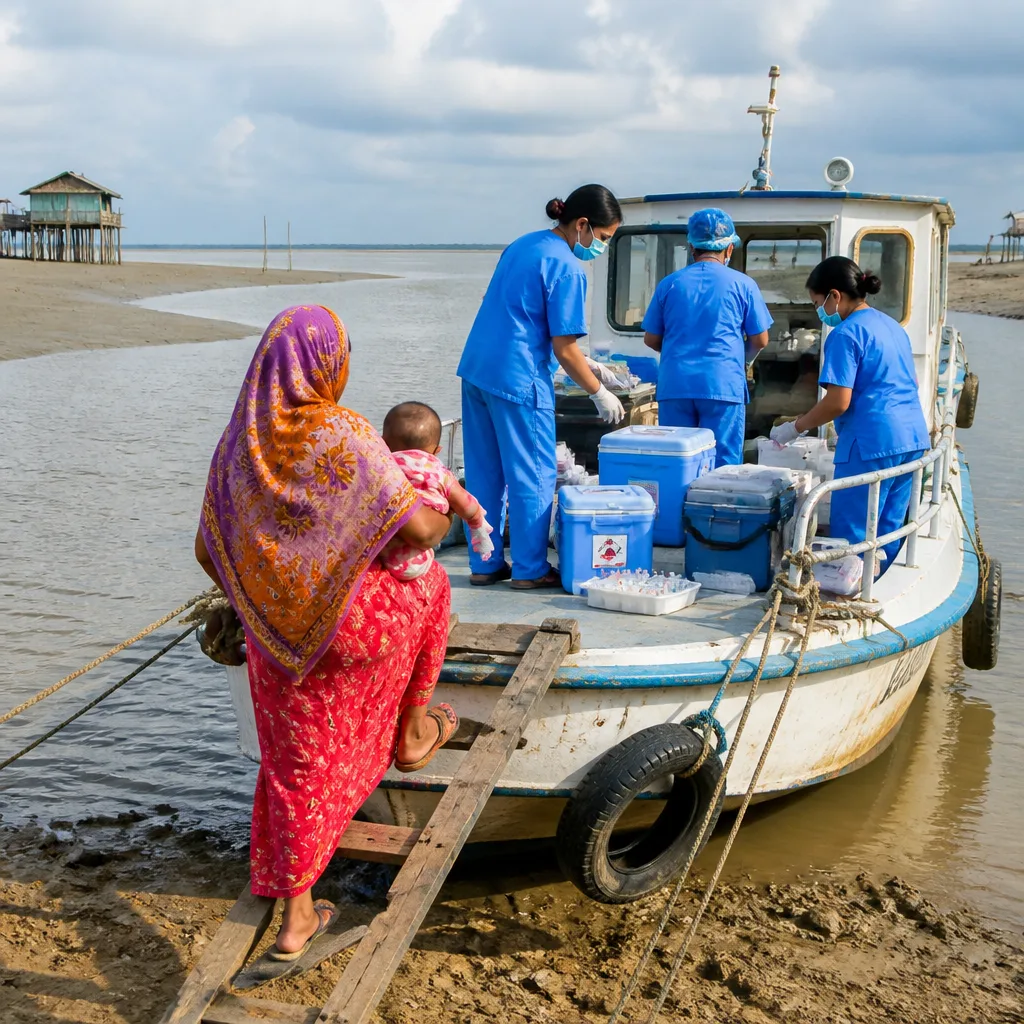
A fleet of mobile boat clinics is carrying doctors, vaccines, medicines and basic laboratory services to remote river islands in Assam, officials and aid agencies said, providing a lifeline to communities that would otherwise have little or no access to primary healthcare.
Outreach to chars where health facilities are scarce
The initiative, run by the Centre for North East Studies and Policy Research and supported by state authorities and UNICEF, began in 2005 and has expanded to 15 boats. According to the UN agency, the network now serves roughly 20,000 people a month across 13 districts.
Assam’s riverine landscape contains more than 2,000 chars — temporary islands and sandbars formed by the Brahmaputra and its tributaries. Many of these settlements have no permanent health infrastructure and suffer frequent flooding and erosion, complicating routine care and outreach.
Focus on mothers and children
Maternal and infant health are major priorities for the boat clinics. Medical teams focus on antenatal check-ups, routine immunisations for newborns and basic curative services. A medical officer involved in the programme said the effort targets pregnant women in need of antenatal care and newborns requiring scheduled vaccinations.
“We are totally dependent on the boat clinic,” said a resident of Barballa river island in Nalbari district. “Whatever medicines people receive here, they get them through the boat clinic.”
Local residents, particularly women, reported substantial benefits from the service. The mobile clinics also provide basic diagnostic tests, medicines and health education during visits.
State indicators lag national averages
Despite progress in recent years, Assam continues to record higher infant, under-five and maternal mortality rates than national figures. Official statistics cited in the report show:
- Infant mortality: Assam 29 per 1,000 live births; national average 24.
- Under-five mortality: Assam 34 per 1,000; national average 28.
- Maternal mortality: Assam 125 per 100,000 live births; national average 88.
| Indicator | Assam | National average |
|---|---|---|
| Infant deaths (per 1,000 live births) | 29 | 24 |
| Under-five deaths (per 1,000 live births) | 34 | 28 |
| Maternal deaths (per 100,000 live births) | 125 | 88 |
Origins and scale of the boat network
The programme, locally known as “Akha” (Assamese for “hope”), started in 2005 and has grown with support from governmental bodies and international partners. Presently, the network operates 15 boats that visit island communities across 13 districts, bringing primary care services to populations that are otherwise cut off from routine health delivery.
UNICEF and the implementing non-profit reported that the boats provide not only curative care but also preventive services such as immunisation and maternal health interventions. Local volunteers and staff coordinate schedules to reach clusters of habitations that are inaccessible by road.
Challenges remain
While the mobile clinics fill crucial gaps, the transient geography, seasonal floods and scarcity of trained manpower in many health facilities continue to pose challenges. Officials acknowledge that persistent infrastructure deficits and human-resource shortages constrain continuous service delivery in several remote areas.
Healthcare workers on the boats must often contend with weather disruptions and logistical constraints, but they remain a critical stopgap measure while broader investments in rural and island health infrastructure are planned and implemented.
Readers are reminded that this report outlines programme activity and official statistics. For personal medical concerns, consult a qualified healthcare professional.