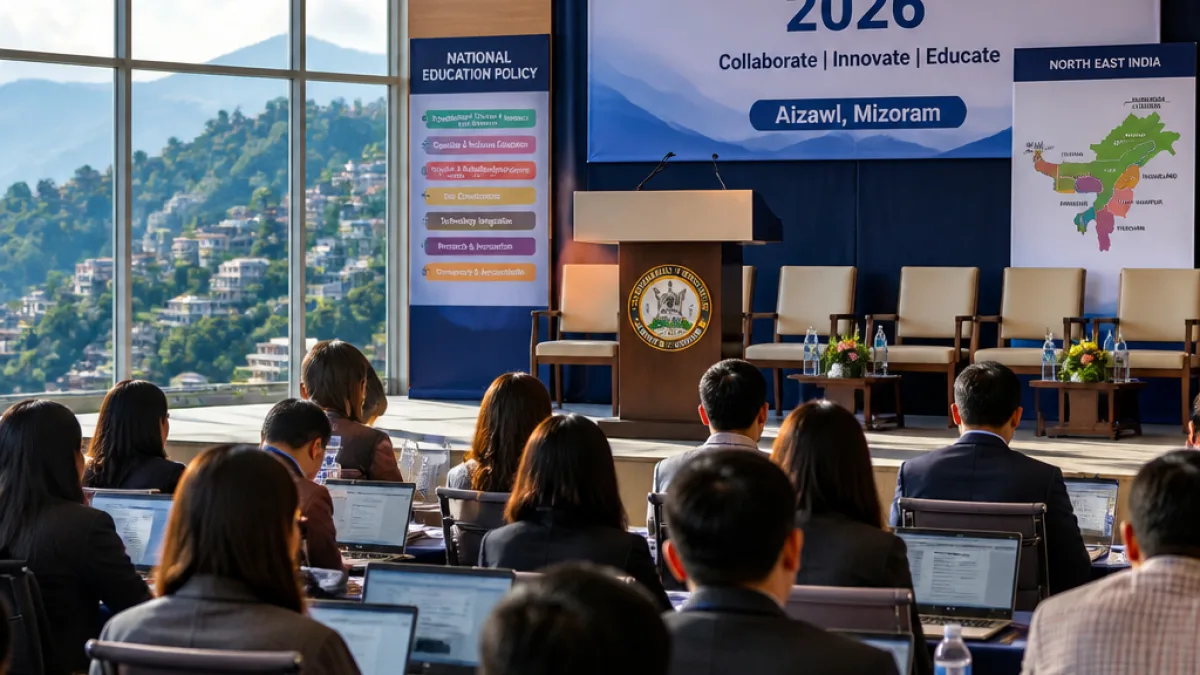
Mizoram has urged the Centre to provide enhanced, region-specific support to address critical gaps in education infrastructure, manpower and connectivity that are hindering implementation of the National Education Policy (NEP) 2020 across the Northeast, officials said after the North East Education Conclave 2026 in Chumoukedima, Nagaland.
State highlights constraints and asks for differentiated approach
R. Vanlalthlana, Mizoram’s Education Minister, told the conclave that a one-size-fits-all approach designed for larger Indian states would not adequately address the region’s distinct geographical and socio-economic conditions. He identified multiple impediments, including declining enrolment in government schools, insufficient secondary schools in rural and remote areas, and staffing shortages in key teacher education institutions such as District Institutes of Education and Training (DIETs) and State Councils of Educational Research and Training (SCERTs).
The minister also flagged limited internet connectivity and the difficulty of providing reliable solar power in far-flung hamlets as factors that constrain the rollout of digital education programmes and other technology-led initiatives. Financial limitations, he said, undermine the states’ ability to recruit additional personnel and expand physical infrastructure.
What Mizoram has already implemented
Mizoram has been piloting and implementing a number of measures to strengthen learning outcomes and fiscal management in schools. The state has:
- Introduced a Standardised Assessment for Elementary Schools to monitor learning levels across grades;
- Established the Vidya Samiksha Kendra for regular education monitoring and assessment;
- Launched Project Intodelh, focusing on financial management and entrepreneurship education to promote economic self-reliance among students.
At the conclave, the Mizoram delegation submitted proposals concerning the implementation of Samagra Shiksha 3.0 and PM USHA, urging that central schemes be adapted to reflect the topography, demographic patterns and livelihoods of the Northeast.
Key gaps identified and proposed focus areas
Vanlalthlana urged the Union government to recognise certain challenges as common across the region and to frame support accordingly. The principal issues highlighted by the state are:
- Infrastructure deficit: scarcity of secondary schools in rural areas and difficulties in ensuring reliable school electricity;
- Manpower shortages: inadequate staffing in DIETs and SCERTs, limiting teacher training and curriculum support;
- Connectivity: poor internet access reduces the effectiveness of digital learning and teacher training modules;
- Finance: limited state budgets constrain recruitment and capital works.
Vanlalthlana argued that these challenges reduce the effectiveness of centrally designed programmes unless allowances are made for the Northeast’s hilly terrain, dispersed settlements and socio-cultural specificity.
Practical implications for students, teachers and communities
If central support is tailored as requested, the likely outcomes for local stakeholders could include improved access to secondary schooling in remote blocks, stronger in-service teacher training through adequately staffed DIETs and SCERTs, and better digital access where connectivity investments are made. The state’s emphasis on entrepreneurship education through Project Intodelh also signals a shift towards linking school learning with livelihood readiness.
For parents and students, the state-level measures already in place — such as standardised elementary assessments and the Vidya Samiksha Kendra — aim to provide clearer tracking of learning outcomes. However, officials at the conclave reiterated that scaling such efforts sustainably would require additional funding and technical support from the Centre.
| Issue | Mizoram's current action | Requested support |
|---|---|---|
| Learning assessment | Standardised Assessment for Elementary Schools; Vidya Samiksha Kendra | Funding for assessment tools and capacity building |
| Teacher training | Existing DIETs and SCERT activities | Additional personnel and training resources |
| Connectivity and power | Limited local solar initiatives | Investment in rural internet and reliable off-grid power |
Officials at the conclave underlined that central schemes such as Samagra Shiksha 3.0 and PM USHA would be more effective if their implementation templates accounted for the Northeast’s small, widely dispersed habitations and higher per-unit cost of service delivery.
Next steps and context
The North East Education Conclave brought together education ministers and delegations from the region to review NEP implementation. Mizoram’s proposals will form part of the broader regional dialogue with the Centre. Any adjustments to central scheme allocations or design will require approvals and budgetary decisions at the Union level.
For parents and educators seeking further information, the state Education Department is the point of contact for details on current assessment initiatives and Project Intodelh. Requests for additional central funding and scheme adaptations are subject to inter-governmental consultations and formal approvals.
Given the interplay of geography, finance and human resources highlighted by Mizoram, the state’s delegation recommended that future central guidelines include explicit provisions for terrain-sensitive planning, flexible cost norms, and dedicated support for teacher-training institutions in the Northeast.