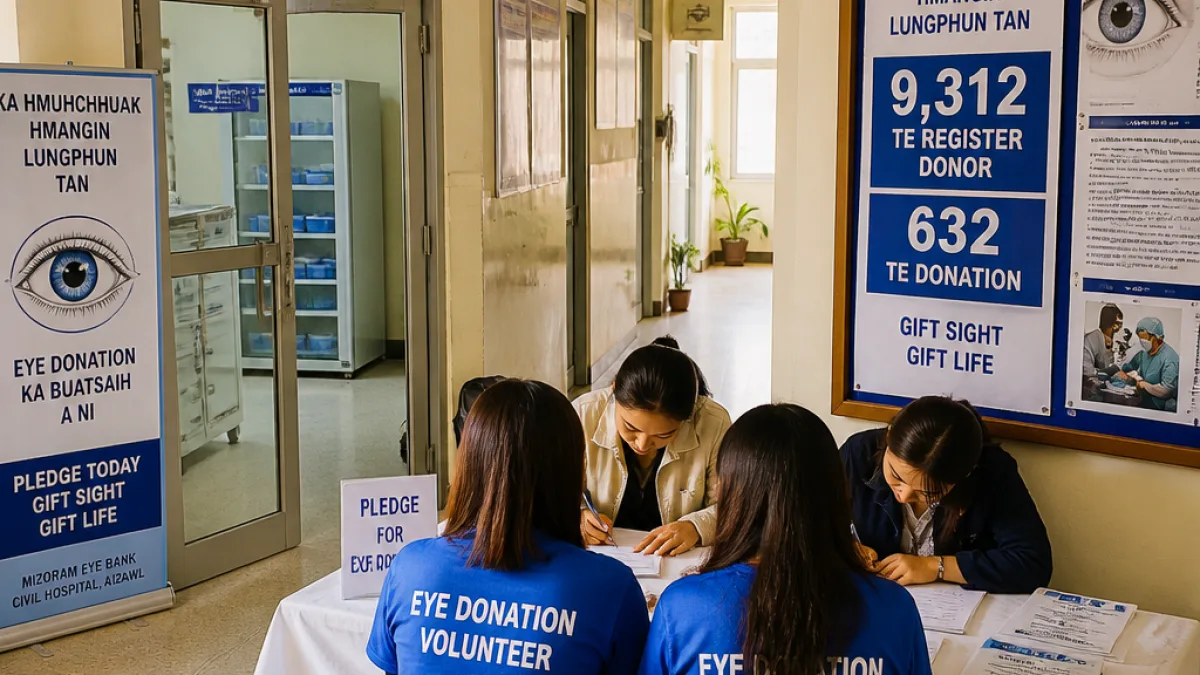
Aizawl: A recent drive in Mizoram has substantially increased commitments to posthumous eye donation, officials reported on Monday during the state's observance of the 41st Eye Donation Fortnight. According to health department figures, 9,345 people in the State have pledged to donate their eyes after death and 632 persons have already donated corneas that helped restore sight to recipients.
State eye-bank registrations and recent activity
The Mizoram Eye Bank, which operates from the Civil Hospital in Aizawl, holds 9,312 registered donors on its rolls. At the programme held on Monday, an additional 33 individuals signed up as donors, taking the cumulative pledges to the figure announced.
Officials also reported that approximately 400 people are currently on the waiting list to receive corneal transplants in the State. In the most recent four-month period between April and July, health authorities recorded 42 corneas retrieved and 23 corneal transplant surgeries performed.
| Metric | Number |
|---|---|
| People pledged (total) | 9,345 |
| Registered eye donors at Mizoram Eye Bank | 9,312 |
| New pledges at programme | 33 |
| People who have donated eyes | 632 |
| Corneas retrieved (Apr–Jul) | 42 |
| Corneal transplants performed (Apr–Jul) | 23 |
| Applicants awaiting corneal transplant | ~400 |
Background and operational note
The Mizoram Eye Bank was set up in 2008 to co-ordinate the retrieval and allocation of donor corneal tissue. The State performed its first successful corneal transplant in September 2009, marking the start of local surgical services for corneal blindness.
Health officials emphasised that eye donation specifically benefits patients with corneal opacity or damage; the cornea from a deceased donor can be transplanted to replace a damaged cornea and potentially restore vision in the recipient. The Principal Director of the Health and Family Welfare Department, Lalthlengliani, reiterated the medical basis for the procedure and the value of donor pledges in reducing avoidable blindness.
What the figures imply for patients and services
- The pool of registered donors — over nine thousand — suggests growing public awareness and willingness to donate ocular tissue in the State.
- With roughly 400 people waiting for corneal transplants, demand continues to outstrip the availability of suitable grafts; retrieval and timely transplantation remain critical.
- Recent retrieval and transplant numbers show that a proportion of pledged donations are being converted into usable tissue and surgical procedures, but capacity and logistics affect output.
Health officials did not provide details of the geographic distribution of donors or recipients within the State, nor figures on how many corneas were forwarded to other centres. They also did not release demographic breakdowns of donors, such as age or gender, at the event briefing.
Practical information for prospective donors and families
Those considering eye donation are generally asked to register with the nearest eye bank or the Civil Hospital, Aizawl, which holds the State's eye-bank registry. Families of a deceased donor must inform the eye bank promptly after death so tissue retrieval can be performed within the medically acceptable time window; otherwise, the cornea may not be suitable for transplantation.
Health authorities encourage individuals to discuss their wishes with family members in advance so that consent can be given quickly at the time of death. The eye bank and hospital teams co-ordinate counselling, retrieval and allocation, and provide information about the procedure to both donors' families and transplant candidates.
The State's observance of the Eye Donation Fortnight this year combined public outreach with registration drives to expand the donor base and educate residents on the mechanics and impact of corneal donation.