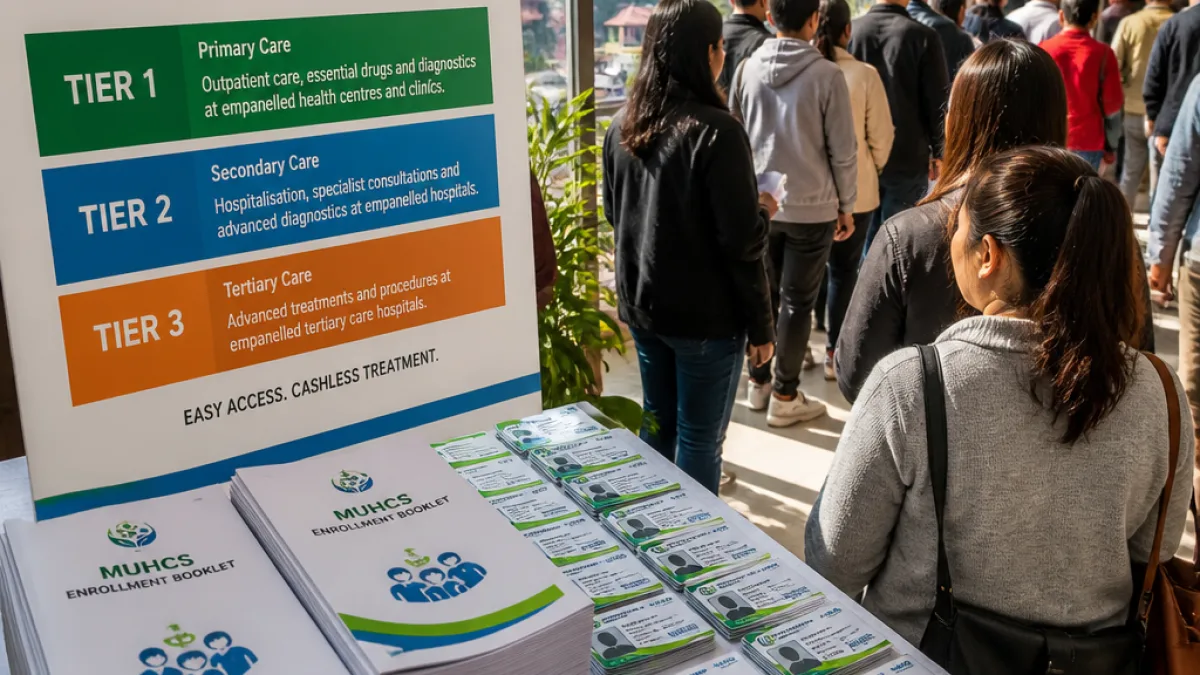
Aizawl: More than 3.2 lakh beneficiary families have been enrolled under phase two of the Mizoram Universal Healthcare Scheme (MUHCS), and the state government has paid out in excess of ₹271 crore towards treatment bills under the scheme’s first two phases, officials said on Sunday.
Coverage breakdown and payments
Officials provided a category-wise breakdown of beneficiaries enrolled under MUHCS 2.0. Of the 3.2 lakh families, 48,091 are general beneficiaries, 35,325 are government employees, 11,928 are pensioners and 2,26,899 are those covered under the Centre’s AB-PMJAY, which is converged with MUHCS, they said.
Since the scheme’s launch in 2025, the government has released a total of ₹271 crore for treatment expenses across MUHCS 1.0 and 2.0. Under MUHCS 1.0 (covering 2025-26), more than 1 lakh patients were treated and the state disbursed ₹171.57 crore towards treatment bills. During that period, about 4,772 patients were referred outside Mizoram for specialised care, the officials added.
For MUHCS 2.0, officials said at least 31,832 patients had received treatment as of 24 August this year, with the government disbursing ₹99.60 crore towards treatment bills under the second phase.
Benefit entitlements and subscription details
The scheme offers different cover limits and subscription options depending on the beneficiary category and chosen ward. Key features reported by officials include:
- General beneficiaries can avail up to ₹5 lakh health cover on payment of an annual fee; the fee depends on ward selection — ₹2,500 for general ward, ₹5,000 for semi-private cabin and ₹10,000 for private cabin.
- Government employees, including contractual and muster-roll staff, pay a monthly contribution ranging from ₹200 to ₹1,500 depending on pay scale to access unlimited cover.
- Pensioners and their spouses may obtain up to ₹2 lakh cover per financial year by surrendering the fixed medical allowance of ₹1,000 per month as subscription to the scheme.
Network of empanelled facilities
MUHCS provides cashless treatment at state-run hospitals and empanelled private and church-run hospitals both inside and outside Mizoram. Officials stated the empanelment roster currently includes:
| Type | Number |
|---|---|
| Private hospitals in Mizoram | 20 |
| Day-care centres in Mizoram | 5 |
| Private hospitals outside the state | 53 |
Origins and rollout
The Zoram People’s Movement (ZPM) administration, led by Chief Minister Lalduhoma, launched MUHCS 1.0 in March 2025 with the stated objective of providing cashless treatment. The second phase of the scheme was announced by the Chief Minister in March this year and expands coverage through convergence with the central government’s Ayushman Bharat–Pradhan Mantri Jan Arogya Yojana (AB-PMJAY), officials said.
What this means for beneficiaries
Officials said the combination of free cashless care at government-run centres and empanelment of private providers aims to reduce out-of-pocket expenditure for families requiring hospital treatment. The convergence with AB-PMJAY appears to have been a significant driver of enrolment, given that the majority of beneficiaries in the current tally fall under the central scheme.
Health watchers note that referral pathways to specialised facilities outside the state — more than 4,700 in MUHCS 1.0 — remain a critical component for tertiary care not available locally. Continued monitoring of claim settlement times and provider empanelment is likely to determine beneficiary satisfaction over time.
Practical information for residents
- Prospective beneficiaries should check their eligibility category (general, employee, pensioner or AB-PMJAY) before selecting a ward and making the applicable subscription.
- State-run hospitals and empanelled private centres will honour cashless claims subject to scheme rules; beneficiaries are advised to carry identification and scheme documents when seeking care.
- Those requiring referral for tertiary care outside Mizoram should enquire about the referral process and pre-authorisation requirements with the treating facility to avoid delays in treatment and claim settlement.
Officials characterised the enrollment and disbursement figures as evidence of growing utilisation of the scheme. The state government will need to maintain administrative capacity and provider networks as enrolment increases to ensure timely care and claim payments, particularly for high-cost procedures.