Assembly gives formal status to a long‑cherished Mizo ode
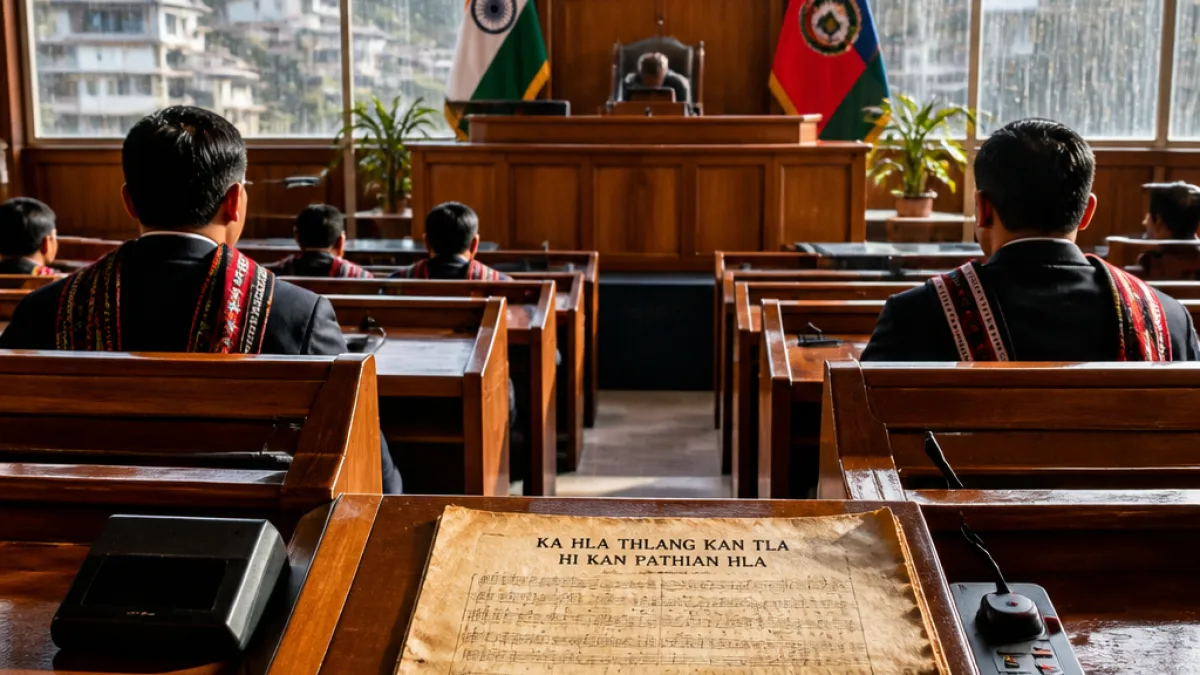
The Mizoram Legislative Assembly on Thursday unanimously approved a resolution to designate "Ro Min Relsak Ang Che", composed by Rokunga, as the official state song. Chief Minister Lalduhoma formally moved the resolution during the ongoing monsoon session and it secured support from members across the political spectrum, the House recorded.
The resolution confers official recognition on a piece long regarded by many Mizos as a cultural and devotional anthem, but which until now had not been given statutory status. The Assembly did not, however, lay down procedural details for how or when the song will be performed at official functions.
Background and prior approvals
The move follows an earlier decision by the state cabinet to approve the song for formal adoption. The composition, credited to Rokunga, dates back to 1947 and has been widely held as an expression of Mizo identity and sentiment.
| Item | Detail |
|---|---|
| Song | Ro Min Relsak Ang Che |
| Composer | Rokunga |
| Era | 1947 (composition year cited in state records) |
| Assembly action | Unanimous resolution to adopt as state song |
Opposition concerns and wider context
During debates, several legislators raised issues relating to a recent communication from the Union Home Ministry concerning the national song "Vande Mataram". The Centre's advisory recommends that all stanzas of the song be rendered at official events; some members said that performing the complete verses could hurt the sentiments of religious minorities because of references to Hindu deities.
Members did not object to the practice of using up to two stanzas, the proceedings showed, but voiced opposition to playing or singing the entire composition. Opposition benches, notably representatives from the Mizo National Front and the Congress, asked for wider consultation before any directive on the national song is implemented at state ceremonies. They urged either an all‑party meeting or a session of all legislature parties to discuss the implications.
- Unanimous Assembly support for making the Mizo composition the state song.
- No procedural guidance yet on official use, timing or protocol for the song.
- Debate linked to Union guidance on rendering all stanzas of 'Vande Mataram', raising minority sentiment concerns.
What legislators said and next steps
While members from across parties backed the resolution to adopt the Mizo song, the House recorded calls for further consultation on issues intersecting national and state symbols. Opposition members demanded that the legislature hold a collegiate deliberation to determine how Centre advisories on national songs should be reconciled with local sensitivities.
The Chief Minister did not, in the Assembly discussion, specify a protocol for performance or the occasions on which the state song will be used. That leaves the administrative machinery — including the protocol office and cultural departments — to frame implementation guidelines in consultation with the elected representatives.
Significance for public life and culture
Formal recognition of the composition will place it alongside other official emblems used at state events, and is likely to shape ceremonial practice at government functions, schools and cultural programmes. For many in Mizoram, the decision formalises what was already an informal cultural practice: the routine rendering of Rokunga’s lines at gatherings and commemorations.
How the state balances the newly adopted song with national protocols—particularly the Centre’s direction on Vande Mataram—remains a practical and political question. The Assembly’s call for broader consultations indicates an intent to reach consensus on matters touching identity, faith and protocol.
Administrative instructions and a formal performance protocol are expected to follow from the state government after consultations with stakeholders and legislators, the proceedings suggested.