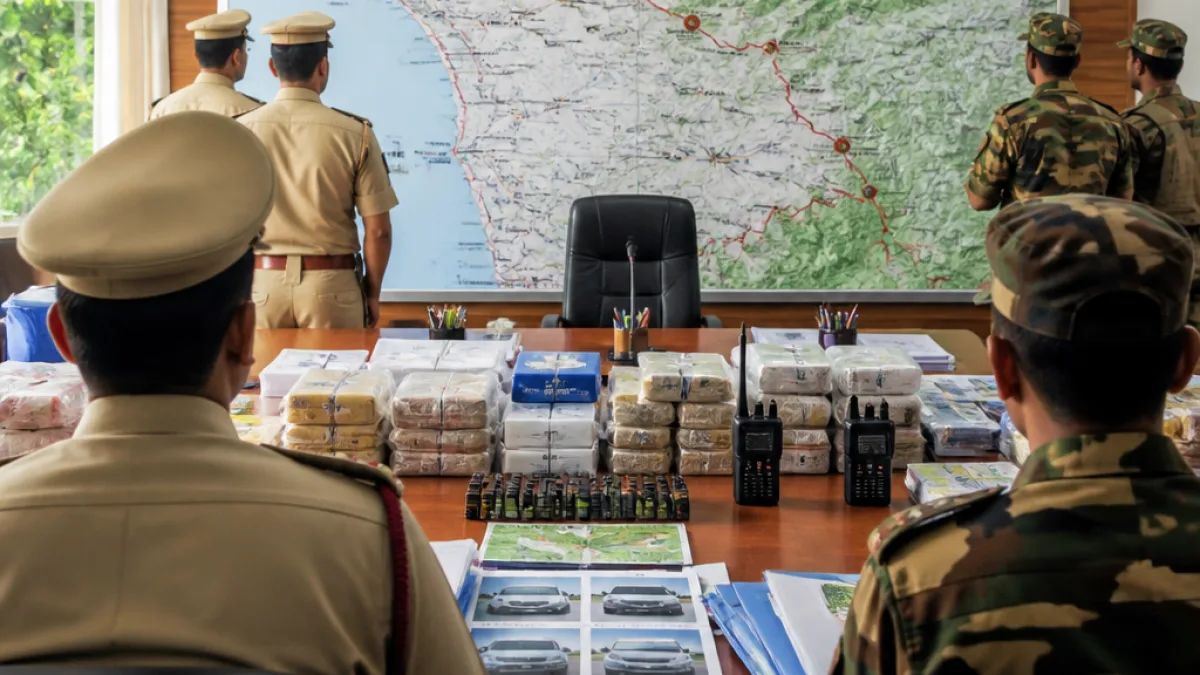
District officials call for coordinated enforcement along the India–Myanmar frontier
Lawngtlai, Sep 22: The Lawngtlai district administration has directed security and civic agencies to step up surveillance and inspections to check illegal trade across the India–Myanmar border, officials said on Tuesday.
Deputy Commissioner Donny Lalruatsanga presided over the meeting where authorities were asked to enhance scrutiny of goods moving across the border and to take measures to prevent the unauthorised movement of vehicles, the administration said.
Who attended and what was discussed
The meeting included representatives from the district administration, the state police, the Assam Rifles, the Lai Autonomous District Council (LADC) and the Central Young Lai Association (CYLA). Participants reviewed recent reports on cross‑border activity and discussed ways to strengthen joint enforcement.
- Intensify inspections of consignments and vehicles at recognised check points and transit routes.
- Increase patrolling along vulnerable stretches of the international boundary.
- Enhance information sharing between civil administration, police and central forces to detect and disrupt smuggling networks.
Local security and economic concerns cited
Officials said the move responded to rising concerns about the consequences of unregulated cross‑border commerce for local security and economic stability. Unlawful trade, they noted, can undermine legitimate businesses, deprive the exchequer of taxes and fuel other criminal activity in border areas.
While the administration did not release operational details, the emphasis on vehicles suggests authorities are targeting not only small consignments but also larger conveyances that can transport substantial quantities of goods across informal routes.
Coordination between civil and paramilitary forces
Experts and officials in border districts often highlight the need for co‑ordinated action between civil administration, local councils and central forces. In Lawngtlai, the presence of the Assam Rifles at the meeting underlines the role of paramilitary units in border management in Mizoram, where responsibility for domestic law and order rests with state police but national security issues bring in central agencies.
| Agency | Role discussed |
|---|---|
| District administration | Lead coordination, issue directives, monitor implementation |
| State police | Local law enforcement, inspection, arrests on domestic offences |
| Assam Rifles | Border patrolling, intelligence sharing, support to civil agencies |
| LADC and CYLA | Local liaison, community awareness, reporting of suspicious movements |
What this means for residents and traders
Heightened checks can lead to delays at customary movement points and increased scrutiny of transporters and traders. Authorities are likely to focus on informal routes used to move goods without documentation or payment of duties. Traders who rely on cross‑border supply chains should expect more frequent inspections and should ensure proper paperwork and declared consignments to avoid seizures or penalties.
Local councils and community organisations, such as the CYLA, were involved in discussions, signalling the administration’s intent to combine enforcement with local cooperation. Community reporting of suspicious activity may be encouraged to complement formal intelligence and patrols.
Background and wider context
Mizoram shares a long and porous frontier with Myanmar, and districts along the boundary periodically report incidents of smuggling and unauthorised trade. Authorities have in the past used a mix of patrols, check points and community engagement to tackle such challenges. The current directive follows recent reports that prompted the district administration to reassess the effectiveness of existing measures.
No arrests or seizures were announced at the time the directive was issued. The district has asked agencies to coordinate and submit regular updates to enable monitoring of enforcement outcomes and any impact on local commerce and security.
Officials said the aim is to balance firm enforcement with minimal disruption to legitimate trade and daily life in border communities.