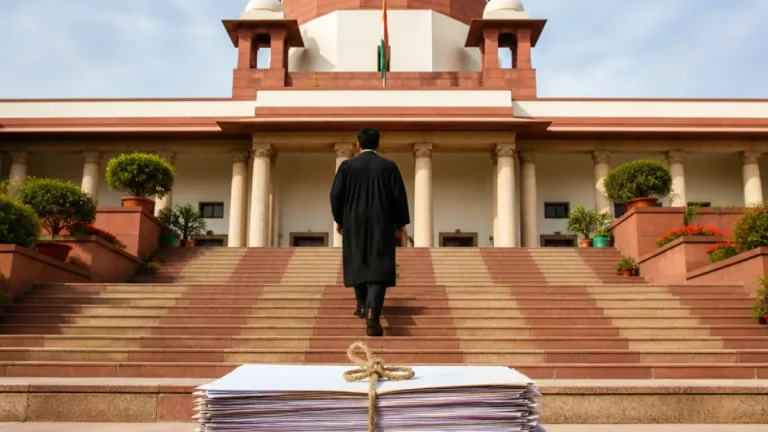
Aizawl / Lawngtlai, Aug 11: A Mizoram legislator has announced plans to file a review petition against a recent Supreme Court judgment that directed two Autonomous District Councils (ADCs) in the State to restore prohibitions on dual membership of an ADC and the State Assembly.
Background to the dispute
Rasik Mohan Chakma, a member of the Mizo National Front (MNF) and an elected representative to the Chakma Autonomous District Council (CADC), said he will challenge the apex court's ruling. The Supreme Court in a judgment dated July 20 observed that "all the ADCs ought to be at par for the purpose of barring dual membership" and directed the Chakma ADC and the Mara ADC to restore the bar, according to reporting.
The petition that led to the top court decision had been moved by Rustom Chakma, a social worker from Lawngtlai in southern Mizoram, after the Gauhati High Court had earlier dismissed his plea seeking a prohibition on holding concurrent membership of an ADC and the State Legislative Assembly.
MLA says apex court relied on incorrect factual premise
Rasik Mohan Chakma contended that the Supreme Court's observation was factually incorrect. He said the Lai ADC had removed the bar on dual membership by repealing its Constitution and Conduct of Business Rules of 2002 in 2010. Consequently, he argued, the Lai ADC no longer barred an individual from being an MLA even though it retained restrictions on holding membership in two or more ADCs.
“The Lai ADC had removed the bar on dual membership of the ADC and the Assembly by repealing its Constitution and Conduct of Business Rules of 2002, in 2010. Consequently, the membership in two or more ADCs was barred, not in the Assembly. Petitioner Rustom Chakma concealed this to secure a favourable judgment, and he interfered with the administration of justice,” he said.
Chakma maintained that he was unable to place this material fact before the Supreme Court because after the Gauhati High Court issued notice the petition was disposed of at the hearing stage. He said he was not given an opportunity to file a written reply in the High Court proceedings, which he implied deprived him of a chance to rebut claims considered later by the apex court.
Constitutional provisions and the legal question
The legal debate centres on Articles 101 and 190 of the Constitution of India and their applicability to ADC membership. The Gauhati High Court had earlier held that those articles do not bar a member of an ADC from becoming an MLA. The Supreme Court, however, took a different view in directing parity among ADCs and restoring the bar in two councils.
Chakma also referred to the constitutional provision on disqualification for holding an office of profit. He noted that Article 191(1) of the Constitution governs the holding of an office of profit and observed that only Parliament and state legislatures have the power to enact laws relating to disqualification for membership. The source material does not record further arguments from him on this point.
Regional map of the ADCs mentioned
| ADC | Principal district | Relevant observation |
|---|---|---|
| Chakma ADC | Parts of Lawngtlai | Directed to restore bar on dual membership by Supreme Court |
| Mara ADC | Siaha district | Directed to restore bar on dual membership by Supreme Court |
| Lai ADC | Adjacent to Lawngtlai / parts of southern Mizoram | Found by Supreme Court to retain bar, though MLA contests this |
Political and administrative implications
The controversy has implications for representation of tribal communities in Mizoram. ADCs are constitutionally recognised bodies intended to administer specified tribal areas and have their own constitutions and rules. Whether a member of an ADC can simultaneously serve in the State Assembly affects both the composition of these councils and the Assembly's membership dynamics.
The source reporting does not record responses from the Gauhati High Court, the Supreme Court registry or the administrations of the ADCs involved. It also does not specify the timeline for the proposed review petition or outline the precise legal grounds that the MLA will press before the apex court.
What happens next
- The MLA, Rasik Mohan Chakma, has said he will file a review petition against the Supreme Court order.
- The apex court's direction requires the Chakma ADC and the Mara ADC to restore a ban on dual membership; the MLA disputes factual findings about the Lai ADC.
- Further legal filings and replies from the ADCs or the State may clarify the constitutional and administrative way forward.
As the matter proceeds, the key issues will be the factual records of each ADC's constitutional position, the interpretation of Articles 101 and 190, and whether the court will accept a review in light of the factual objections raised by the MLA.