
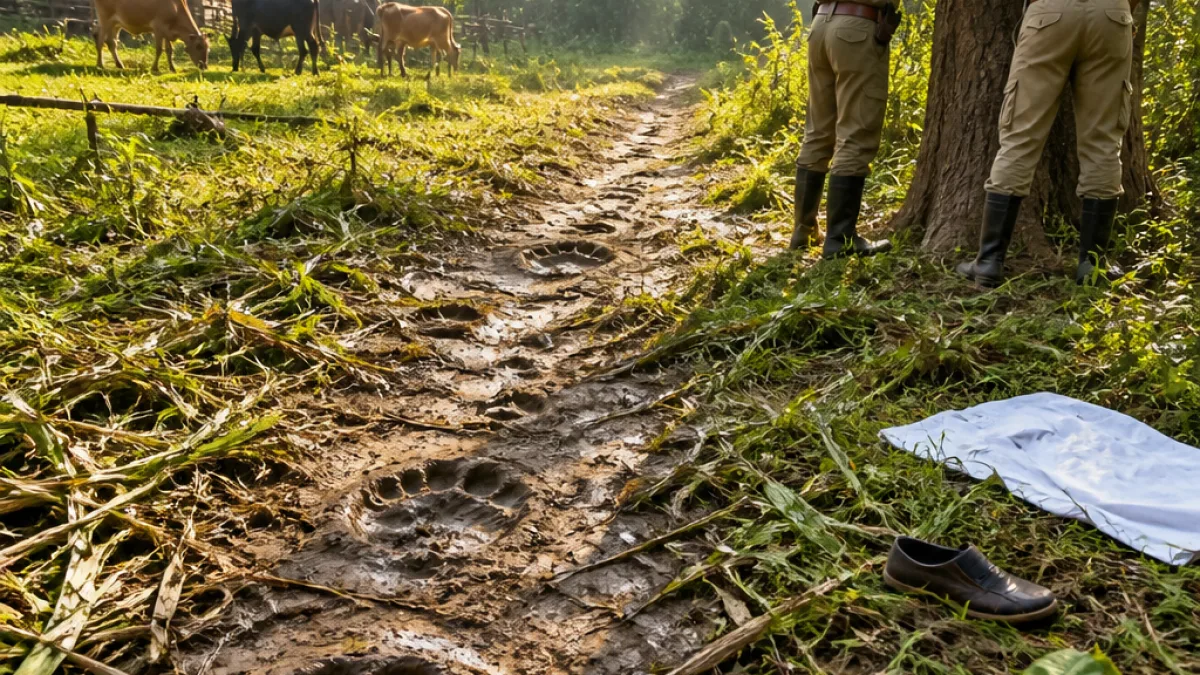
Balrampur, Chhattisgarh: A 59‑year‑old man was trampled to death by a wild elephant on Sunday while grazing cattle in a forest under the Ramanujganj range of Chhattisgarh's Balrampur district, officials said, underscoring the persistent human‑elephant conflict in the northern parts of the state.
The victim, identified as Indranath Singh of Shivpur village, was attacked at about 5.30 am roughly one kilometre from his home, an official said. He died on the spot and his body was later taken for post‑mortem examination, the official added.
Compensation and immediate response
Forest department personnel reached the site after being informed of the incident. The administration disbursed ₹25,000 as immediate financial assistance to the victim's family. A further compensation of ₹5.75 lakh will be released after completion of required formalities, the official said.
| Item | Amount |
|---|---|
| Immediate assistance | ₹25,000 |
| Remaining compensation | ₹5.75 lakh |
Members of a community volunteer group known as the Hathi Mitra Dal have been making announcements through loudspeakers to warn villagers about elephant movement in the area, officials said.
Pattern of movement and local context
Forest officers said three elephants had entered the area from neighbouring Jharkhand about 12 days earlier and had been moving through the forest. Another elephant is reported to have reached the vicinity during the night and attacked the villager in the early morning hours.
Local forest staff and volunteers regularly issue advisories and conduct awareness drives, but the recent attack highlights the difficulties of preventing sudden encounters between people and elephants when the animals roam across forest and village areas.
- Incident time: about 5.30 am.
- Location: Ramanujganj forest range, Balrampur district.
- Victim: Indranath Singh, 59, resident of Shivpur village.
- Immediate aid: ₹25,000; pending compensation: ₹5.75 lakh.
Scale of the problem in Chhattisgarh
Forest officials said the northern part of the state has grappled with human‑elephant conflict for about one-and‑a‑half decades. Districts repeatedly cited as affected include Surguja, Raigarh, Korba, Surajpur, Jashpur and Balrampur.
According to the officials' figures cited in the report, more than 335 people have been killed in elephant attacks across Chhattisgarh in the last five years. The repeated movement of herds through forest patches and adjacent settlements has led to crop damage, livestock losses and occasional human fatalities, they said.
Mitigation measures and challenges
Authorities have taken several steps over the years to reduce conflict, including community‑based volunteer patrols, early‑warning announcements, and compensation schemes for victims. Yet practical challenges remain: the free movement of elephants across state borders, fragmented forest corridors, night‑time movements of animals, and dependence of local communities on forestland for grazing and livelihood.
Forest officers stated that teams continue to monitor the area. The use of loudspeaker announcements by Hathi Mitra Dal is intended to alert villagers to recent elephant movement, while forest staff carry out regular checks to track herds and attempt to guide them away from populated pockets.
The attack in Ramanujganj again draws attention to the need for integrated measures — including landscape‑level planning for wildlife corridors, timely information systems for villages, and sustained compensation and livelihood support — to mitigate such conflicts in the longer term.
No further details on the post‑mortem findings or additional administrative actions were immediately available.