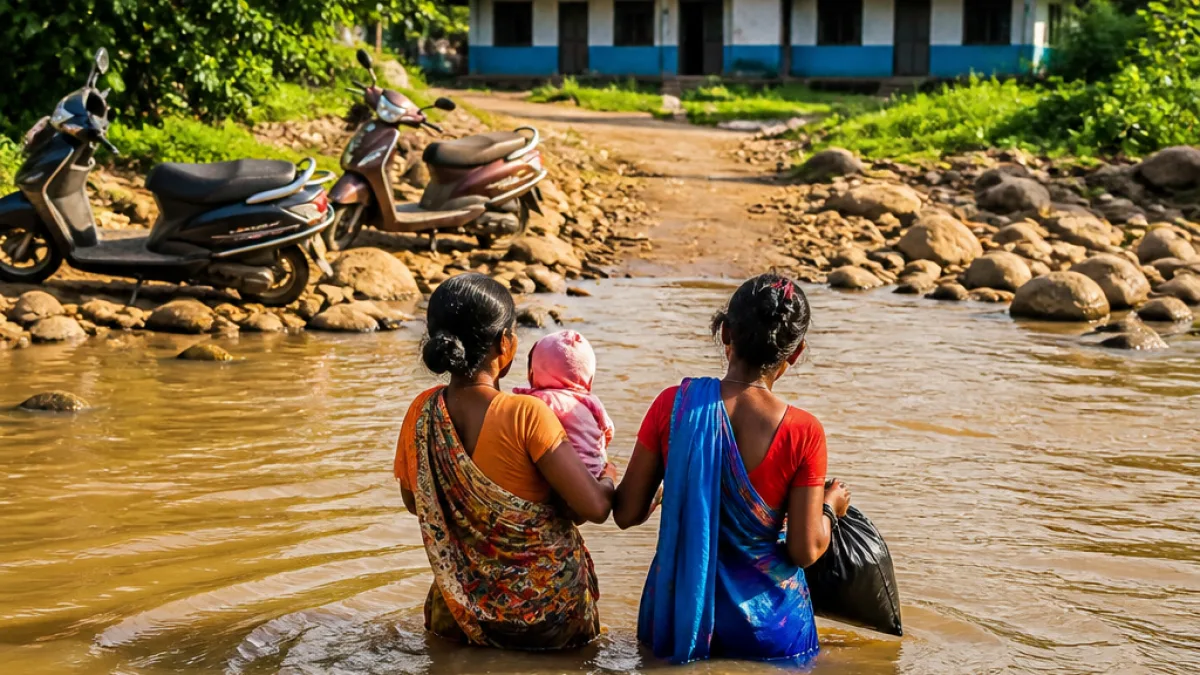
Routine crossing of swollen river to keep classes running
Balrampur — Two government teachers posted to a tiny hamlet in Wadrafnagar block of Balrampur district continue to reach their school on foot every monsoon despite treacherous terrain and a river that often cuts the village off from motorable roads.
Teachers Sandhya Haldar and Karmila Toppo travel from the last accessible motor point at Marna, walk nearly 3 km over rocky, hilly ground, and then ford the waters at the confluence of the Moran and Iriya rivers to reach the government school in Dhaurpur hamlet.
Toppo, who has been posted at the school since 2014, makes the crossing daily during the rains — at times while holding her nine‑month‑old daughter — because the village is inaccessible to vehicles when water levels rise.
“We park our scooters at Marna, and the route is entirely hilly. We walk 3 kilometres, cross the river, and then reach the school,” Haldar said.
When water rises, access is uncertain
The teachers said the depth at the crossing fluctuates with rainfall and upstream flows. On some days they manage to wade through when the water is low; on others they are forced to turn back when the current is too strong or the water reaches stomach height.
They added that district officials advise staff not to attempt the crossing when conditions are hazardous, but the decision to travel is often determined by whether the children would miss school.
What the journey involves
- Starting point: Marna — the last point vehicles can reach.
- On‑foot terrain: almost 3 km of uphill and rocky track from Marna to the river.
- River crossing: across the Moran–Iriya confluence; depth varies, sometimes from waist to stomach height.
- Frequency: daily during the monsoon when conditions permit.
Why teachers persist
Despite obvious personal risk, both teachers said they prioritise the students’ need for regular classes. They described the children as young and vulnerable, and said the pupils show visible joy when the staff reach the hamlet to teach.
The teachers also noted the emotional burden when weather prevents them from making the trip; they feel unable to provide education on days when the crossing is impossible.
Local context and wider implications
Dhaurpur lies beyond a riverine confluence that renders road access impossible during heavy monsoon spells. Such seasonal isolation is common in parts of the state and poses operational challenges for the education department, healthcare delivery and public services.
The situation raises several policy and administrative questions: the safety protocols for staff expected to travel in risky conditions; contingency teaching arrangements for cut‑off hamlets; and longer‑term infrastructure solutions such as footbridges, raised all‑weather access tracks or community transport plans.
| Parameter | Reported detail |
|---|---|
| Distance on foot from Marna to school | ~3 km |
| Teacher posted since | 2014 (Karmila Toppo) |
| Infant carried | 9 months |
Practical considerations for parents and officials
For parents in Dhaurpur and similar hamlets, contingency measures during the monsoon could include later start times, temporary community learning centres at safer locations, or home visits when safe. Education department teams may need to map cut‑off habitations and prepare rapid response plans for prolonged isolation.
Local administrations are responsible for issuing clear advisories about travel in hazardous conditions and for exploring low‑cost infrastructure such as footbridges or raised causeways that can improve safety and continuity of services.
The devotion of teachers such as Haldar and Toppo underlines both the service ethic of frontline educators and the infrastructural deficits that leave remote communities vulnerable during the rainy season. Their actions ensure children continue to receive classroom time, but also point to a need for institutional measures that reduce risk for staff and learners alike.
Further details on district‑level responses were not available in initial reports.