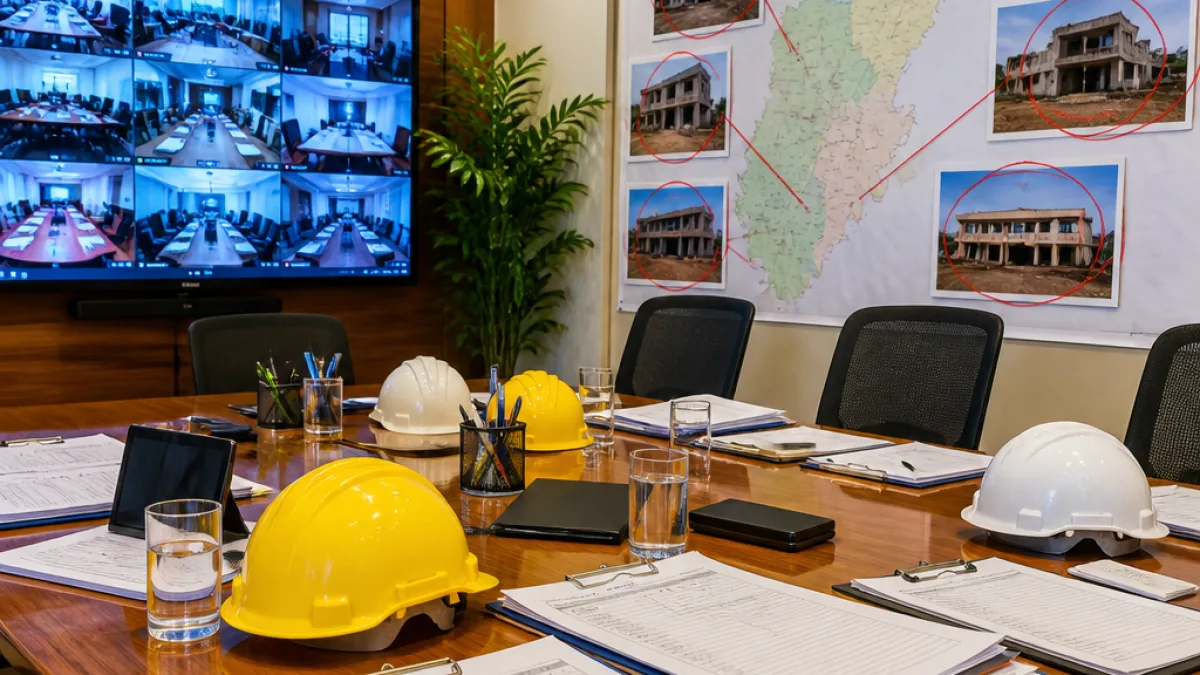
Raipur: Chhattisgarh Chief Minister Vishnu Deo Sai on Thursday asked district administrations to conduct an immediate and comprehensive safety audit of hostels, paying-guest (PG) accommodations, coaching centres, schools and other large educational buildings across the state, instructing officials to identify hazards proactively and correct deficiencies within fixed timelines.
Top-level review and enforcement push
The direction came during a review meeting held via video conference with divisional commissioners, collectors, inspectors general of police and superintendents of police. District officials were told to assess not only recently reported problems but also potential risks in older and dilapidated structures used for educational and public purposes.
"Administrative responsibility does not end with action after an incident. Potential risks must be identified and addressed beforehand," the Chief Minister said during the meeting.
Sai emphasised that inspections must be forward-looking rather than reactive, and tasked collectors and SPs with personally monitoring compliance and periodically reviewing progress on corrective measures.
Scope, timelines and accountability
Officials were ordered to prioritise buildings that host large numbers of students or public users—hostels, coaching centres, school complexes and public libraries—and to draw up clear deadlines for rectifying defects identified during inspections.
- Immediate safety audits of educational facilities and PG accommodations across all districts.
- Assessment of structural condition for old, dilapidated and earthquake-prone buildings used by students and the public.
- Clear timelines to be set by district administrations for rectification of hazards.
- Personal oversight required from collectors and superintendents of police; periodic compliance reviews mandated.
The Chief Minister warned that administrative officers would be held responsible for lapses in implementing the directives. While the order stops short of prescribing a single inspection format, it assigns district administrations the task of identifying local hazards and taking preventive action without waiting for complaints or accidents to occur.
Why the move matters
Chhattisgarh has a mix of modern and ageing educational infrastructure. Many rural and semi-urban institutions operate out of older buildings or makeshift arrangements such as rented hostels and PGs. The CM’s instruction seeks to reduce the risk of avoidable incidents involving large numbers of children and young adults, especially as some structures may not meet current safety standards.
Local administrations now face the practical task of surveying a wide range of facilities, prioritising high-risk sites, arranging remedial works and, where necessary, relocating occupants. The involvement of senior police officers is intended to ensure enforcement and coordination, including traffic management during repair works and safety of inspection teams in remote areas.
Implementation: what to expect next
District collectors will be required to compile inspection reports listing identified defects, corrective measures, estimated costs and completion deadlines. The state government is likely to monitor progress through periodic reviews chaired by senior officials, although the CM’s office has not yet announced a fixed state-level reporting schedule.
| Responsibility | Expected action | Monitoring |
|---|---|---|
| Collectors | Lead district inspections; set remedial deadlines; compile reports | Periodic review by divisional commissioners and CM office |
| Superintendents of Police | Support enforcement; ensure safety of teams; oversee compliance | Joint monitoring with collectors |
| District engineering bodies | Assess structural soundness; estimate repair costs | Reports to collectors |
Parents, school managements and hostel operators will be expected to cooperate with inspections and implement short-term safety measures such as removing unsafe furniture, securing stairways and organising safe evacuation routes until major repairs are completed.
Past incidents and public response
While the state has not released a tally of structures slated for inspection, officials in several districts have in recent months carried out ad hoc checks after isolated incidents and media reports raised concerns about building safety. The CM’s statewide order formalises and scales up that approach, making compliance a matter of official priority.
Education administrators and local bodies will now need to balance immediate safety fixes with longer-term capital works, including possible reconstruction or replacement of buildings found beyond repair. Funding, prioritisation and contractor availability will be immediate challenges for district teams.
The government has not announced dedicated emergency funds with this directive; district authorities are likely to use existing municipal, panchayat and school budgets initially, and may seek state assistance where required.
Officials in affected districts have been instructed to begin inspections immediately and submit status reports to their divisional commissioners. The Chief Minister’s emphasis on proactive risk identification signals a push towards preventing tragedies rather than reacting to them after the fact.