Raipur: Chhattisgarh Chief Minister Vishnu Deo Sai on Wednesday accused the Congress party of treating tribal communities as a "vote bank", asserting that the Bharatiya Janata Party government had prioritised their welfare and development.
CM cites earlier central focus on tribal development
Sai noted that during Prime Minister Atal Bihari Vajpayee's tenure the Centre had created a separate ministry for the development of Scheduled Tribes, and said the present BJP government had worked to implement welfare measures directed at tribal populations.
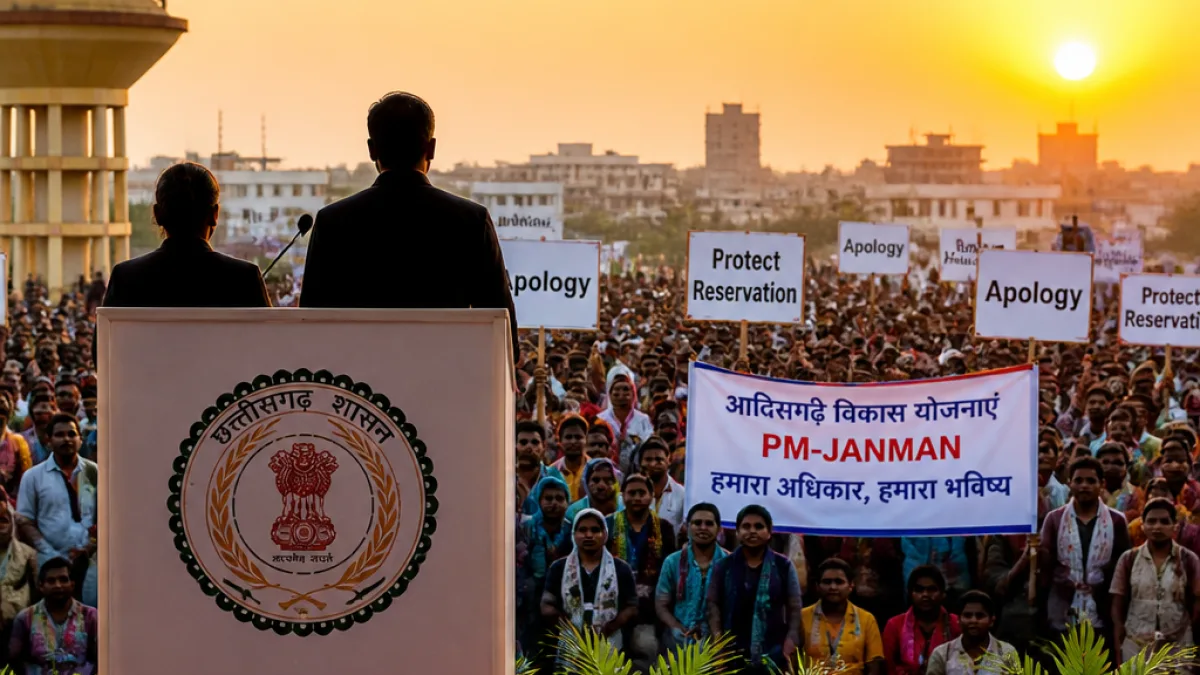
The Chief Minister pointed to benefits reaching tribal communities through a range of central and state initiatives, including the PM-JANMAN scheme for Particularly Vulnerable Tribal Groups (PVTGs), as evidence of the government's commitment.
"The Congress party has used the tribal community solely as a vote bank. If anyone has truly cared for the tribal community, it is the Bharatiya Janata Party government," Sai said.
Opposition body rejects CM's claim, seeks apology
Responding to the remarks, Vikrant Bhuria, national president of the All India Adivasi Congress, accused the BJP government of neglecting the tribal community. Bhuria, who was in Raipur to attend a meeting of the Adivasi Congress executive committee and the Tribal Advisory Council at Rajiv Bhawan, demanded that the chief minister apologise.
Bhuria alleged that despite receiving the support of tribal voters during his own political career, the chief minister had "denied their very existence" by not extending greetings on Tribal Day. He also defended the continuation of reservation, saying it remained necessary until social, economic, educational and mental equality was achieved.
What each side says — at a glance
| Claim | Made by |
|---|---|
| Congress treated tribals as a "vote bank" for decades; BJP prioritises their welfare | Chief Minister Vishnu Deo Sai |
| BJP government has neglected tribal community; CM denied tribals' existence by not greeting on Tribal Day; reservation still necessary | Vikrant Bhuria, All India Adivasi Congress |
Background and policy context
The exchange highlights enduring political contestation over tribal welfare and reservation policy in India. Sai referenced the creation of a separate ministry for Scheduled Tribes under a previous BJP-led central government to underline his argument that the BJP has historically taken institutional steps aimed at tribal development. The PM-JANMAN scheme cited by the chief minister targets PVTGs, a category of tribal communities identified by the government as being especially vulnerable and eligible for focused assistance.
On the other side, Bhuria framed reservation as a continuing corrective measure addressing historical injustice and caste-based discrimination, arguing that it cannot be discontinued until substantive equality is achieved across social, economic and educational dimensions.
Local implications
- Political rhetoric around tribal welfare is likely to feature in state-level campaigning and outreach, particularly in tribal-majority constituencies.
- Public attention may focus on delivery and outcomes of schemes such as PM-JANMAN and other tribal welfare programmes to assess competing claims.
- Tribal Advisory Council meetings and executive committee sessions, such as the one Bhuria attended, will remain forums for pressing grievances and seeking accountability from state authorities.
The dispute between the state government and the Adivasi Congress emphasises the continued salience of tribal issues in Chhattisgarh politics. Both sides have framed their positions around welfare delivery and historical justice; assessing those claims will depend on data about scheme coverage, fund utilisation and local outcomes, which were not detailed in the statements reported on Wednesday.
Officials and political representatives in Raipur did not provide additional documentary evidence in the comments filed on record at the time of the statements. The matter may surface again in meetings of the Tribal Advisory Council and in future public communications by the state government and tribal organisations.