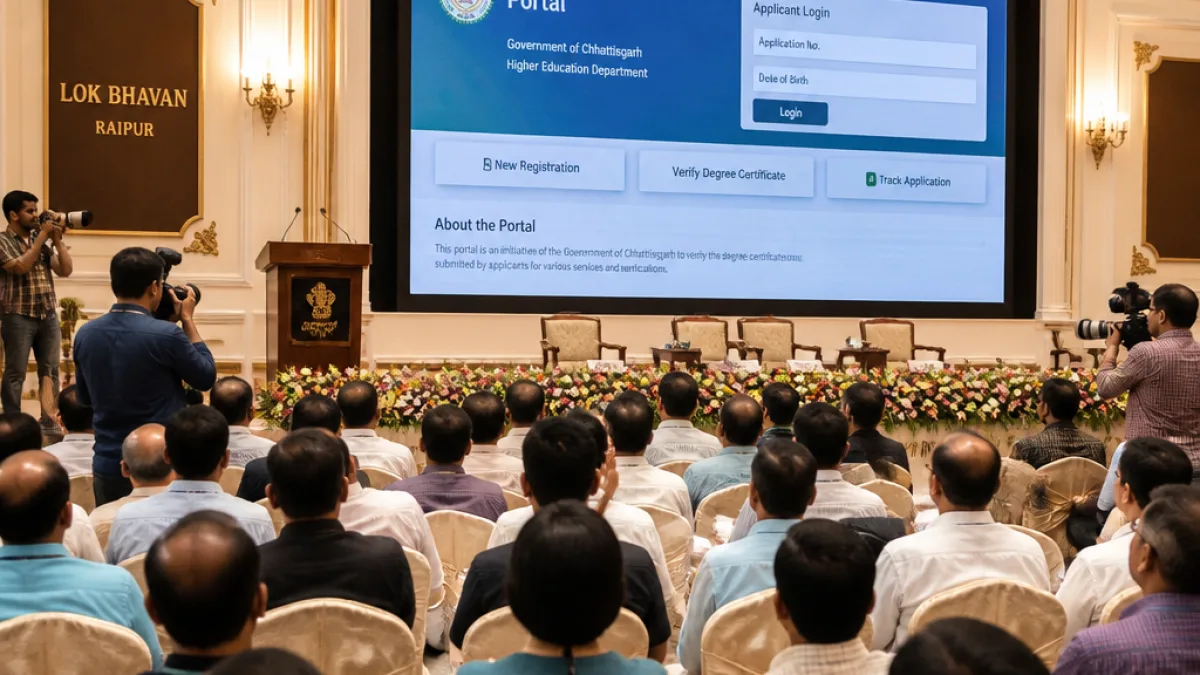
The Chhattisgarh government on Monday launched a digital platform that allows verification of degrees and academic records issued by private universities in the state, the administration said. The site, developed by the Chhattisgarh Private Universities Regulatory Commission (CGPURC), hosts records for all 21 private universities operating in Chhattisgarh and is intended to strengthen transparency in higher education.
What the portal does
Launched at Lok Bhavan by Governor Ramen Deka, the portal — available at cgpurc.cgstate.gov.in — provides a digital trail of a student’s academic journey, according to officials. The system stores information from initial admission entries through to the issuance of degrees, enabling checks at multiple stages.
- Verification: Students, employers and institutions can confirm whether a degree actually corresponds to an admission record held by the university.
- Irregularity flags: The platform is designed to highlight mismatches such as qualifications lacking a matching admission or entries that appear to be backdated.
- Course and approval status: The portal lists courses offered by private universities along with their recognition and approval details.
"Digital records will provide students with accurate information while strengthening transparency and accountability in higher education," Chief Minister Vishnu Deo Sai said.
Why the move matters
Authorities said the initiative responds to growing concerns about the authenticity of academic credentials and the practical difficulties employers and institutions face when checking qualifications. By centralising records for private universities, the state aims to make verification quicker and reduce reliance on paper documents that can be forged or altered.
For prospective students, the portal offers a way to confirm whether a university and the specific course they are considering are validly recognised before they take admission. Employers and other higher-education institutions can use the database to validate claims made by applicants.
How it could help detect irregularities
The portal’s capacity to cross-check admission entries against degree awards is a key feature. Where a degree entry does not have a corresponding admission record, or where timestamps suggest retroactive additions, the system can help bring such anomalies to light for regulatory follow-up.
| Feature | Intended benefit |
|---|---|
| Admission-to-degree digital trail | Enables end-to-end verification of a student’s record |
| Course recognition status | Helps applicants confirm that a programme is approved |
| Irregularity flagging | Assists regulators and employers to spot suspect credentials |
Practical information and next steps
The CGPURC-developed portal currently contains data for all private universities listed by the commission in the state. Users seeking verification should visit the site and follow the on-screen prompts to search by student name, enrolment number or degree details. Officials have said the database is intended as an authoritative reference for verification.
Regulators will be expected to investigate cases where the portal indicates potential irregularities. The platform does not itself annul degrees; it provides documentary evidence that may prompt administrative or legal action when inconsistencies are found.
Context and implications
Across India, concerns about fake or unauthorised qualifications have prompted institutions and employers to demand easier verification mechanisms. Chhattisgarh’s move places private-university records online in an effort to reduce fraud and improve confidence in the state’s higher-education certificates. How quickly the portal will be integrated into recruitment and admission verification workflows will depend on awareness among stakeholders and the responsiveness of regulatory bodies to issues unearthed through the database.
Officials at the CGPURC and state education department will have to ensure the portal remains updated and secure, and that privacy safeguards for student data are maintained while enabling legitimate verification requests.