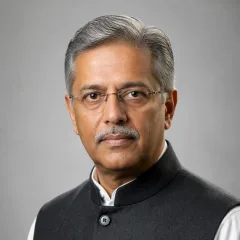
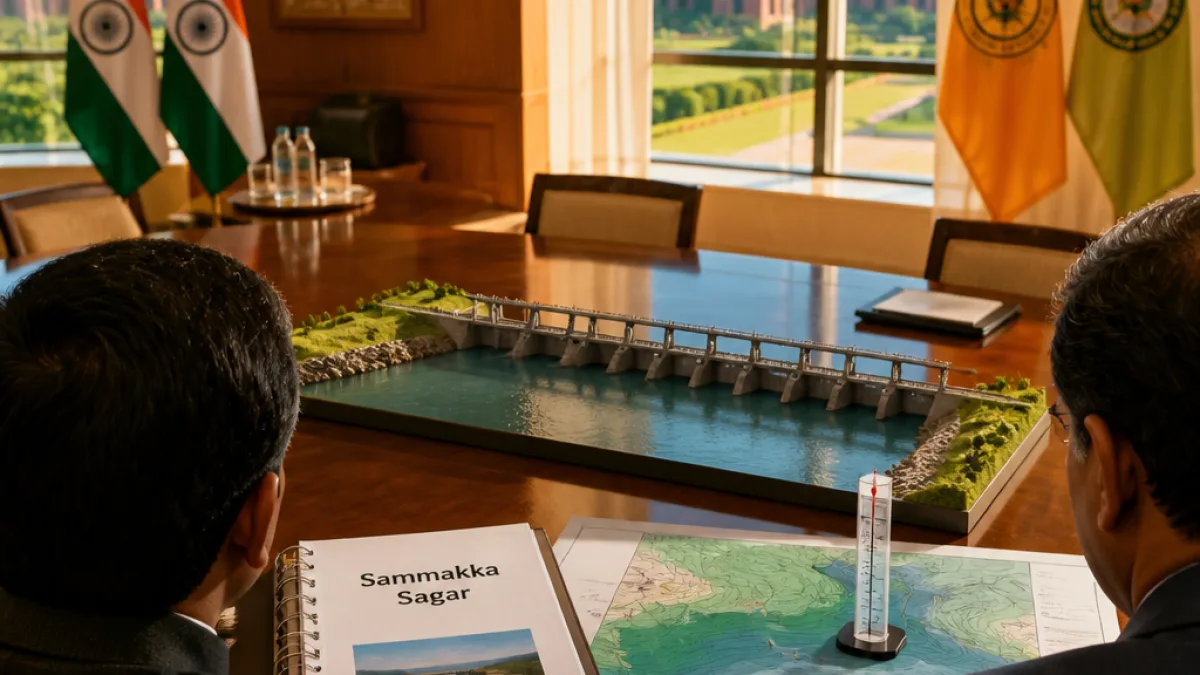
New Delhi: Telangana Irrigation, Food and Civil Supplies Minister N. Uttam Kumar Reddy met Chhattisgarh Chief Minister Vishnu Deo Sai in New Delhi and requested the early issuance of a No Objection Certificate (NOC) to allow storage up to the full reservoir level of the Sammakka Sagar Project, also referred to in reports as the Sammakka Sarakka barrage.
Telangana seeks co‑operation to realise irrigation benefits
During the meeting, Uttam Kumar Reddy sought Chhattisgarh’s co‑operation so that the barrage at Tupakulagudem in Kannaigudem mandal of Mulugu district can be operated to its designed full reservoir level. The minister emphasised that enabling storage to the full level is necessary for the project to deliver its planned irrigation benefits.
“Telangana will pay full compensation for the land and houses that will be submerged in Chhattisgarh. We request the State Government to issue the NOC at the earliest to enable us to store water fully in the barrage,” the minister said.
He assured the Chief Minister that Telangana would meet the compensation requirement for affected land and dwellings in Chhattisgarh and expressed readiness to work with the neighbouring State to resolve outstanding issues related to the project.
Project specifications and intended benefits
Official descriptions of the Sammakka Sagar Project, which lies across the Godavari, note the following technical details:
- Length: 1,143 metres
- Gates: 59 radial gates
- Designed storage capacity: 6.94 TMC at full reservoir level of +83 metres
- Planned diversion: 46.96 TMC of Godavari water for irrigation
Telangana has framed the Sammakka Sagar barrage as part of measures to improve irrigation stability, including benefits for schemes connected to the Sriram Sagar Project (SRSP) and the Ramappa–Pakhal Link Canal. Reports indicate the project is intended to stabilise large ayacuts across several districts in Telangana and to supply drinking water to villages along the distribution route.
Who stands to benefit and where
Published figures for areas expected to benefit under SRSP Stage II and linked schemes include:
| Area / Scheme | Approx. Ayacut (acres) |
|---|---|
| SRSP Stage II – Suryapet | 234,199 |
| SRSP Stage II – Mahabubabad | 96,494 |
| SRSP Stage II – Khammam | 85,774 |
| SRSP Stage II – Warangal | 22,422 |
| SRSP Stage II – Jangaon | 1,111 |
| Ramappa–Pakhal Link Canal – Mulugu | 8,000 |
| Ramappa–Pakhal Link Canal – Narsampet (Warangal) | 22,000 |
According to published material, the barrage’s water diversion is expected to stabilise around 440,000 acres under SRSP Stage II and provide a new ayacut of 30,000 acres under the Ramappa–Pakhal Link Canal, besides supporting parts of the Devadula Lift Irrigation Scheme and village drinking‑water requirements.
Inter‑state sensitivities and compensation pledge
The request to Chhattisgarh to issue an NOC is inherently inter‑state in nature because the barrage’s reservoir inundation footprint extends to areas within Chhattisgarh. In such cases, legal, administrative and humanitarian considerations typically include mapping of inundation extent, verification of ownership of submerged land, precise loss assessment, and a framework for compensation and rehabilitation.
Uttam Kumar Reddy’s explicit assurance that Telangana will pay “full compensation” addresses one of the principal concerns that states typically raise when a neighbour’s project affects land and houses within their jurisdiction. The minister also signalled willingness to engage with Chhattisgarh authorities to settle outstanding matters so storage can proceed to the intended levels.
Next steps and what to watch for
- Whether Chhattisgarh issues the NOC and under what conditions;
- Details of the compensation mechanism, timelines and the agency responsible for payments;
- Any technical assessments or joint inspections to define inundation limits and affected households;
- Possible conditions attached by Chhattisgarh regarding environmental clearances, rehabilitation or legal safeguards.
At the time of reporting, formal confirmation from Chhattisgarh government offices about the outcome of the New Delhi meeting or any subsequent decisions on the NOC had not been published.