
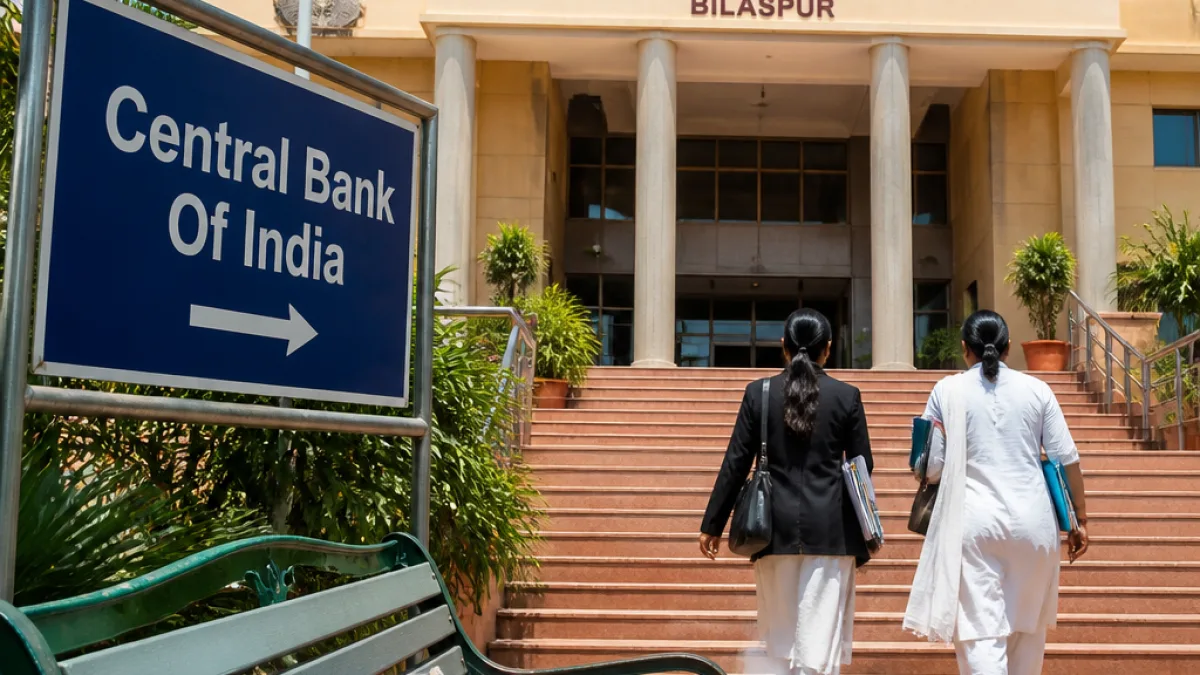
Bilaspur: The Chhattisgarh High Court has directed a bank to provide compassionate appointments to two married daughters of employees who died while in service, holding that their marital status is not a valid ground for denial when the bank's scheme does not distinguish between married and unmarried daughters.
Bench sets aside single-judge order, cites equality provisions
A division bench comprising Chief Justice Ramesh Sinha and Justice Ravindra Kumar Agrawal delivered the judgment on July 30, allowing separate appeals filed by Sheena David of Bilaspur and Ankita Mishra of Raipur. Both petitioners had applied for compassionate appointment after their fathers, who were employed with Chhattisgarh Rajya Gramin Bank, died while in service.
The bench set aside a May 7 order of a single judge and consequential administrative rejections that had denied the daughters' claims solely because they were married. The high court observed that the bank's scheme includes a "wholly dependent son" and a "wholly dependent daughter" but does not classify daughters by marital status, making dependency the operative criterion.
"Thus, the scheme itself makes dependency, and not marital status, the determinative criterion," the court observed.
The court found that rejecting the claims on the basis of marriage, while married sons had been considered eligible under the same scheme, amounted to arbitrariness and discrimination contrary to Articles 14 and 15 of the Constitution.
Relief ordered and timeline for appointments
The high court directed the bank to issue orders of compassionate appointment for suitable posts commensurate with the petitioners' educational qualifications. It ordered that the appointments be made within 90 days from the date the bank receives the court order.
The judgment emphasised parity in treatment between sons and daughters where the scheme does not distinguish marital status, and held that dependency should be the determinative factor in assessing entitlement under the compassionate appointment policy.
Implications for other claimants and institutions
The ruling potentially affects other pending and future claims by daughters seeking compassionate employment benefits from the bank and similar institutions in the state. Where a scheme refers to dependants without qualifying daughters by marital status, this decision indicates that married daughters cannot be excluded simply because they are married.
- Plaintiffs: Sheena David (Bilaspur), Ankita Mishra (Raipur)
- Employer: Chhattisgarh Rajya Gramin Bank
- Bench: Chief Justice Ramesh Sinha and Justice Ravindra Kumar Agrawal
- Orders set aside: Single-judge order dated May 7 and consequential rejection orders
- Compliance timeline: Appointments to be made within 90 days of receipt of order
| Petitioner | City | Employer | Relief | Deadline |
|---|---|---|---|---|
| Sheena David | Bilaspur | Chhattisgarh Rajya Gramin Bank | Compassionate appointment directed | 90 days from receipt of order |
| Ankita Mishra | Raipur | Chhattisgarh Rajya Gramin Bank | Compassionate appointment directed | 90 days from receipt of order |
Legal reasoning and constitutional angle
The bench reasoned that treating married daughters differently from sons in the absence of express statutory differentiation would be arbitrary. By invoking Articles 14 (right to equality) and 15 (prohibition of discrimination) the court underscored that administrative schemes must be applied in a non-discriminatory manner.
The ruling does not create new legislative provisions but interprets the existing scheme governing compassionate appointments to require assessment based on dependency rather than marital status. The court's direction to the bank is specific to the appellants' claims, but the principle enunciated may guide adjudication of similar disputes.
What affected applicants and employers should note
Employers and banks that maintain compassionate appointment policies should examine whether their rules or administrative practices implicitly or explicitly discriminate on the basis of sex or marital status. Applicants who have been denied on similar grounds may consider reviewing the judgment and approaching appropriate forums for redress, subject to legal advice and time-bar constraints.
The high court's order provides immediate relief to the two petitioners and sets a precedent that could influence future claims in Chhattisgarh where scheme language focuses on dependency without differentiating daughters by marital status.