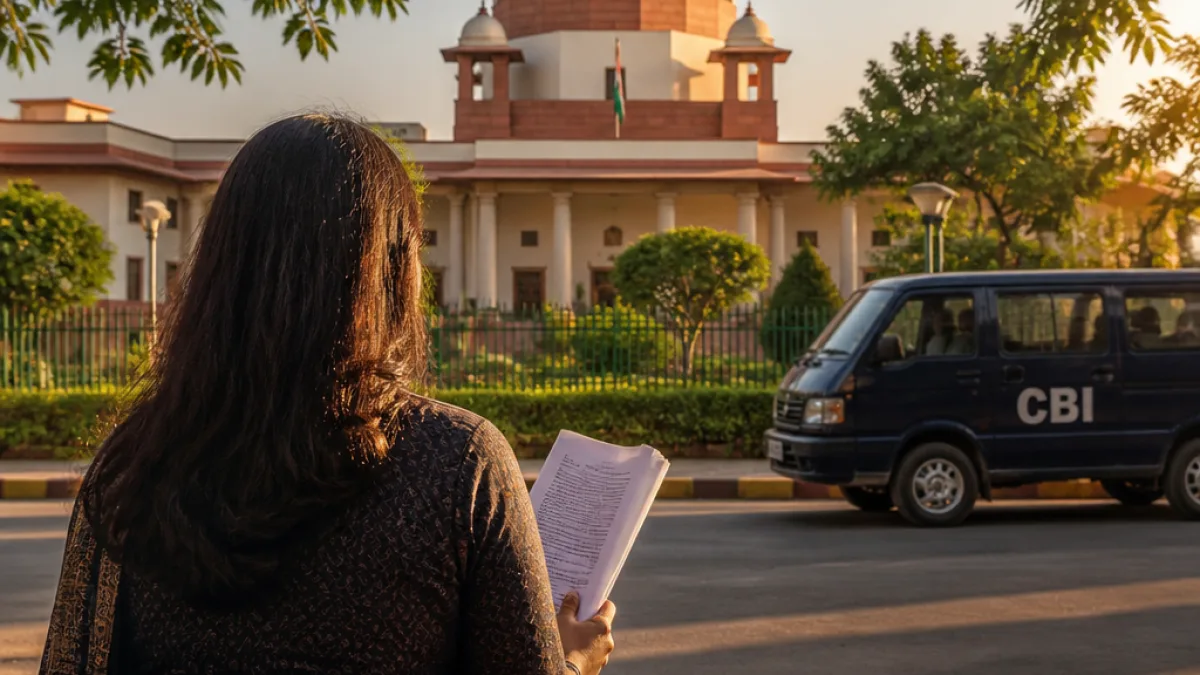
The Supreme Court of India on Thursday transferred to the Central Bureau of Investigation the probe into the custodial death of Shravan Suryavanshi (alias Sarvan Tamre), finding the Chhattisgarh State machinery had failed to investigate despite a judicial inquiry concluding that the deceased sustained fatal injuries in custody. A bench of Justice Vikram Nath and Justice Sandeep Mehta also set aside relief granted by the Chhattisgarh High Court and directed the State to immediately pay ₹25 lakh as interim compensation to the widow.
Court cites inaction by state authorities
The apex court observed that despite the judicial inquiry confirming an antemortem head injury as a cause of death, the State had not registered a First Information Report (FIR) or pursued an effective criminal investigation. The bench expressed "grave concern" over the absence of prompt, independent fact-finding by local law enforcement and prison authorities.
Facts of the case and timeline
Suryavanshi was arrested on 18 January 2024 by Head Constable Uma Shankar Rathore of Police Station Seepat, District Bilaspur, under Section 34(2) of the Chhattisgarh Excise Act, 1915, allegedly for possession of six litres of raw mahua liquor valued at ₹1,200. He was lodged in Central Jail, Bilaspur and, following deterioration in health, was shifted to CIMS Hospital, Bilaspur on 21 January 2024. He died at the hospital on 22 January 2024 at around 6:00 a.m.
| Date | Event |
|---|---|
| 18 Jan 2024 | Arrest at Seepat police station, Bilaspur |
| 21 Jan 2024 | Shifted to CIMS Hospital, Bilaspur |
| 22 Jan 2024 | Died at CIMS Hospital (~6:00 a.m.) |
| Post-mortem | Found six antemortem injuries; cause of death listed as cardio-respiratory arrest due to head injury |
Post-mortem findings contradict prison medical report
The jail hospital's initial medical record attributed death to cardiopulmonary arrest with aspiration pneumonitis arising from alcoholic withdrawal and delirium tremens, without noting external injuries. A subsequent post-mortem, however, recorded multiple antemortem injuries and concluded the cause of death as cardio-respiratory arrest due to complications from a head injury caused by a hard, blunt object. The post-mortem estimated the scalp wound to be within one day old.
- Bleeding from the tip of the penis
- Occipital scalp laceration measuring 4 x 2 x 0.5 cm with swelling and bleeding
- Swelling with redness above the right wrist
- Swelling on both legs
- Contusions on the right thigh and the nape of the neck
High Court relief set aside
The Supreme Court set aside what it described as inadequate relief previously granted by the Chhattisgarh High Court and ordered that the State must immediately pay ₹25 lakh to the widow as interim compensation. The bench directed commencement of a CBI investigation into the circumstances of the arrest, the custodial period, medical care provided in custody and any possible criminality by public servants or others.
Legal and administrative implications
The transfer of the probe to the CBI effectively places investigative responsibility with a central agency that will examine whether arrests, custody procedures, prison medical care and post-arrest handling complied with law and standards. The order also underscores the judiciary's expectation that state authorities act promptly when a custodial death is alleged and that medical and prison records must be transparent and reliable.
What comes next
With the CBI now ordered to investigate, the agency is expected to register a case, collect evidence, record statements and submit its findings to the court. The interim compensation direction requires the State government to pay the widow immediately; further relief, criminal charges or departmental action will depend on the CBI's findings and subsequent judicial proceedings.
The matter raises wider questions about custodial safeguards and the conduct of criminal justice agencies in Chhattisgarh. The Supreme Court's strong direction signals increased judicial scrutiny where state mechanisms appear to have failed to protect the right to life and to ensure impartial enquiries into deaths in custody.