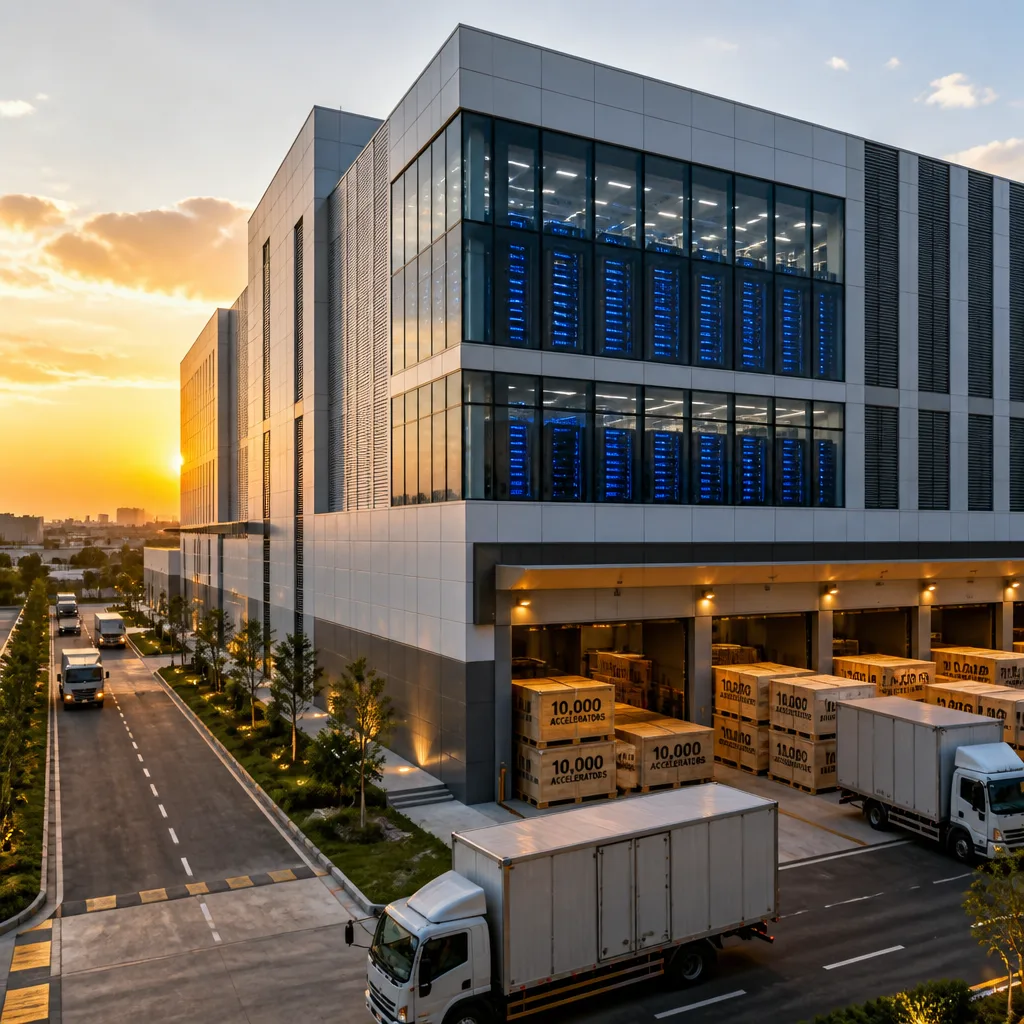
India's engineering major Larsen & Toubro (L&T) has secured an order worth up to ₹150 billion (about $1.57 billion) from US cloud platform Together AI to develop and host an AI data centre that will use 10,000 NVIDIA B300 accelerator chips, Reuters reported on Thursday.
Deal structure and capacity
The contract, won by L&T's AI infrastructure subsidiary LTN Compute, is in the range of ₹100 billion to ₹150 billion (₹10,000 crore to ₹15,000 crore). The centre will be set up at the company's Vyoma.AI campus in Chennai and will be used to support Together AI's cloud platform for AI inference, fine‑tuning and training, Reuters reported.
| Item | Detail |
|---|---|
| Buyer | Together AI (US cloud platform) |
| Provider | L&T's LTN Compute |
| Location | Vyoma.AI campus, Chennai |
| Capacity | 10,000 NVIDIA B300 chips |
| Contract value | ₹100–150 billion (₹10,000–15,000 crore; $1.05–1.57 billion) |
What this means for India
The order marks a significant push by an Indian engineering conglomerate into the large‑scale AI infrastructure business. Deploying 10,000 B300 accelerators will make this among the largest single installations of such chips in the country, according to the report.
- Scale: A 10,000‑chip cluster indicates capacity for substantial model training and inference workloads, and positions Chennai as a local hub for AI compute.
- Capabilities: NVIDIA's B300 is described as one of the more powerful chips for AI inference, which is the process of running trained AI models to generate outputs. Fine‑tuning refers to updating a pre‑trained model on new data, and training is the initial process of creating a model from scratch.
- Industry impact: The project marks L&T's formal entry into the so‑called AI factory business — integrating compute, data centre engineering and managed services for AI workloads.
Risks and strategic considerations
While the contract is a boost for domestic AI infrastructure, it also highlights India's ongoing reliance on foreign semiconductor technology for high‑end AI work. The B300 chips are produced by NVIDIA, a US company, and large deployments of such accelerators are sensitive to international supply chains and export controls.
For Indian customers and policymakers, the deal underlines two tensions: the need to rapidly build AI compute capacity to support research and commercial services, and the strategic goal of strengthening domestic semiconductor design and manufacturing. Analysts and industry participants have previously cautioned about concentrating critical AI capacity around a few vendors or geographies; this deployment will add significant compute yet depend on imported accelerators.
L&T's shares rose as much as 1.2 percent in mid‑day trade following the announcement, Reuters reported, indicating investor approval of the company's move into a higher‑margin, technology‑heavy line of business.
Operational use
The Reuters report said the data centre will support Together AI's cloud platform for three principal activities:
- Inference: Running trained models to provide outputs for applications such as chatbots, recommendation engines and image analysis.
- Fine‑tuning: Adapting large pre‑trained models to specific tasks or datasets to improve performance on niche or local requirements.
- Training: The compute‑intensive process of creating or substantially updating models using large datasets.
The project underlines growing private investment into AI compute capacity in India, and signals that global AI platforms are looking to host significant workloads inside the country. The Reuters story was reported by Mridula Kumar from Bengaluru and edited by Sonia Cheema and Janane Venkatraman.
Implications for users and industry: For Indian companies and developers, the new facility could mean faster access to large‑scale AI resources with lower latency and potentially better compliance with local data rules. For policymakers, it will raise questions about ensuring resilience in supply chains and encouraging domestic capabilities in semiconductor and systems integration.