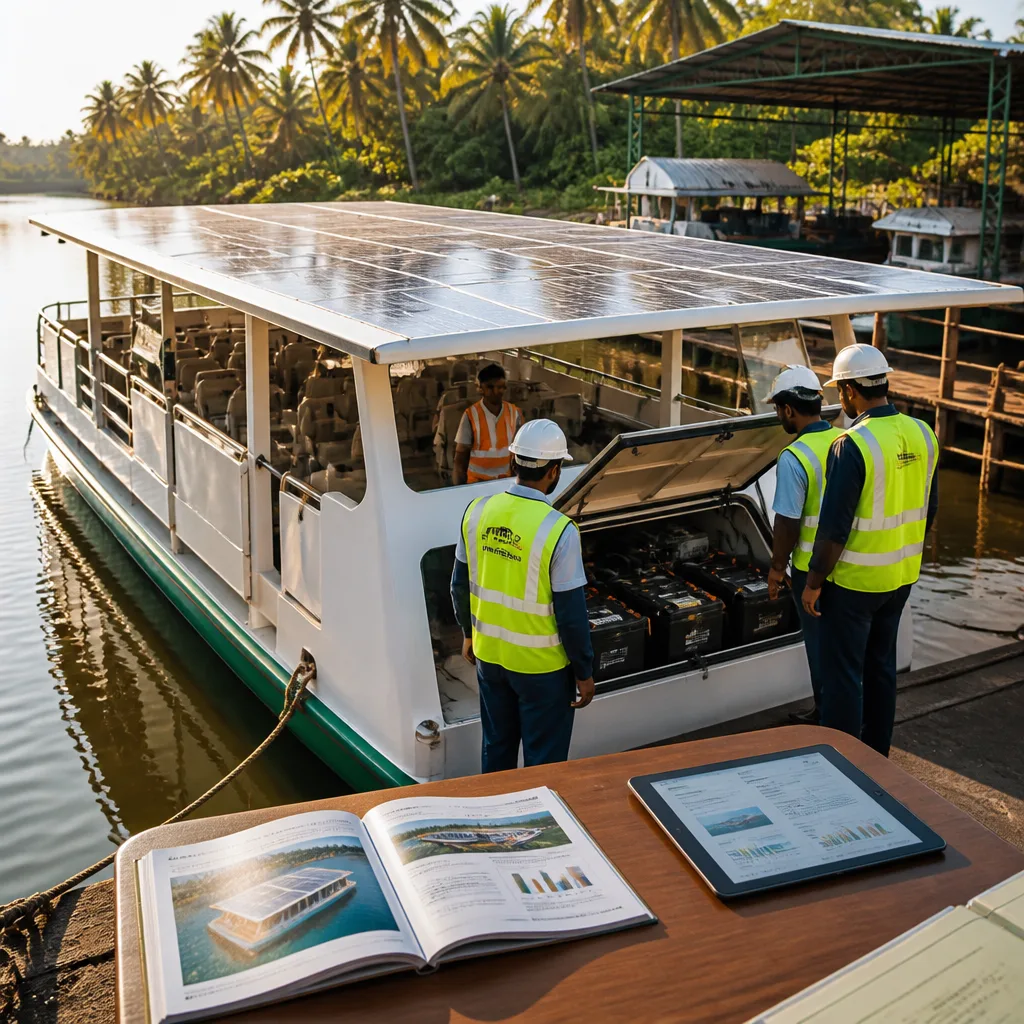
Navalt, the Kerala marine-technology startup behind India’s first solar ferry Aditya, has been profiled in a case study published by the Harvard Business Review, according to reporting by ETV Bharat. The study, authored by Shiril Saju and Prashanth Varma of IIM Bangalore, maps Navalt’s journey from a small boat-maker to a technology-driven marine enterprise and highlights its cost and manufacturing innovations.
What the case study spotlights
The IIM Bangalore authors focus on three areas where Navalt claims to have made practical advances:
- Indigenous battery system for its solar vessels, which the study says helped lower manufacturing costs and shorten production time.
- The economics of solar-powered passenger transport, with Navalt’s operating figures cited as showing fares can work out to as little as four paise per kilometre in passenger travel.
- The firm’s transition from building solar boats to positioning itself as a broader marine-technology company, leveraging domestic engineering and design.
Background: roots and milestones
Navalt was established in 2013 by Sandith Thandasherry, a naval architecture graduate of IIT Madras from Peringottukara, Thrissur. After early professional experience in Gujarat and a stint with major shipyards in South Korea and Japan, Sandith pursued an MBA in France before returning to India and founding Navalt.
After nearly four years of research and development, the company launched Aditya in 2017, described in the study as India’s first solar ferry. The vessel continues to operate on the Vaikom–Thavanakkadavu route in Kerala, running on solar energy.
| Year | Event |
|---|---|
| 2013 | Navalt founded by Sandith Thandasherry |
| 2017 | Launch of solar ferry Aditya (Vaikom–Thavanakkadavu route) |
| 2026 | Case study on Navalt published in Harvard Business Review (authors from IIM Bangalore) |
Why this matters
The HBR case offers three practical takeaways for policy-makers, investors and urban planners considering zero-emission water transport:
- Cost competitiveness: Navalt’s claim of fares as low as four paise per km for passenger travel suggests solar vessels can be economically viable on shorter ferry routes where charging infrastructure and daylight operations are predictable.
- Localisation of key systems: An indigenous battery solution can reduce dependence on imported subsystems, cut lead times and bring down unit costs — a strategic advantage for domestic shipbuilders and operators.
- Scalability of a niche technology: Navalt’s shift from one-off solar boats to a broader marine-technology approach signals a path to commercial scaling beyond demonstration vessels.
For commuters and local transport planners, the study’s figures underline a real possibility: on suitable routes, solar ferries can offer a low-cost, low-emissions alternative to diesel launches and road detours. For manufacturers and policy-makers, Navalt’s experience highlights the value of developing home-grown components to control costs and delivery schedules.
Limitations and context
The case study, as reported, emphasises Navalt’s innovations and economics but is rooted in a particular operational context — short-distance ferry routes with favourable solar conditions and predictable usage patterns. Wider adoption will require attention to battery lifecycle, seasonal solar variability, regulatory frameworks for waterways and integration with urban transport systems.
Navalt’s feature in an HBR case by IIM Bangalore authors places an Indian clean-transport innovator on an international academic stage and could accelerate interest from cities, state governments and private operators exploring low-emission marine mobility.
What it means for you: commuters on suitable water routes could see cheaper, greener services; transport planners gain a tested model for low-cost operation; and manufacturers have a template for combining local engineering with renewable power to lower both capital and operating expenses.