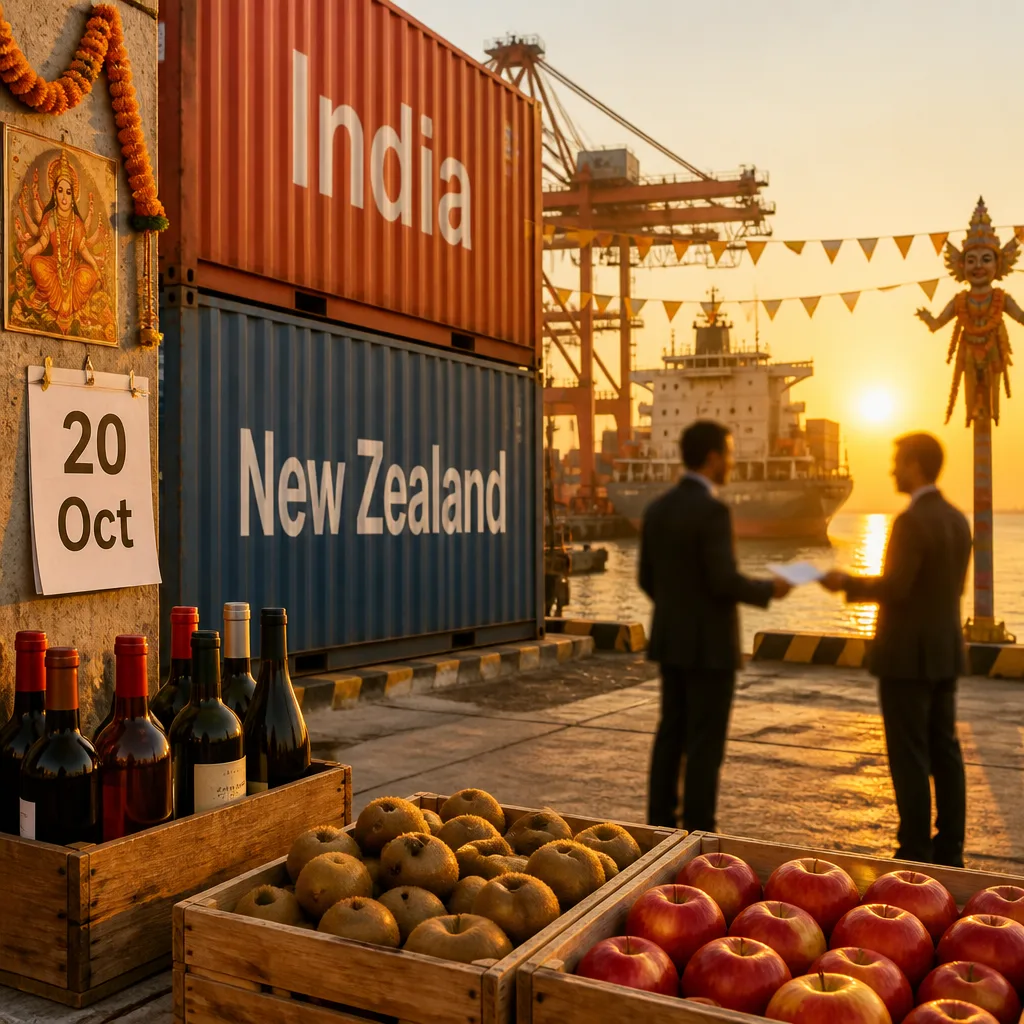
New Delhi, October 20 (provisional) — The India–New Zealand Free Trade Agreement (FTA) will enter into force on 20 October, coinciding with Dussehra, the commerce and industry minister Piyush Goyal said on Monday, delivering a major new market opening for Indian exporters.
What the deal does
Under the agreement, 100 per cent of Indian exports to New Zealand will receive duty‑free access from the day the FTA becomes operative. New Zealand has agreed to eliminate or sharply reduce tariffs on about 95 per cent of its exports to India — including key agricultural and horticultural items such as wine, kiwifruit and apples, according to media reports.
The pact also includes provisions to ease mobility rules for students and workers, and contains an investment commitment: Wellington has pledged to invest $20 billion in India over the next 15 years, the reports said.
Immediate trade context
Official data cited by media show bilateral merchandise trade rose to $1.3 billion in 2024‑25 from $873 million in 2023‑24 — a 49 per cent increase. In the same period, India’s merchandise exports to New Zealand increased to $711 million, up by 32 per cent. Services exports from India to New Zealand were reported at $634 million in 2024.
| Indicator | 2023-24 | 2024-25 | Change |
|---|---|---|---|
| Bilateral merchandise trade | $873 million | $1.3 billion | +49% |
| India's merchandise exports to NZ | — | $711 million | +32% |
| India's services exports to NZ | — | $634 million | +13% (reported) |
What it means for businesses and consumers
- Exporters: Indian firms across sectors including textiles, pharmaceuticals, machinery and processed foods gain tariff-free access to the New Zealand market, removing existing duties that in some cases reached up to 10 per cent on items such as ceramics, carpets, cars and auto parts.
- Importers and consumers: New Zealand products will become more competitive in India as tariffs are eliminated or cut on most lines; this could increase availability of fruit, wine and other NZ goods and pressurise local suppliers in some segments.
- Investors and services firms: the $20 billion pledge by New Zealand and the mobility provisions offer scope for deeper investment ties and easier movement of students and skilled workers, potentially boosting services trade.
“It is huge for both countries,” New Zealand High Commissioner to India Patrick John Rata said, describing the pact as a major development for bilateral ties, according to media reports.
New Zealand’s minister for trade and investment, Todd McClay, exchanged formal documents with India’s high commissioner to New Zealand as both sides completed internal legal steps required for enactment, the commerce ministry said in reports. The agreement was signed in New Delhi on April 27 after roughly nine months of talks.
Wider policy implications
The FTA marks another step in India’s strategy to broaden trade partnerships beyond traditional large markets. For Indian exporters, the tariff removal on the New Zealand side removes an immediate cost barrier; for New Zealand exporters, negotiated liberalisation of about 95 per cent of lines opens a fast‑growing market though some sensitive sectors may retain protection for a transition period as per implementation schedules reported during negotiations.
Policymakers and industry bodies will watch sectoral schedules and rules of origin closely: the benefits for specific companies will depend on the speed of domestic compliance, certification procedures and non‑tariff measures that can affect trade flows even after tariffs fall.
For consumers and firms, the practical impact will become visible over months as tariff schedules are published and businesses adjust supply chains and pricing. The agreement also signals a strengthening economic partnership that the governments expect to support jobs, services growth and investment ties between the two countries.