Airport turns abundant rainfall into a strategic water resource
Lokapriya Gopinath Bordoloi International (LGBI) Airport in Guwahati has stepped up its sustainability efforts by implementing an integrated rainwater harvesting and treatment system to supply both potable and operational water needs, the airport said in a media release.
Guwahati lies in a high-rainfall zone, receiving an annual average of 1,800–2,200 mm of rain. According to the release, the airport had already recorded around 1,320 mm of rainfall up to 9 August 2026. The facility has capitalised on this natural advantage by installing rainwater collection infrastructure across the airport campus.
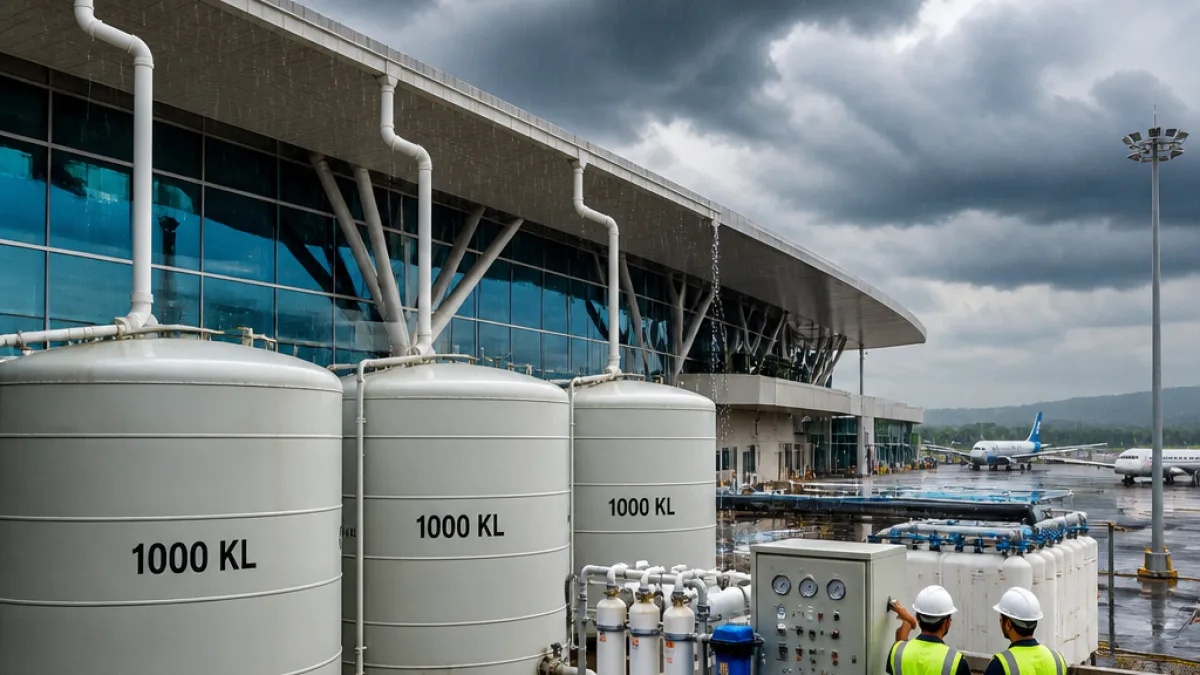
The project features two large rainwater storage tanks with a combined capacity of 1,000 kilolitres (KL). Collected water is routed to the airport's Water Treatment Plant (WTP) for multi-stage purification before being deployed for a range of uses, including drinking water fountains, equipment cleaning and make-up water for cooling towers, the statement said.
"In July 2026, approximately 28% of the total water consumed at Terminal 2 was met through harvested rainwater," the release added, highlighting the immediate operational benefit of the system.
Integrated management across airport functions
The airport described the initiative as an "integrated water management approach" that requires coordination among multiple departments. Engineering & Maintenance (E&M), Environmental, Social & Governance (ESG), Operations and Projects teams are involved in capturing, treating and redistributing rainwater for various uses across the terminal complex.
Terminal 2, described in the release as a newly built, state-of-the-art facility, has already demonstrated the capacity of the scheme to reduce dependence on external water sources, the airport said. With increasing passenger numbers and ongoing infrastructure development, officials framed the system as a means to both conserve resources and ease pressure on municipal or groundwater supplies.
Operational benefits and standards
According to the airport, water intended for potable use is subjected to advanced purification processes at the WTP to ensure it meets the prescribed quality standards for drinking water. Treated rainwater is then used selectively — for drinking fountains and other potable points — while simultaneously servicing non-potable operational requirements.
The release also positioned the Guwahati airport's effort as pioneering within the Airports Authority of India–associated AAHL network, indicating that the model could be replicated at other airports where rainfall and infrastructure permit.
- Annual rainfall (Guwahati): 1,800–2,200 mm
- Rainfall recorded till 9 Aug 2026: ~1,320 mm
- Storage capacity: 1,000 KL (combined)
- Terminal 2 reliance in July 2026: ~28% of water consumption met by harvested rainwater
| Item | Detail |
|---|---|
| Storage tanks | Two tanks, combined capacity 1,000 KL |
| Primary uses | Drinking fountains, equipment cleaning, cooling tower make-up water |
| Key departments | E&M, ESG, Operations, Projects |
For a city like Guwahati, where annual precipitation is high but surface runoff and urban drainage are recurring challenges, harvesting rainwater can deliver dual benefits: augmenting water supply and mitigating runoff pressure during monsoon months. Airport officials framed the system as an example of resource optimisation that aligns with broader sustainability goals and operational resilience.
While the release focuses on the airport's internal gains, the scheme may also have indirect local advantages. Reducing demand on municipal water networks and groundwater can ease supply stress in surrounding neighbourhoods, particularly when urban expansion and rising passenger footfall increase the need for reliable utilities.
Airport authorities said the programme's effectiveness depends on continued monitoring, maintenance of the treatment plant and coordinated operations between technical and environmental teams, especially as infrastructure grows. The airport also flagged the potential to expand or adapt the system to meet future water needs as development continues.
As cities across the region seek sustainable ways to manage water in the face of variable rainfall and urban pressures, Guwahati's LGBI Airport offers a visible demonstration of one approach — turning plentiful monsoon precipitation into a managed, treated and useful resource for critical public infrastructure.