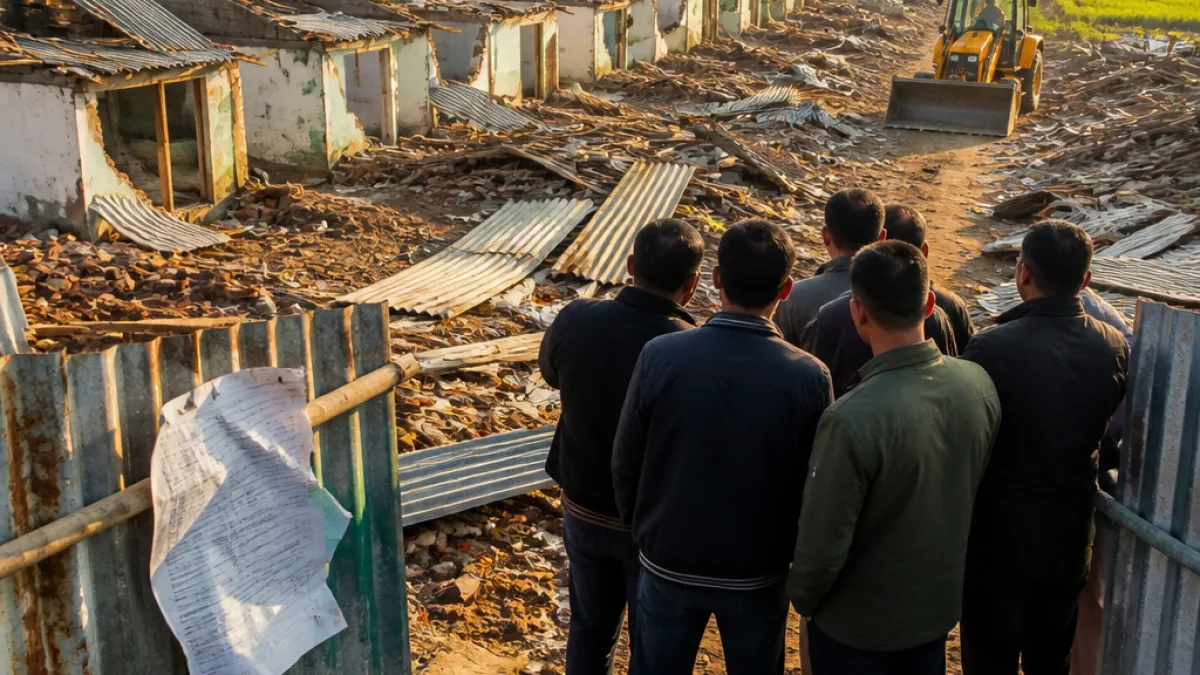
Guwahati: The Gauhati High Court has raised serious questions over the Assam administration’s demolition of 21 dwelling units on private agricultural land in Goalpara district, saying the action prima facie appears to be a misuse of law and may have violated principles of natural justice and fundamental rights.
Court flags possible misuse of Disaster Management statute
Hearing a petition filed by the owners of the demolished houses, Justice Devashis Baruah on September 11 remarked that there seemed to be no imminent danger to justify the drastic step of razing homes on private farmland earlier this month. The judge noted that the administration’s action prima facie appears to be a misuse of the Disaster Management Department Act, 2005, and directed the district commissioner and the circle officer to file affidavits explaining the demolition.
"Rather, it also prima facie appears to be a misuse of the Disaster Management Department Act, 2005,"
Demolition, notices and procedural concerns
The petition was filed by 21 individuals whose houses were demolished after notices were issued by the circle officer of Matia in Goalpara. According to the petitioners’ affidavit, notices were served on September 5 directing owners to demolish their own houses within 24 hours or face legal action. The demolitions were reportedly carried out in the early hours of September 7.
Justice Baruah observed that the manner in which the notices were issued did not reflect accepted legal norms and that the action “prima facie appeared to be illegal, unauthorised and violative of the principles of natural justice”, which engage Articles 14 and 21 of the Constitution.
Material on record and next steps
The court took note of an additional affidavit filed by the petitioners that included photographs of the demolition and a claim of losses suffered. The judge asked the authorities to respond to this additional affidavit. The matter has been posted for further hearing on October 13, when the court will consider whether compensation is warranted if the demolition is found to be unauthorised by law.
| Key dates | Action |
|---|---|
| 5 September | Notices issued by circle officer of Matia asking owners to demolish houses within 24 hours |
| 7 September | Reported demolition of 21 dwelling units in early hours |
| 11 September | Gauhati High Court hearing; order recorded by Justice Devashis Baruah |
| 13 October | Next scheduled hearing |
Legal and social implications
The petitioners’ pleadings, as placed before the court, assert that the 21 affected persons were owners of the respective plots of agricultural land on which their homes stood. The demolitions therefore raise questions about the limits of executive action, use of disaster-management laws for land or encroachment disputes, and the procedure required before depriving people of their homes.
The court’s reference to Articles 14 and 21 highlights two central legal concerns: equality before law and protection of life and personal liberty. If notices were issued without a hearing or opportunity to be heard, the action could run afoul of settled administrative-law principles that require fairness and reasoned decision-making.
- Number of dwelling units demolished: 21
- Location: Matia circle, Goalpara district
- Allegation: Demolitions carried out on private agricultural land after 24-hour notices
- Next hearing: 13 October
What to watch
The court-ordered affidavits from the district commissioner and the circle officer will be critical in establishing the factual and legal basis relied upon by the administration for the demolitions. The high court will then decide whether the demolitions were authorised under any statutory power and, if not, whether compensation or other remedies should be directed.
Beyond the immediate legal contest, the case touches on broader governance issues in Assam: how local administrations address land-use disputes, the application of disaster-management statutes in non-disaster contexts, and the safeguards necessary to protect property and procedural rights of vulnerable groups. The petitioners’ additional affidavit, including photographic evidence, has been placed on record for the court’s consideration.
The matter will return to the Gauhati High Court on 13 October for further hearing.