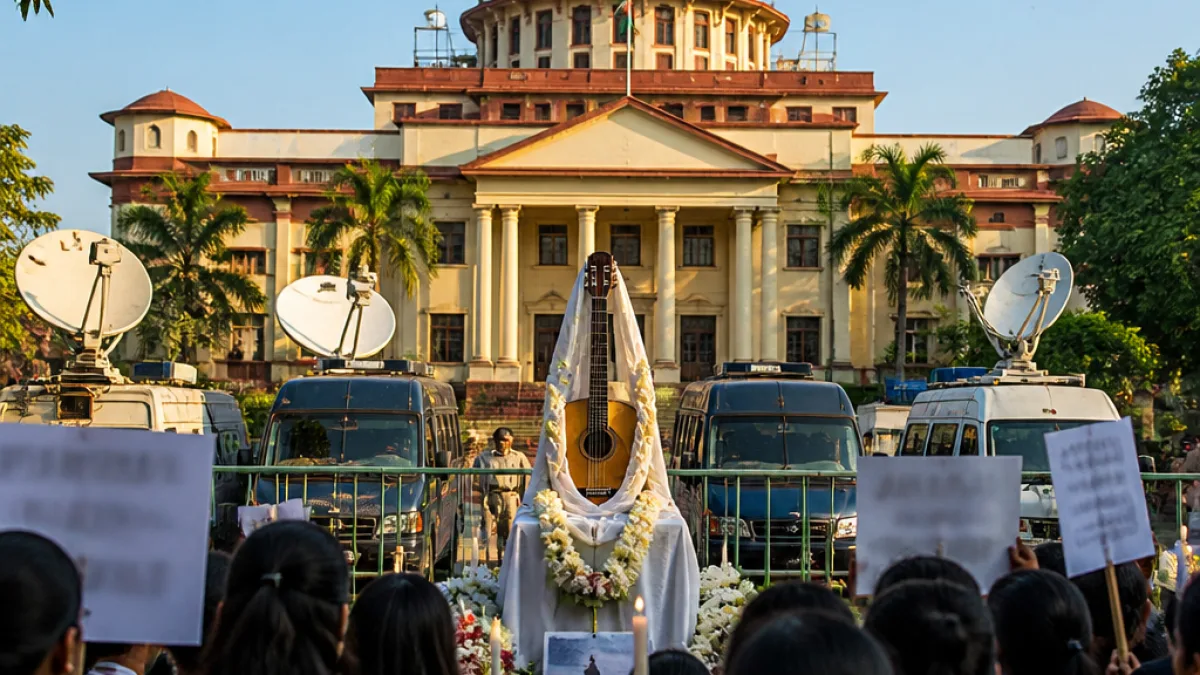
GUWAHATI: One year after Assam’s most prominent musical figure, Zubeen Garg, died during a seaside outing in Singapore, the state remains marked by his absence even as a fast-track court in Guwahati proceeds with a murder trial involving seven accused.
Public outpouring and official probes
Garg died on September 19 last year after becoming unresponsive during a second swim near Lazarus Island, Singapore. Immediate rescue attempts and cardiopulmonary resuscitation were carried out, and he was later pronounced dead at Singapore General Hospital, according to initial reports from Singapore authorities.
The news of his death triggered an unprecedented public reaction in Assam. When Garg’s body was brought back, more than 1.5 million people are estimated to have joined his final journey to Kamarkuchi in Sonapur, near Guwahati, and his cremation drew a turnout that drew national and international attention.
Conflicting investigative trajectories
Singapore investigators concluded that Garg’s death was due to accidental drowning and reported no evidence of foul play in their probe. In contrast, law-enforcement agencies in Assam have pursued a different line, filing criminal charges and treating the matter as an alleged homicide.
Following the singer’s death, more than 60 First Information Reports were lodged across Assam, prompting the state government to constitute a Special Investigation Team (SIT) to examine the complaints and related evidence. Within days, the investigation in Assam shifted towards an alleged murder theory.
Arrests and charges
Between October 1 and 10 of last year, Assam Police arrested seven people in connection with the case. The accused include the Singapore festival organiser, Garg’s manager, two musicians, a close relative and two personal security officers. They face charges that, as reported, include murder, culpable homicide, criminal conspiracy and financial offences. Proceedings in a fast-track court in Guwahati are now under way.
| Date | Event |
|---|---|
| 19 September (last year) | Garg becomes unresponsive while swimming near Lazarus Island; pronounced dead at Singapore General Hospital |
| 21 September (last year) | Body brought to Kamarkuchi, Sonapur; large public funeral procession and cremation |
| 1–10 October (last year) | Seven arrests made by Assam Police; charges include murder and related offences |
Social response and continuing demand for justice
The divergence between the Singapore autopsy and the Assam criminal case has fed widespread public debate across Assam. Fans, civil society groups and political outfits have repeatedly demanded a thorough judicial probe and accountability. The filing of multiple FIRs and the state government’s SIT reflect the scale of public concern.
- Singapore finding: accidental drowning, no evidence of foul play reported.
- Assam response: numerous FIRs, SIT constituted, seven arrests and criminal prosecution in India.
- Public reaction: mass attendance at funeral and ongoing calls for justice across the state.
Legal and cross-border complexities
The case underscores the legal complexities that arise when an incident involves multiple jurisdictions. Singapore’s investigative conclusions form one official record, while criminal proceedings in India are shaped by local complaints, evidence collected by Indian investigators and the charges framed by Assam Police. How the fast-track court addresses conflicting records and cross-border material will be closely watched.
For Assam’s many communities who followed Garg’s work—he was widely known as a singer, composer and film artist with national recognition—the case is both a criminal matter and a cultural wound. The continuing trial keeps alive questions about the circumstances of his death and about how cross-border deaths involving public figures are investigated and adjudicated.
What comes next
The fast-track court in Guwahati will take forward the prosecution against the seven accused. The pace and outcome of the trial, any further investigative findings and potential legal exchanges with Singapore authorities will determine whether Assam’s demand for conclusive legal answers is met through domestic criminal justice processes.
The case will remain a focal point for Assam’s public discourse in the near term, combining grief over the loss of a cultural figure with scrutiny of policing, prosecution and international investigative cooperation.
Reporting from Guwahati.