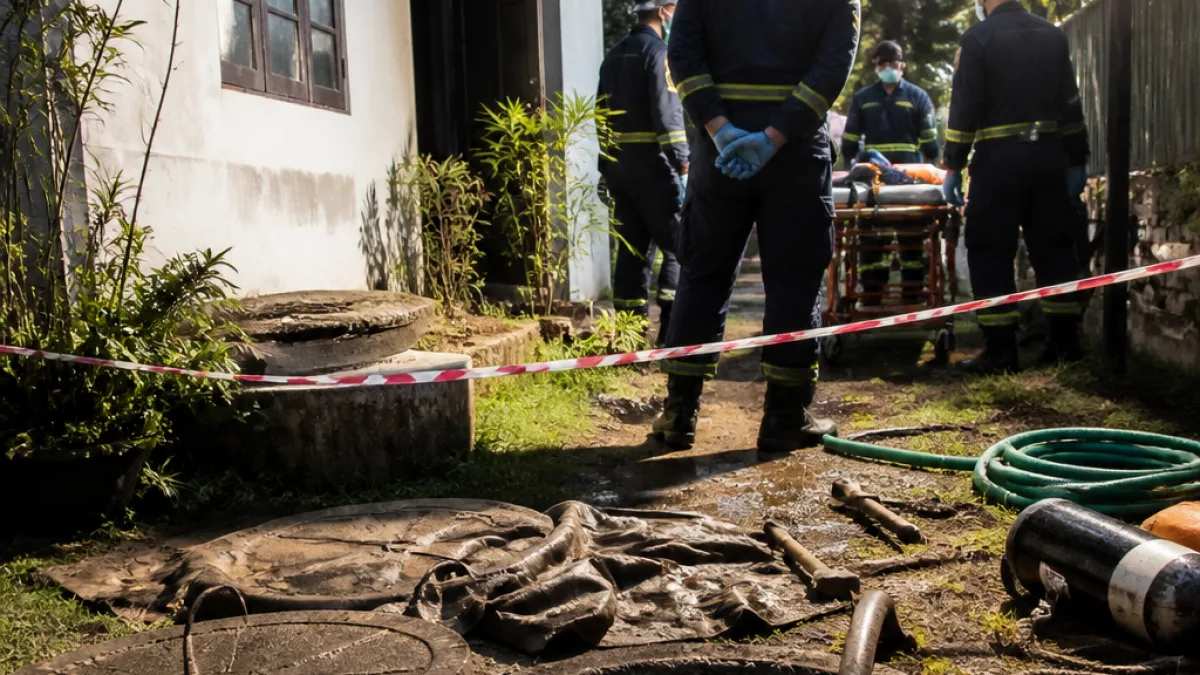
Rangdokram (South Garo Hills)/Shillong: Four labourers from Assam’s South Salmara-Mankachar district died after being overcome by noxious fumes while attempting to open and repair an underground septic tank at a private residence in Rangdokram, police said on Sunday.
Rescue attempt left more people affected
Police said they received information at around 3 pm that two workers collapsed after being exposed to gases emanating from the septic tank at the house of Sebastian C. Sangma. Two others who rushed in to help were also rendered unconscious. Local fire-and-rescue teams and police launched an operation to pull the victims out.
During the operation, two rescue personnel reportedly became unconscious and were given immediate medical assistance. Authorities did not disclose their current clinical condition.
Victims identified
The four deceased men were identified as Mofidur Rohman (34) of Diara; Ajiyer Rahman (41) of Chengurchar; Ismail Hussain (20) of Chomrashali; and Rakib Hussain (22) of Boalia. All four were residents of Assam’s South Salmara-Mankachar district, according to police records.
| Name | Age | Place |
|---|---|---|
| Mofidur Rohman | 34 | Diara |
| Ajiyer Rahman | 41 | Chengurchar |
| Ismail Hussain | 20 | Chomrashali |
| Rakib Hussain | 22 | Boalia |
Possible cause under investigation
Preliminary findings by investigators indicate that the septic tank may have lacked a proper gas outlet or soak pit, a situation that can permit accumulation of hazardous gases such as hydrogen sulphide or methane in confined spaces. Police said a formal inquiry is under way to determine the exact cause of death and to identify the specific gas involved.
Officials noted that confined-space incidents with septic systems and wells are not isolated in the region. The police report recalled a similar tragedy two months ago at Lapalang in Shillong, where five workers reportedly lost their lives due to suffocation while working in a dug-out well in a private compound.
Safety and prevention considerations
Working in or near septic tanks and other confined spaces carries known risks from toxic and asphyxiating gases. Safety protocols commonly recommended by occupational and public-health authorities include:
- Testing the atmosphere for oxygen levels and toxic gases before entry.
- Providing forced ventilation and establishing a safe means of extracting gases.
- Using personal protective equipment (PPE), including appropriate respirators or self-contained breathing apparatus where required.
- Ensuring a trained attendant remains outside the confined space to monitor and summon help if needed.
It was not immediately clear whether any of these precautions were in place at the Rangdokram residence. Local police and civic authorities are expected to share findings from the ongoing probe once available.
Cross-border implications and community impact
The victims hailed from Assam but the incident occurred in Meghalaya, underscoring the routine cross-border movement of labour in the north-east for daily and contractual work. Such tragedies place additional strain on families and local administrations across state lines and revive questions about occupational safety standards for informal workers.
Community members and local leaders often point to inadequate awareness about confined-space hazards and a lack of access to safety equipment for casual and contract labourers. Authorities in both Assam and Meghalaya have previously been urged to intensify awareness campaigns and enforcement of safety norms for such high-risk activities.
Police in South Garo Hills said they will complete forensic and medical examinations and submit a detailed report to district authorities. Depending on the findings, the case may prompt directives to strengthen safety measures on private sites where maintenance work requires entry into enclosed spaces.
The incident remains under active investigation; further details, including the status of the rescuers who were treated after losing consciousness, are awaited from the district police and health officials.