Rainwater system expanded as part of wider sustainability push
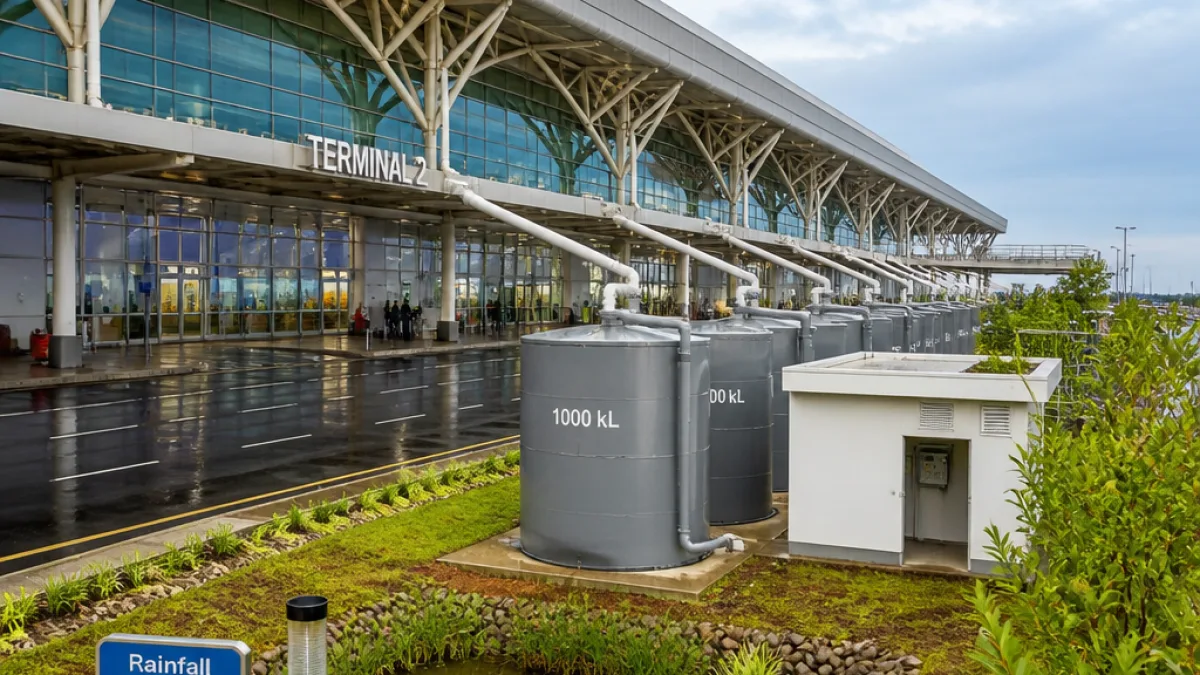
The Lokapriya Gopinath Bordoloi International (LGBI) Airport in Guwahati has strengthened its rainwater harvesting and utilisation infrastructure, with harvested precipitation meeting around 28% of the total water consumed at its newly opened Terminal 2 during July, airport officials said on Wednesday. The enhancement forms part of the airport’s broader sustainability agenda and its stated objective of "becoming water positive" by integrating collection, treatment and reuse across operations.
Guwahati receives substantial annual rainfall — typically between 1,800 and 2,200 mm — presenting significant potential for capture and reuse. Airport records show about 1,320 mm of rainfall had been registered at the facility up to 9 August this year, according to officials.
| Parameter | Figure |
|---|---|
| Annual rainfall range (Guwahati) | 1,800–2,200 mm |
| Rainfall recorded till 9 Aug | 1,320 mm |
| Combined tank capacity | 1,000 kilolitres |
| Share of Terminal 2 water from rainwater (July) | 28% |
How the system works and where the water is used
Airport officials described an integrated water management approach that coordinates Engineering and Maintenance, Environment, Social and Governance, Operations and Projects teams to ensure captured rainwater is treated and reused for multiple operational needs. The harvested water is collected in two large tanks and processed through the airport’s Water Treatment Plant before being distributed.
- Drinking water for public fountains after multi-stage purification to meet prescribed potable standards
- Cleaning of airport equipment
- Make-up water for cooling towers
Officials said the emphasis on reuse aims to reduce dependence on external water sources and to improve resource efficiency as passenger numbers rise and infrastructure expands.
"becoming water positive"
Significance for urban water security in Assam’s largest city
The airport’s move to scale up rainwater harvesting is notable given the high demand for water in aviation facilities — for passenger amenities, maintenance and air-conditioning systems — and the seasonal variability of city supplies. Greater reliance on harvested rainwater can relieve pressure on conventional sources and contribute to more resilient local water management, particularly in a climate where intense monsoons predominate.
Officials emphasised that potable applications draw on multi-stage treatment and purification so that water quality meets required drinking standards. The initiative also reflects a wider trend among large infrastructure sites to integrate sustainable practices into routine operations to limit environmental impacts while securing long-term resource availability.
While the airport has reported the proportion of Terminal 2’s July consumption met by harvested rainwater, officials did not provide data on monthly variations or projected annual water savings based on the system’s current capacity. They said coordination across technical and operational departments is crucial to capture, treat and allocate rainwater efficiently.
For Guwahati — a city that contends with both heavy monsoon rainfall and pressure on groundwater and municipal supplies — institutional measures that conserve and recycle rainwater at scale can form one element of broader urban water-security strategies. The airport’s adoption of an integrated water-management system illustrates how transport hubs can contribute to local sustainability goals while catering to increasing passenger footfall and expanding infrastructure.