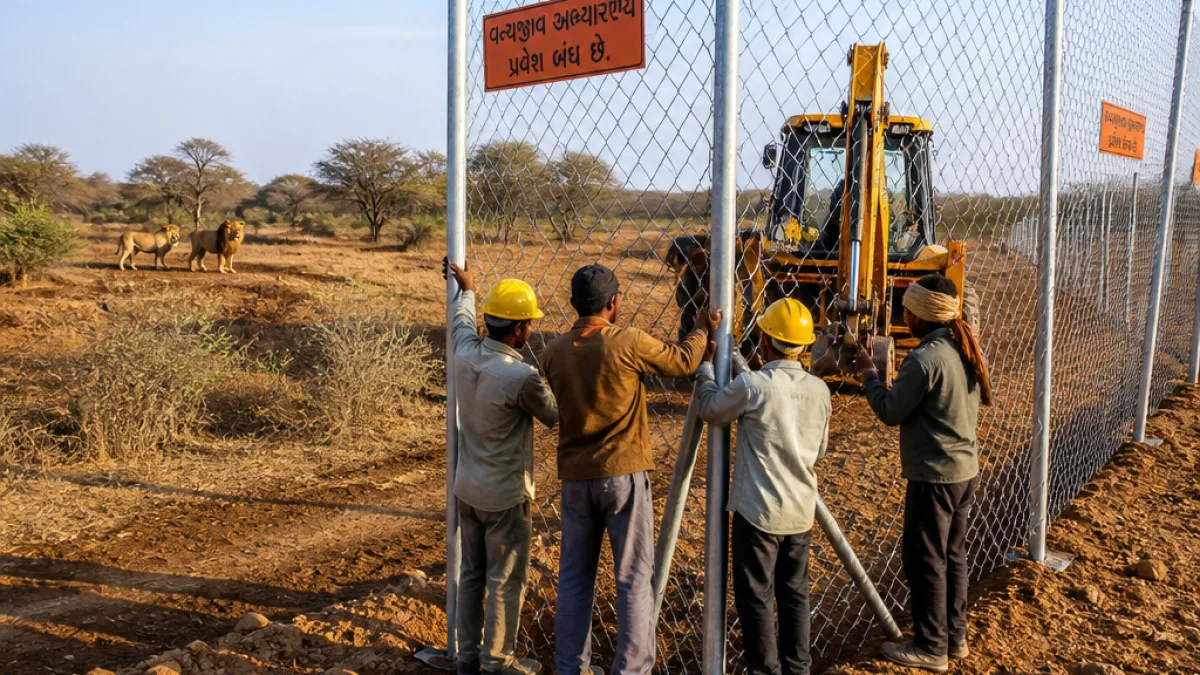
Gandhinagar/Dhari: The Gujarat forest department has initiated work to create a specially fenced enclosure of 100 hectares at Ambardi Safari Park to house lions identified in attacks on humans, officials said on Monday. The move comes amid mounting concerns over increasing lion-human conflict across Saurashtra.
Designated fenced area at Ambardi
Ambardi Safari Park, which lies within the Gir Protected Area in Dhari taluka of Amreli district, will see a portion of its area cordoned off to keep animals implicated in incidents involving people. Work has already been started, the state’s Principal Chief Conservator of Forests and Head of Forest Force, Dr Jaipal Singh, IFS, said, adding that necessary instructions have been issued for the project.
"Lions involved in human attacks will be kept in a suitable environment by fencing a designated area at Ambardi Safari Park. Necessary instructions have been issued for this work, and the required work has been initiated," Dr Jaipal Singh said.
Ambardi Safari Park, developed for wildlife tourism and conservation, covers about 365 hectares and hosts Asiatic lions, leopards, chital, nilgai, chinkara, peafowl and numerous bird species. The park was established in 2017 with the objective of promoting wildlife conservation while supporting eco-tourism in the region.
Policy rationale and local impact
Forest department officials say the enclosure is intended to reduce further human casualties and property losses while providing a suitable environment for the animals. The initiative is part of a broader set of measures the department periodically undertakes — including relocation and translocation — to manage human-wildlife conflict and maintain ecological balance.
Officials cited a recent rise in deadly encounters across Junagadh, Amreli and Bhavnagar districts as prompting the latest decision. Conservationists and local communities have increasingly voiced alarm over attacks that have led to loss of life and damaged livelihoods in villages along the fringes of lion habitat.
Operational and management considerations
Key operational questions remain about how lions will be identified for relocation to the enclosure, the criteria for confinement, veterinary care, and long-term management. The department has said the animals will be kept "in a suitable environment" but has not publicly issued detailed protocols on rehabilitation, monitoring, or release.
- Enclosure size: 100 hectares within the existing 365-hectare Ambardi Safari Park.
- Location: Ambardi Safari Park, Gir Protected Area, Dhari, Amreli district.
- Species present: Asiatic lions, leopards, chital, nilgai, chinkara, peacocks and various birds.
Establishing a fenced zone inside a protected area carries implications for park visitors, tourism operations and habitat connectivity. Restricting the movement of large carnivores may alter local prey dynamics and could affect the behaviour of neighbouring prides. The department will need to balance public safety with conservation best practice and national wildlife laws.
Financial and logistic aspects
The department has not disclosed an estimated cost or a timeline for completion of the enclosure. Fencing over a 100-hectare area, establishing veterinary facilities, shifting operations and monitoring systems will require coordination between divisional forest officers, veterinary experts and on-ground staff in Amreli and adjoining ranges.
| Parameter | Detail |
|---|---|
| Park total area | 365 hectares |
| Proposed fenced enclosure | 100 hectares |
| Established | 2017 |
Local elected representatives and tourism stakeholders will be watching the project closely. Ambardi has become an important wildlife tourism destination in Saurashtra, providing income to nearby villages through guided safaris and ancillary services. Restricting a portion of the park may require recalibrating tourism operations and visitor management plans.
Context: rising conflict in Saurashtra
Human-lion conflict has been an ongoing challenge in Gujarat, where the conservation recovery of the Asiatic lion has increased their numbers and range beyond protected core areas. While population growth and wider distribution are conservation successes, they have also led to more frequent encounters with people in fringe settlements and agricultural areas. The recent spike in fatal incidents across multiple districts has intensified calls for decisive action to prevent further loss of life.
The enclosure at Ambardi forms part of the state forest department’s response to those calls. How effectively the measure reduces attacks, and whether it will be paired with community-level measures such as compensation schemes, livestock protection, early-warning systems and outreach, will determine its long-term utility.
Forest authorities have begun ground work at Ambardi and say they will implement the plan while keeping animal welfare and public safety in view.