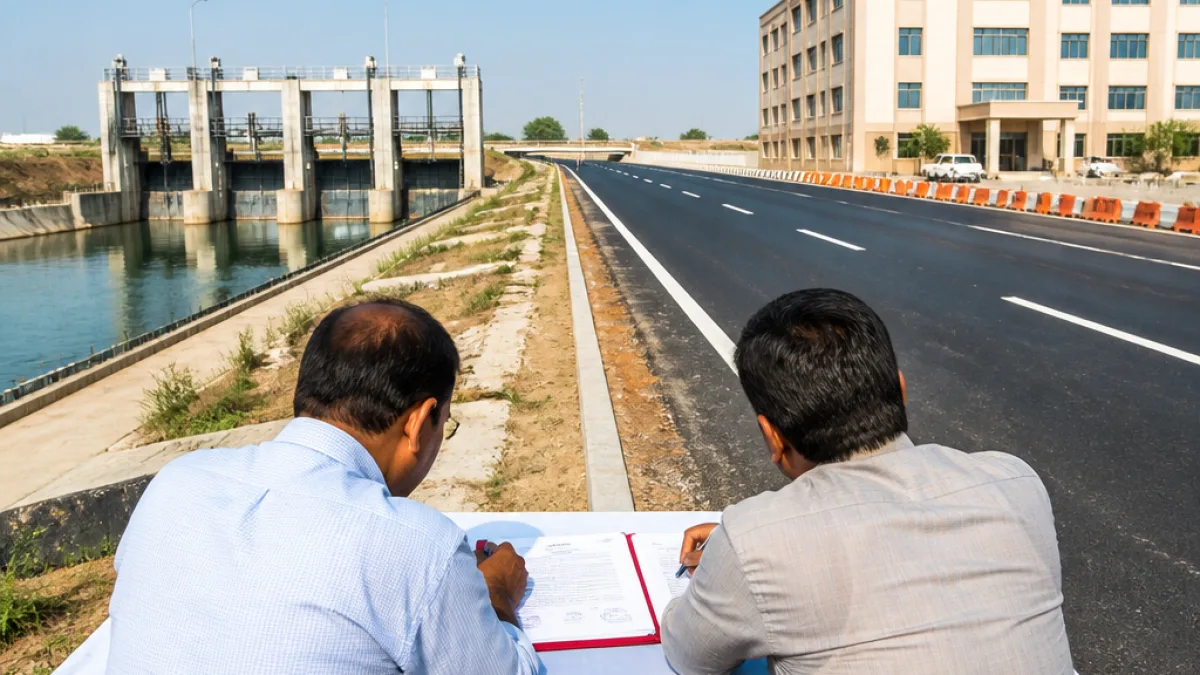
NEW DELHI: The National Highways Authority of India (NHAI) and Sardar Sarovar Narmada Nigam Ltd (SSNNL) on Tuesday signed a memorandum of understanding to create a simplified, time‑bound framework for granting approvals for National Highway projects across Gujarat, an official statement said.
Aim to streamline inter‑departmental clearances
The statement said the MoU is intended to strengthen inter‑departmental coordination, facilitate faster approvals and ensure seamless execution of National Highway and irrigation infrastructure projects. The two agencies described the arrangement as a measure to promote integrated infrastructure planning in Gujarat.
By formalising coordination between the federal agency responsible for highways and the state‑level irrigation body that manages the Sardar Sarovar Project, the partners expect to accelerate implementation timelines and reduce the overall financial implication associated with project execution, the statement added.
Officials framed the MoU as a milestone in collaborative delivery of large civil works in the state, where highway expansion and irrigation modernization programmes often intersect with land, water‑management and construction activity.
What the agreement covers
- Establish a simplified, time‑bound approval framework for National Highway projects in Gujarat.
- Enhance coordination between NHAI and SSNNL for integrated planning of highway and irrigation works.
- Improve efficiency of project implementation and reduce financial costs associated with delays.
The MoU is expected to address routine friction points that arise when linear road projects cross irrigation infrastructure or protected project land managed by SSNNL, although the statement did not provide a project‑level list or timelines.
Implications for project delivery and costs
Delays in statutory approvals and inter‑agency clearances are a common cause of cost escalation in civil infrastructure. The two agencies said the collaborative framework will help mitigate such delays by setting agreed processes and timeframes for decisions, which could constrain claims and prolonged litigations that inflate project budgets.
| Expected outcome | Benefit |
|---|---|
| Faster approvals | Shorter implementation timelines |
| Improved coordination | Fewer operational conflicts between highway and irrigation works |
| Reduced financial implication | Lower cost overruns from delays |
Neither agency disclosed detailed procedural provisions of the MoU in the statement. The announcement was released from New Delhi and attributed to an official statement issued on Tuesday.
Infrastructure stakeholders in Gujarat have for years called for clearer inter‑agency mechanisms that can reconcile competing land and water uses with fast‑moving road programmes. If implemented effectively, the MoU could set an administrative template for other states where large irrigation projects and highways overlap.
Beyond procedural gains, the accord could influence timelines for upcoming National Highway stretches in Gujarat, many of which are critical for freight movement linking ports, industrial clusters and agricultural hinterlands. Faster approvals can reduce the holding cost for contractors and improve the investment climate for complementary private spending along corridor projects.
For now, the MoU signals an intent to institutionalise co‑operation between a central implementing agency and a state irrigation corporation; the practical impact will be measured by subsequent project clearances, adherence to the timeframes and the volume of work unlocked under the arrangement.