BEML awarded rolling-stock contract for Ahmedabad–Mumbai high-speed corridor
Bengaluru-based BEML Limited has secured a contract worth more than ₹5,400 crore from the National High Speed Rail Corporation Limited (NHSRCL) to supply and maintain high-speed trains for the 508-km Ahmedabad–Mumbai High-Speed Rail Corridor, according to the company and project reports. The deal makes BEML the lead domestic manufacturer for what is being billed as India’s first indigenous bullet-train production programme.
The trains will be manufactured at BEML’s High-Speed Rail Complex in Bengaluru. Under the contract, the company will not only deliver the rolling stock but will also be responsible for ongoing maintenance for the corridor, which traverses Gujarat and Maharashtra and includes key facilities in the Ahmedabad region.
Union Railway Minister Ashwini Vaishnaw said the first coach had been completed and was undergoing testing, and that trial runs were expected to begin in May–June.
Project details released with the announcement indicate the indigenous trainset is designed for a maximum testing speed of 280 kmph, while regular operational speeds are expected to exceed 250 kmph. The higher testing envelope allows authorities to qualify safety and signalling systems required for sustained operations at premium speeds.
Local infrastructure and operations nodes
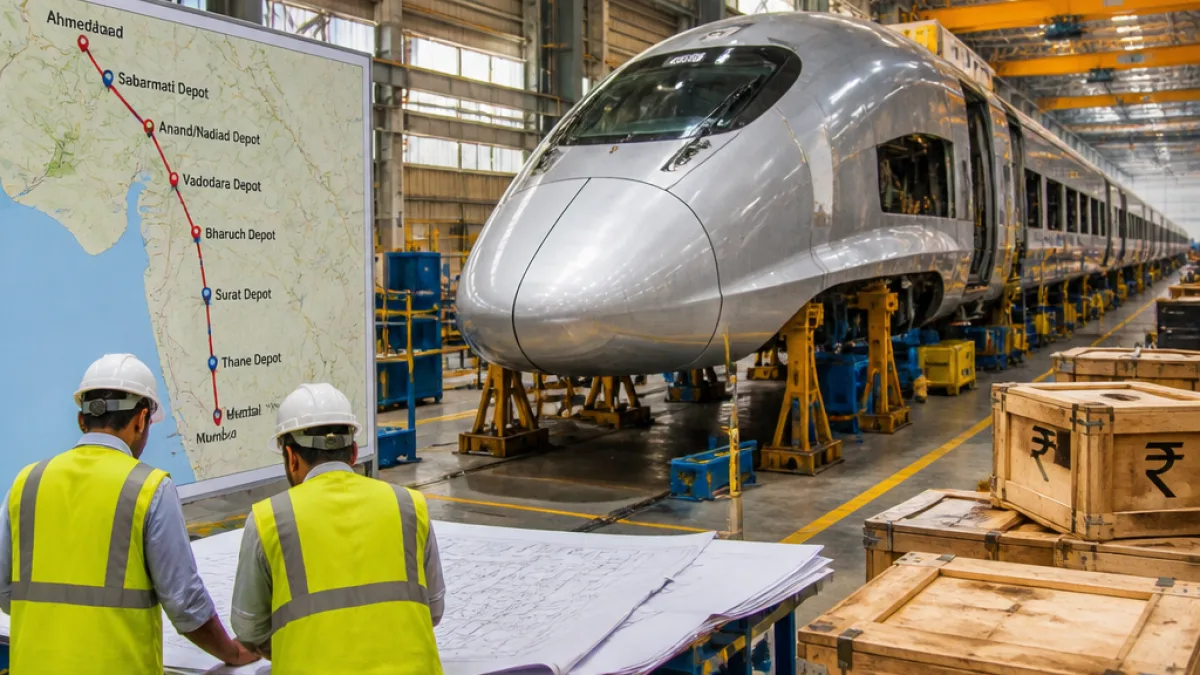
For Ahmedabad, the project includes modern rolling-stock depots at Sabarmati in the city and at Surat in Gujarat, along with a depot at Thane in Maharashtra, which will serve train operations and maintenance needs. NHSRCL and project communications have identified the Surat–Vapi stretch as the first possible operational section in Gujarat.
- Contract value: ₹5,400 crore-plus
- Corridor length: 508 km
- Design testing speed: 280 kmph
- Expected regular speed: >250 kmph
- Depots: Sabarmati (Ahmedabad), Surat, Thane
NHSRCL sources indicate the Surat–Vapi section could begin passenger operations by August 2027, making it the first functional segment of the corridor. The timeline highlights phased commissioning intended to deliver early benefits to commuters and bolster regional connectivity within Gujarat.
Industrial and regional implications
The decision to award the contract to a public sector engineering company and to manufacture the trains domestically aims to expand India’s capabilities in high-speed rail technology and rolling-stock manufacturing. For Ahmedabad and Gujarat’s broader industrial ecosystem, the project carries multiple implications:
- Supply-chain opportunities for component manufacturers in and around Ahmedabad as rolling-stock production ramps up.
- Employment prospects in operations and maintenance at the Sabarmati depot once construction and commissioning progress.
- Potential increase in land- and service-related demand near stations and depots as sections become operational.
The Sabarmati depot, specifically, will be a local hub for routine maintenance and operations oversight, creating a focal point for skilled jobs and ancillary services. NHSRCL’s model of domestic manufacture plus in-country maintenance responsibility is designed to retain technical work and after-sales support inside India rather than outsource it overseas.
| Item | Detail |
|---|---|
| Contracting agency | NHSRCL |
| Manufacturer | BEML Limited (High-Speed Rail Complex, Bengaluru) |
| Contract value | ₹5,400 crore-plus |
| Corridor length | 508 km |
| Testing / operational speeds | Testing: 280 kmph; Regular: >250 kmph |
Officials have emphasised that advanced safety, control and signalling systems will be integral to the rolling stock to meet high-speed operational norms. The project’s phased approach — starting with sections such as Surat–Vapi — is intended to allow trials and limited operations to commence while work continues on remaining segments.
For Ahmedabad residents, the project is likely to bring faster inter-city connectivity to Mumbai, but it also raises questions that will require follow-up reporting: precise employment figures tied to the Sabarmati depot, timelines for additional depot construction, and the sourcing strategy for critical components. NHSRCL and BEML statements so far underline domestic manufacturing and maintenance as core elements of the contract.
As work advances on the corridor, municipal planning around stations and depots in the Ahmedabad area may need to align with increased commuter flow and logistics activity. The project remains a major infrastructure priority for both state and central agencies, with economic and mobility outcomes to be observed over the coming years.