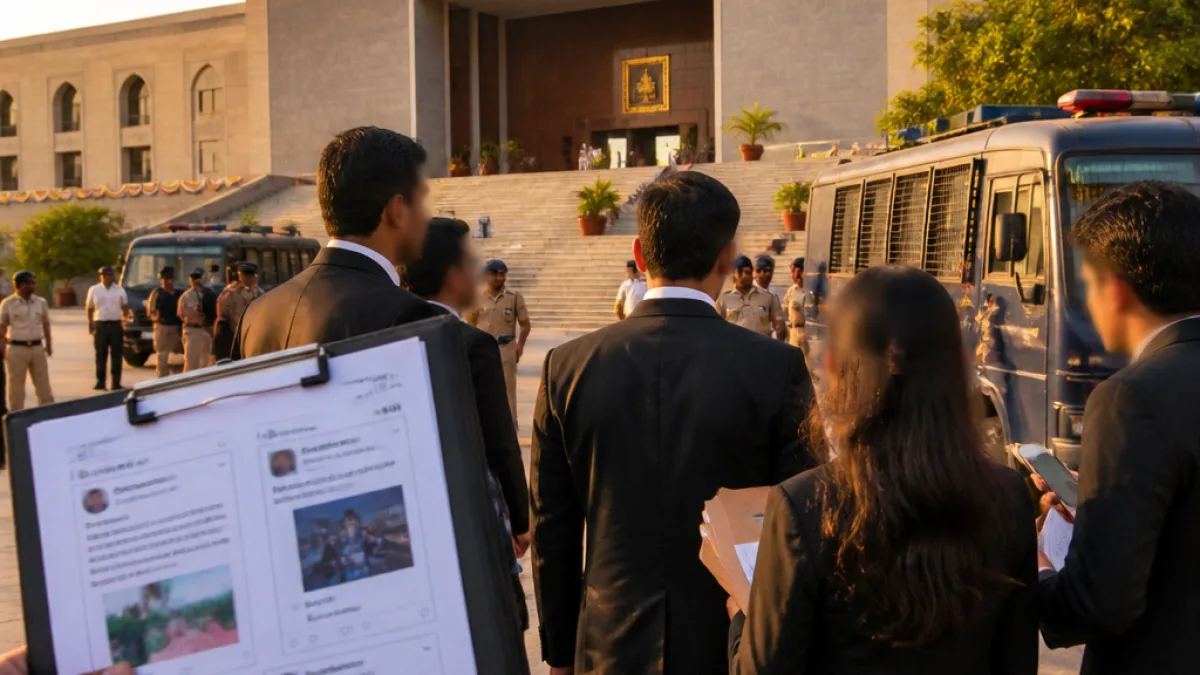
Gandhinagar: The Gujarat High Court on Wednesday refused to grant interim relief to journalist Ravi Nair, who is in judicial custody in a criminal defamation case lodged by Adani Enterprises Limited over a series of posts on X between October 2020 and July 2021.
Background and jail custody
Nair was taken into custody on September 17 and sent to jail after a Gandhinagar magistrate’s court issued a non-bailable warrant earlier this month for his failure to appear in person at a hearing in the appeal against his conviction. The underlying defamation case stems from posts relating to the allegations first raised by the United States-based short seller Hindenburg Research and reporting on a strike against the proposed privatisation of the Jawaharlal Nehru Port Trust.
On February 10, a magistrate court in Gandhinagar had convicted Nair and sentenced him to one year in prison. The magistrate observed that, as a journalist and public commentator, Nair should have been conscious of the reach and consequences of categorical statements on digital platforms that could affect reputations.
Appeal, bail and attendance directions
Nair challenged the conviction before the sessions court in Gandhinagar. That court granted him bail on March 9 and directed him to remain present during hearings of his appeal. The journalist did not attend a hearing on September 3, prompting the sessions court to issue a non-bailable warrant, which was subsequently executed when he was taken into custody on September 17.
When Nair opted to challenge the execution of the warrant before the High Court, the bench observed that a challenge to the non-bailable warrant could not be entertained after the warrant had already been executed. The court also criticised the lawyer for not disclosing that Nair had separately approached the sessions court seeking regular bail, a point reported by the legal news portal Bar & Bench.
Contention on attendance record
Defence counsel for Nair told the High Court that the journalist had attended three of eight hearings in his appeal and had been granted an exemption on another date. The lawyer contended the sessions court’s assertion that Nair had been absent for six months was factually incorrect and objected to the characterization of the journalist as “absconding”.
“The sessions court’s finding that Nair had not appeared for six months was factually incorrect,” the defence argued, according to reporting by Bar & Bench.
Counsel for Adani Enterprises argued the contrary, stressing Nair’s conduct before the appellate court and supporting the issuance and execution of the non-bailable warrant.
Legal and public-interest implications
The case sits at the intersection of criminal defamation law, digital-age commentary and corporate reputational rights. Criminal defamation trials arising from social media posts have raised recurring debate nationally over freedom of expression, the reach of digital statements and the remedies available to individuals and corporations claiming reputational harm.
Key procedural elements in this matter include:
- The original conviction and one-year sentence by a Gandhinagar magistrate on February 10.
- Grant of bail by the sessions court on March 9 with directions to attend appeal hearings.
- Issuance and execution of a non-bailable warrant after absence at a hearing on September 3, and custody from September 17.
- High Court refusal to grant interim relief on the ground the warrant had already been executed and for the defence’s failure to disclose a parallel bail plea before the sessions court.
Timeline
| Date | Event |
|---|---|
| Oct 2020–Jul 2021 | Series of posts by Ravi Nair on X under dispute |
| Feb 10 | Magistrate convicts Nair; sentences him to one year |
| Mar 9 | Sessions court grants bail; directs presence at appeal hearings |
| Sep 3 | Nair absent at hearing; warrant later issued |
| Sep 17 | Warrant executed; Nair taken into custody |
| Sep 23 | Gujarat High Court refuses interim relief |
Next steps in litigation
With the High Court declining interim relief, the appeal process in the sessions court remains the principal legal avenue. The sessions court’s earlier direction that Nair be present during hearings continues to be a focal procedural requirement. Further developments will depend on future hearings in the appellate forum and any further applications filed before the High Court.
The case will be watched closely by journalists, legal practitioners and corporate stakeholders for its potential implications on how criminal defamation law is applied to digital commentary and reporting connected to corporate affairs.
(Reporting from Gandhinagar; court developments reported via public court records and Bar & Bench.)