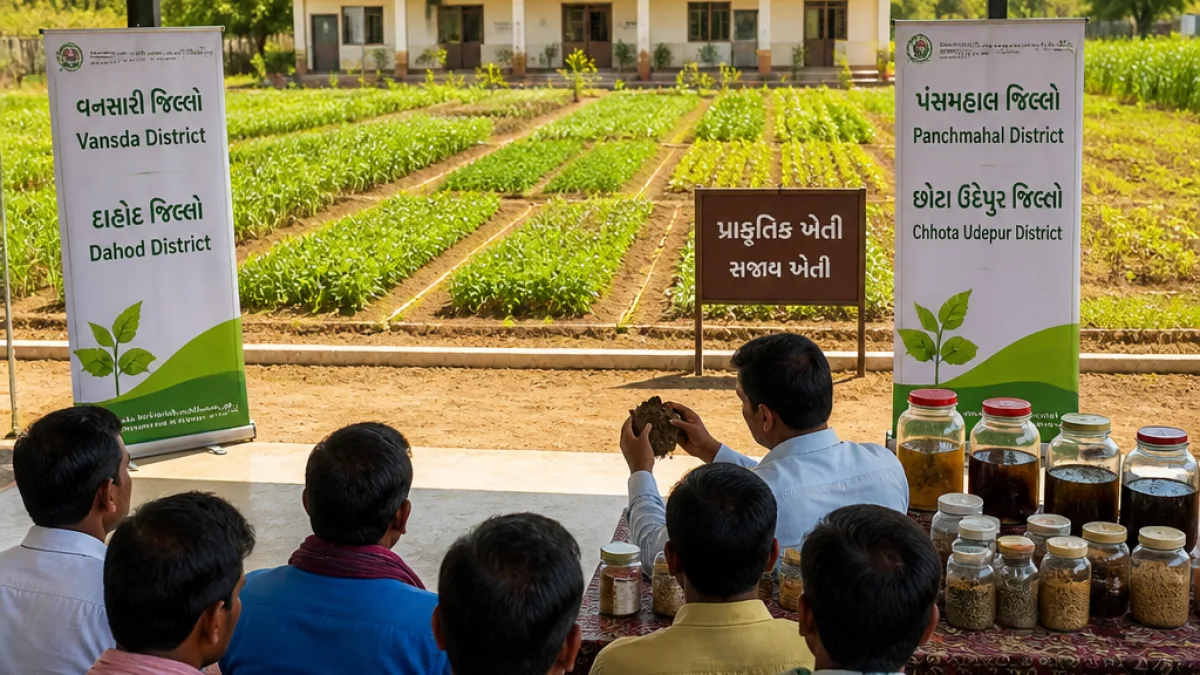
The Gujarat government has approved the creation of four Centres of Excellence for natural farming in Navsari, Morbi, Bhavnagar and Chhota Udepur districts, allocating ₹20 crore in the 2026-27 budget to establish model campuses that will train farmers, produce bio-inputs and provide technical support, the Chief Minister's Office said on Tuesday.
Objective and coverage
According to the CMO release, the centres are aimed at strengthening the state’s campaign to expand natural farming by providing hands-on training, demonstrations and affordable inputs. Each centre will be developed with modern facilities capable of training 100 farmers at a time, and will serve both practitioners of natural farming and those looking to adopt the practice.
First-phase locations and implementing agency
The government has identified specific sites for the first phase of the programme:
- Navsari: Nani Bhamti village, Vansda taluka
- Morbi: Halvad
- Bhavnagar: Valavad village, Sihor taluka
- Chhota Udepur: Chudel village, Jetpur Pavi taluka
The Gujarat Prakrutik Krishi Vikas Board has been entrusted with implementation and ongoing management of the scheme, the release said.
Facilities, inputs and services
The centres will function not only as training hubs but as model campuses that supply and demonstrate natural farming inputs and techniques. Services to be provided include:
- Training in preparation and use of bio-inputs such as Jeevamrut, Ghan Jeevamrut, Beejamrut and Neemastra
- Production and sale of bio-inputs at nominal prices to local farmers
- Availability of mulching materials, seeds, horticultural saplings, cuttings and grafts
- Soil testing and quality testing of agricultural produce
- Practical demonstrations and guidance on new technologies and primary agri-practices
Practical training and outreach
The centres are planned to provide hands-on demonstrations and guidance in on-farm practices tailored to local cropping systems. Farmers already practising natural farming and new adopters will have access to extension services, according to the CMO. The stated objective is to create easily accessible local hubs that reduce dependency on external chemical inputs and support transition to low-cost, ecological practices.
Budgetary and policy context
The allocation of ₹20 crore for 2026-27 signals a targeted investment in state-led support systems for natural farming. The move follows broader efforts by the state to scale up sustainable agriculture models through demonstration projects and decentralised input production. The document released by the CMO indicates a combination of training, input manufacture and testing facilities will be central to the centres’ operations.
Potential local impacts
For farmers in the designated districts, the centres could lower the cost of transitioning to natural farming by making bio-inputs available locally and offering practical training. The production and sale of planting material and inputs at the centres could also create small-scale local supply chains. By providing soil testing and quality checks, the government aims to strengthen market readiness for produce grown through natural methods.
Implementation challenges and considerations
Establishing model campuses with operational capacity to train 100 farmers at a time will require timely capital outlays, hiring of extension staff and sustained input production. The Gujarat Prakrutik Krishi Vikas Board’s experience in natural-farming promotion will be central to converting infrastructure investment into measurable increases in adoption. Monitoring, local farmer engagement and supply-chain management for inputs will determine the scheme’s effectiveness on the ground.
| District | Site | Primary focus |
|---|---|---|
| Navsari | Nani Bhamti, Vansda taluka | Training, bio-input production, demonstrations |
| Morbi | Halvad | Model campus, extension services |
| Bhavnagar | Valavad, Sihor taluka | Input distribution, sapling production |
| Chhota Udepur | Chudel, Jetpur Pavi taluka | Soil testing, farmer training |
The CMO release notes that the initiative will be undertaken under the guidance of Governor Acharya Devvratji as part of ongoing efforts to promote natural farming in the state.
Further details on timelines for centre commissioning, staffing and the pricing structure for produced inputs are yet to be released by the implementing agency.