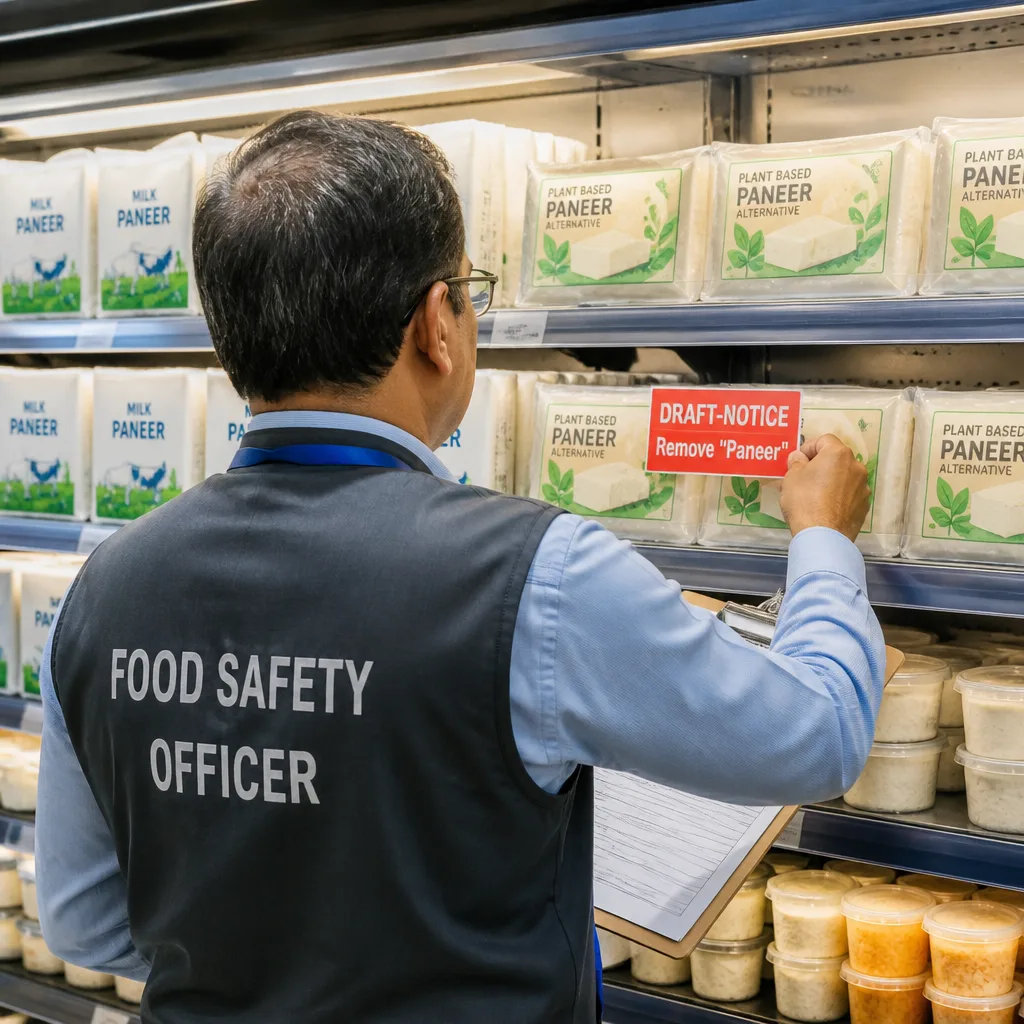
New Delhi: The Food Safety and Standards Authority of India (FSSAI) has proposed draft regulations to prohibit the manufacture and sale of products not derived from milk from being marketed as "paneer" across the country, the regulator said on Thursday.
Regulatory move aims at clearer labelling
The draft Food Safety and Standards (Prohibition and Restrictions on Sales) Amendment Regulations, 2026, circulated by FSSAI, would make it impermissible to describe or present non-dairy analogue products using the name "paneer". Under the proposal, items registered or licensed under an "Analogue in Dairy Context" category would have to stop using the word "paneer" in their nomenclature, labelling and marketing, the regulator said.
The proposal follows intensified scrutiny of dairy substitutes and several state-level enforcement actions. Authorities in Maharashtra and Gujarat recently carried out checks after concerns were raised that some products sold as paneer may not be milk-based.
Health and consumer information concerns
FSSAI noted that analogue paneer is formulated to imitate the taste, texture and appearance of conventional paneer but may contain vegetable oils, starches, emulsifiers and other non-dairy constituents instead of milk fats and milk proteins. Such products are often less expensive to produce and may be attractive for bulk food preparation.
Regulators emphasised that the central concern is consumer deception and the right of buyers to make informed decisions on the basis of ingredients, nutritional value, dietary needs and price. Conventional paneer provides milk-derived protein, fat and other nutrients; an analogue product may therefore have a differing nutritional profile depending on its formulation.
- Proposed ban: No sale or marketing of products not derived from milk under the name "paneer".
- Transitional rule: Existing analogue dairy products would be required to remove "paneer" from labelling and marketing.
- Reasoning: Prevent consumer deception and ensure accurate labelling of food composition.
Regulatory context and implications
The draft amendment seeks to create a uniform national approach after varied state actions. If finalised, the rule would standardise how paneer is defined at a pan-India level and restrict names that imply a product is milk-derived when it is not. The move sits within a broader effort to tighten labelling and curb food adulteration in the dairy sector.
FSSAI also stressed that the term "analogue" does not by itself mean a product is unsafe or toxic; health implications depend on the specific ingredients and formulation. The regulator's primary focus is ensuring transparency so consumers understand whether a product contains milk-based nutrients or has been formulated from alternative ingredients.
| Feature | Conventional paneer | Analogue paneer (as described by FSSAI) |
|---|---|---|
| Primary source | Milk-derived proteins and fats | Vegetable oils, starches, emulsifiers and other non-dairy constituents |
| Nutritional profile | Milk protein, milk fats and associated nutrients | Varies by formulation; may contain less milk protein and more vegetable fat or starch |
| Typical commercial advantage | Traditional product | Generally lower production cost |
Next steps and consumer guidance
The draft regulation will be subject to consultation and finalisation by FSSAI. Should it be notified as a final rule, businesses marketing dairy substitutes would be required to amend labels and product names accordingly.
Health authorities and consumer groups may examine nutritional claims and ingredient lists to verify compliance. Meanwhile, consumers are advised to check ingredient declarations and nutrition information on packaged foods. For specific dietary or health concerns, readers should consult a qualified medical practitioner or a registered dietitian.
The move forms part of ongoing regulatory attention on food labelling and adulteration, aiming to balance product innovation with transparent information so that consumers can make choices aligned with dietary needs and preferences.