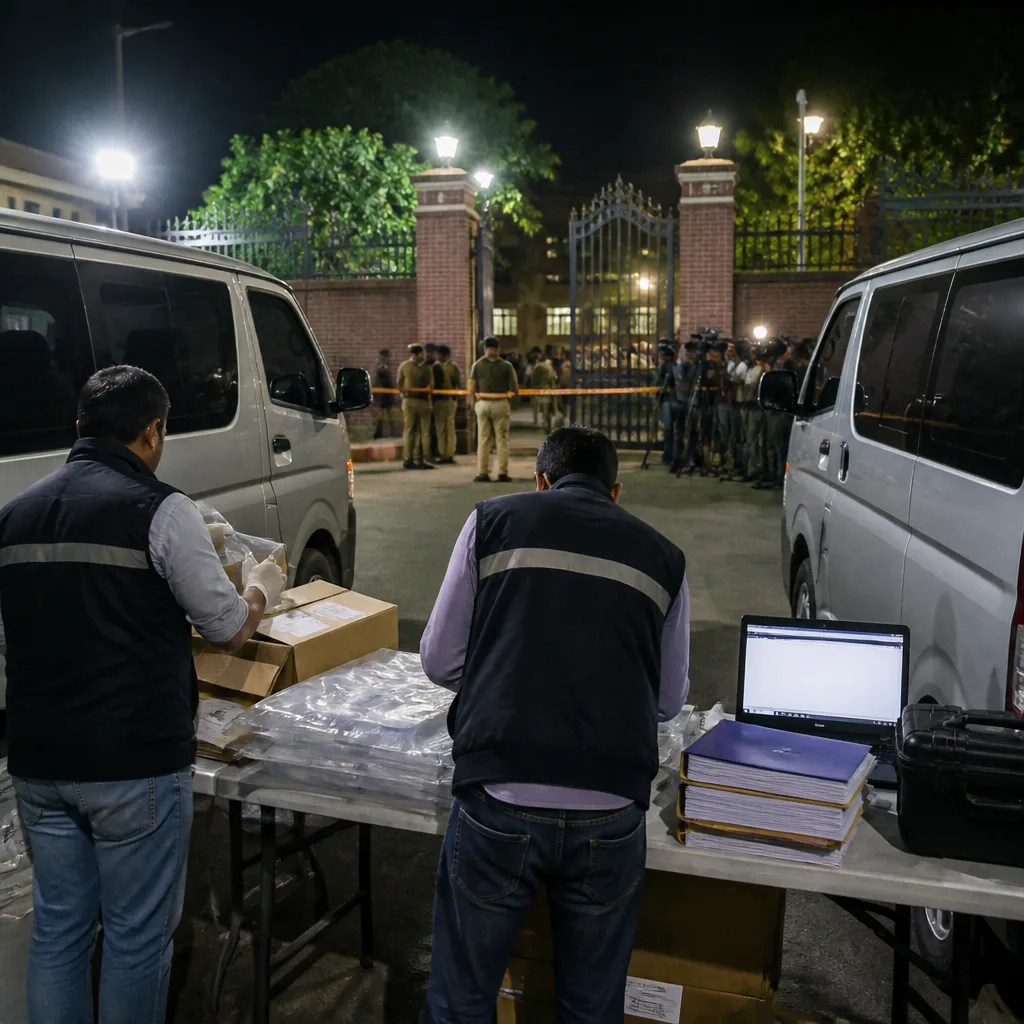
The Enforcement Directorate (ED) on Wednesday carried out searches at 10 locations across Rampur, Saharanpur and Delhi in a probe connected to jailed Samajwadi Party (SP) leader Azam Khan, officials said. The agency said the action was conducted under provisions of the Prevention of Money Laundering Act (PMLA) to trace alleged proceeds of crime and collect digital evidence, documents and financial records.
Scope of searches
Authorities reported that premises linked to the Mohammad Ali Jauhar University and its trust were among the sites examined. ED officials characterised the operation as aimed at following paper and electronic trails to establish alleged diversion and use of government funds, rather than a political exercise.
| Aspect | Detail |
|---|---|
| Number of locations searched | 10 |
| Districts/territories covered | Rampur, Saharanpur and Delhi |
| Primary entity mentioned | Mohammad Ali Jauhar University and its trust |
| Statute invoked | PMLA |
Political reaction
The Samajwadi Party described the raids as part of what it called a campaign of "vindictive politics" by the ruling Bharatiya Janata Party. SP spokesperson Ashutosh Verma alleged that investigative agencies were being used to target leaders associated with previous governments and said the BJP had "nothing of its own to offer".
"The BJP had ‘nothing of its own to offer’ and was therefore pursuing political vendetta against people associated with earlier governments," the party spokesperson said, according to reporting.
Mr Verma also criticised the Uttar Pradesh government’s handling of schemes launched during Akhilesh Yadav's tenure as Chief Minister, alleging that existing SP projects were being renamed and that the government was singling out Azam Khan in Rampur.
SP chief Akhilesh Yadav attacked the BJP over what he described as selective targeting, saying those who build educational institutions were being targeted while alleged corruption elsewhere was ignored. He invoked a range of controversies — including donation collections for the Ram Temple, the codeine seizure case, the Maha Kumbh, Smart City projects, alleged corruption involving police personnel and illegal construction by BJP representatives — to question the government's priorities, as reported.
ED's stated rationale
The Enforcement Directorate, as per officials, said the searches were focused on tracing proceeds of crime and on gathering documents and digital material that may be relevant to allegations of diversion or misuse of government funds. The agency executed the searches under the PMLA, which permits search and seizure in money-laundering inquiries.
The ED did not, in the available reporting, disclose any arrests or details of seized documents and devices. The timing of such operations and any subsequent enforcement steps—including attachment of assets or prosecution—would be governed by the agency’s continuing investigation and legal procedure under the PMLA.
Context and potential consequences
The searches are likely to intensify political debate in Uttar Pradesh, where the SP remains a major opposition force. The party has frequently alleged that central investigative agencies are used for political ends; the ruling side has countered that agencies act independently within the law. How evidence gathered in the searches is assessed by investigators and, if applicable, by courts, will determine whether the matter advances to prosecution under the PMLA.
- Immediate outcome: Searches conducted at 10 locations; officials say evidence-gathering is underway.
- Political fallout: SP called the action vindictive; BJP and ED maintain the probe is legal and procedural.
- Legal path: Any further action depends on the ED’s findings and follow-up under PMLA procedures.
At present, reporting notes the ED’s stated investigative purpose and the SP’s allegation of political vendetta. Independent verification of allegations from either side was not available in the material reviewed.