
Municipal chief stresses implementation, inter-department coordination
Dehradun: Dehradun Municipal Commissioner Alok Kumar Pandey on Tuesday directed a time-bound and coordinated push to implement measures under the National Clean Air Programme (NCAP), reviewing major pollution sources and insisting on regular monitoring and public awareness to improve the city's air quality.
Chairing a meeting of the district-level implementation committee, Pandey examined ongoing efforts to control emissions from key sources and told officials that planning alone would not suffice without strict execution and oversight, according to the municipal note circulating after the meeting.
The meeting reviewed specific pollution drivers and the range of steps being taken. Officials from the Uttarakhand Pollution Control Board (UPPCB), the Regional Transport Office (RTO) and the Municipal Corporation of Dehradun (MCD) attended.
Priority actions highlighted
Pandey asked departments to intensify monitoring and enforcement at sites that contribute to particulate pollution. He underlined the need to check:
- road dust generation and accumulation;
- pollution from construction and demolition (C&D) sites;
- open burning of solid waste and other polluting activities.
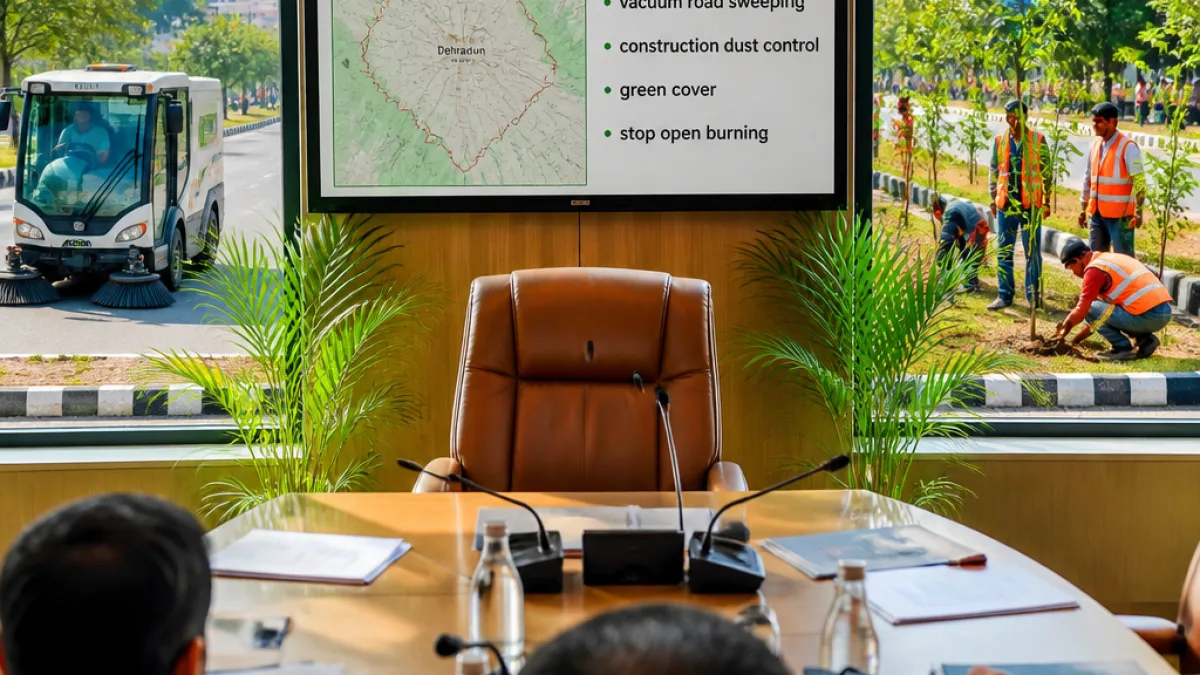
The municipal commissioner also outlined operational and awareness measures already underway to reduce airborne pollution. These include vacuum-based road sweeping, targeted dust-control measures at roads and construction sites, expansion of green areas through plantation drives, and information, education and communication (IEC) campaigns to promote segregation of wet and dry waste at source.
Enforcement, monitoring and citizen role
Officials were instructed to take necessary action against violations detected during inspections, the municipal statement said. Pandey emphasised interdepartmental coordination and regular reporting of progress so the committee can track outcomes against NCAP targets.
The municipal commissioner appealed to residents to play a direct role in improving ambient air quality by refraining from open burning of waste, segregating waste at source and preventing construction material from spilling on to public roads. He said such community actions would complement government measures to reduce particulate pollution.
What the plan covers
Measures discussed at the meeting are aligned with typical NCAP interventions and, as stated by the municipal office, focus on reducing particulate matter through both engineering and behavioural steps. The main components flagged for implementation in Dehradun are:
| Intervention | Purpose |
|---|---|
| Vacuum road sweeping | Remove settled dust and lower re-suspension of particles |
| Dust control at C&D sites | Reduce emissions from construction activities |
| Plantation drives | Increase green cover to help trap particulates |
| IEC and waste segregation | Reduce open burning and promote source segregation |
Officials were also asked to step up spot checks and coordinate with the RTO on vehicle-related emissions and with UPPCB on industrial and other point-source pollution, the statement added.
Context and next steps
Dehradun, like many urban centres in the plains and foothills, faces seasonal and year-round air-quality challenges from dust, vehicular emissions, construction activity and waste burning. The municipal meeting signals an administrative focus on translating NCAP priorities into local action through monitoring, enforcement and public engagement.
The district-level committee will continue to oversee the implementation; the municipal note said officials should ensure measures are effective and time-bound and that information campaigns are strengthened to familiarise citizens with causes of pollution and their role in mitigation. Progress updates and enforcement actions reported by the UPPCB, RTO and MCD will determine how swiftly the city moves towards NCAP targets.












