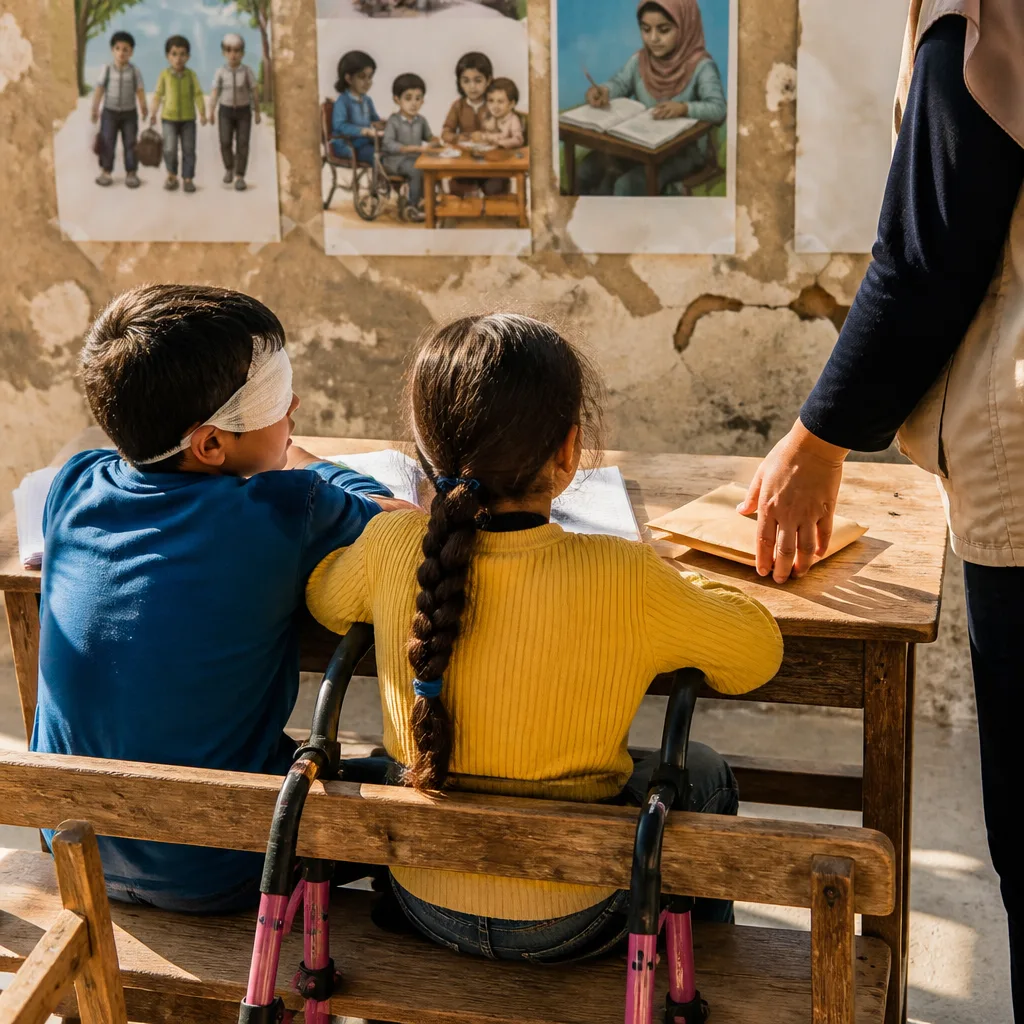
When violence, displacement and damaged services converge, children with disabilities are among the most likely to be left behind in education. Two cases from conflict-affected areas documented by humanitarian agencies show how focused support — medical care, assistive devices and cash assistance — can return children to classrooms and restore hope for families.
From exclusion to classroom
In one example, a 12-year-old girl named Binta endured seven years of worsening eye pain that kept her out of school and away from friends. Community volunteers working with Save the Children International identified her and referred her to a Children’s emergency fund. Backed by EU humanitarian aid, that fund covered the medical expenses that allowed Binta to undergo eye surgery at the Yobe State University Teaching Hospital. To prevent the cost of recovery from pushing her family further into hardship, they were also provided with multipurpose cash assistance. The combined support enabled her to return to the classroom with renewed confidence.
"Before, I did not go to school and I was often unhappy," Binta recalled, describing the years she spent away from her peers.
Another child, a five-year-old named Mu’azu, illustrates the broader realities facing young children with disabilities in crises: limited access to specialised health care, scarce assistive devices and weakened infrastructure that make simple tasks — like walking to a neighbour’s house or seeing a chalkboard — daunting obstacles. Humanitarian actors say that timely identification and targeted assistance can do more than relieve physical suffering; it can preserve a child’s dignity and open the door to education.
What worked: a mix of services
The cases underline several interventions that, when combined, improved access to education for children with disabilities:
- Community outreach and case identification — volunteers connected vulnerable children with services.
- Medical and rehabilitation services — surgery and clinical care addressed impairments preventing school attendance.
- Cash assistance — multipurpose household support reduced the economic burden of treatment and recovery.
- Assistive devices and specialist referrals — although often scarce in humanitarian settings, these restore function and independence.
These elements echo longstanding guidance from disability-inclusive humanitarian practice: support must be holistic and centred on both the child and their family to prevent exclusion from education.
| Intervention | Immediate outcome |
|---|---|
| Medical treatment paid by emergency fund | Restored ability to attend school (Binta) |
| Multipurpose cash assistance | Reduced financial strain during recovery |
| Community volunteer outreach | Identification and referral of vulnerable cases |
These stories also expose persistent gaps. In many conflict-affected contexts, families cannot access specialised care or assistive technologies because health systems are disrupted, supply chains are broken and funding is limited. That means identification by local volunteers and flexible funding mechanisms are often the decisive factors in whether a child with a disability can learn.
For educators and policy-makers, the lessons are practical. Disability-inclusive responses in emergencies need:
- mechanisms to find and refer children with specialised needs;
- funds that cover both care and the household impacts of accessing that care;
- partnerships between humanitarian health services and education providers to ensure a return to school is supported and sustained.
Those interventions are not only about restoring function; they are about protecting children’s right to education. For families and communities on the frontlines of crises, the difference between receiving or missing such support can determine whether a child’s education — and future — is preserved.
These individual cases, supported by EU humanitarian aid and implemented through local and international actors, serve as a reminder that modest, targeted investments can have outsized effects on inclusion. The challenge remains to scale such approaches so that more children with disabilities in emergencies can reclaim their classrooms and childhoods.