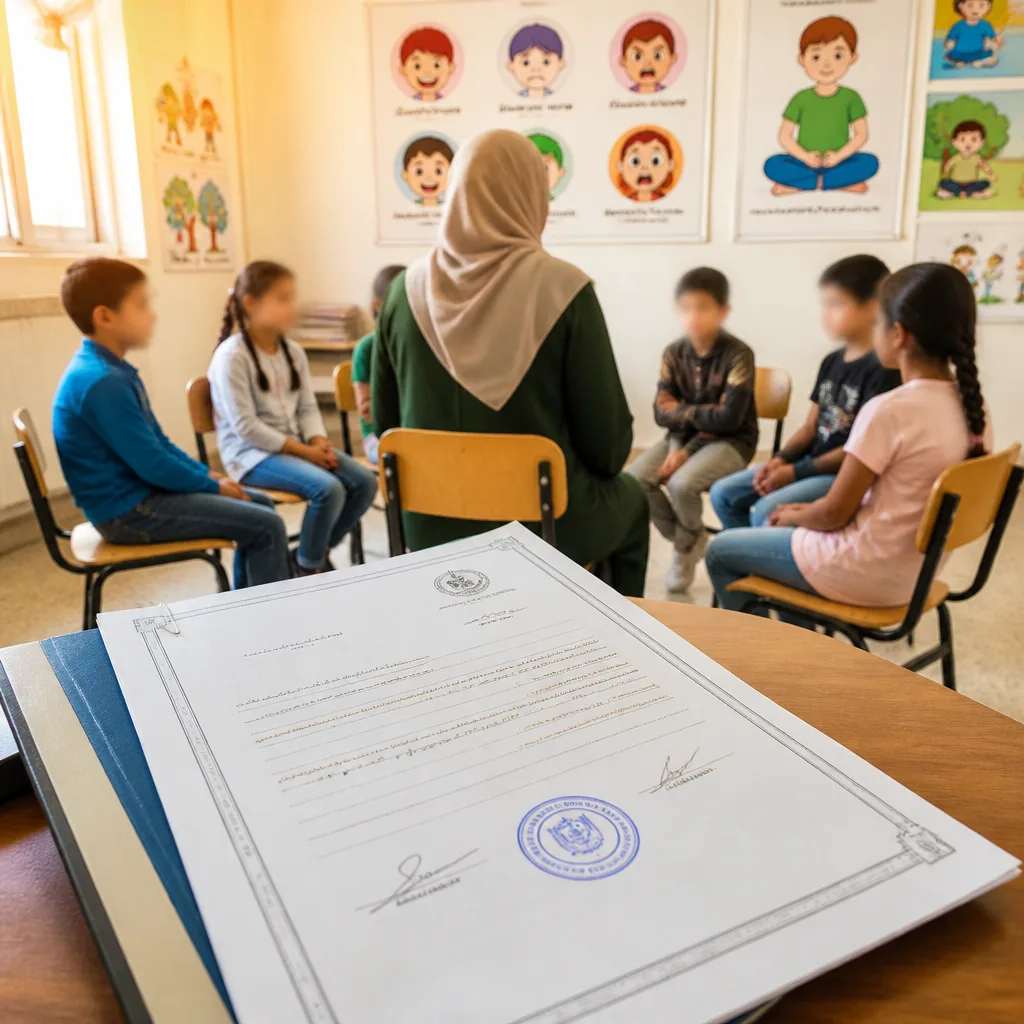
Syria’s Ministry of Education has formalized a national roll-out of an evidence-based social and emotional learning programme after signing a White Label Agreement (WLA) with the Norwegian Refugee Council (NRC), officials announced. The agreement allows the ministry to adapt and apply the Better Learning Programme (BLP) methods within its own education system while retaining the approach’s evidence-based standards.
Scaling psychosocial support into classrooms
The WLA is intended to help teachers support children’s social and emotional development and their ability to cope with daily pressures as part of routine classroom practice. NRC has delivered BLP in Syria in recent years and has implemented the programme across humanitarian operations in other countries. The ministry’s adoption marks the first time a national ministry has signed a WLA for BLP, NRC said.
“We are delighted that the Syrian Ministry of Education has adopted NRC’s BLP as part of the education system,”
The NRC highlighted research from seven countries showing that integrating psychosocial support into daily school life improved the psychosocial wellbeing of seven in ten supported children. The agreement aligns with ministry priorities and national frameworks, officials said, and is designed to strengthen teachers’ ability to support learning and development in the classroom.
Why officials say it matters
Years of violence and socioeconomic hardship in Syria have had a substantial impact on children. According to the ministry and NRC, about a third of Syrian children are experiencing psychosocial distress and conflict-related stress. By adopting BLP methods, the Ministry of Education aims to create more supportive and inclusive learning environments that can reach large numbers of students through existing school systems.
Hassan Mohamad al Hussein, head of Planning and Statistics at the ministry, said cooperation with partners is intended to develop practical and sustainable educational practices that strengthen teachers’ capacity to support children in the classroom. NRC’s Syria country director, Federico Jachetti, framed the agreement as a milestone enabling the ministry to draw on evidence-based practices developed through BLP.
What the White Label Agreement allows
The WLA permits the ministry to:
- Adapt BLP methods and integrate them into national curricula and classroom practice under the ministry’s branding.
- Use NRC’s evidence-based tools and approaches while retaining oversight and ownership at the ministry level.
- Scale interventions beyond NGO programmes by embedding psychosocial support into daily school activities.
NRC noted that BLP has been implemented in 36 countries, and that evidence from those programmes underpins the case for integrating psychosocial elements into routine schooling rather than delivering them only as separate relief activities.
| Measure | Figure |
|---|---|
| Countries where BLP has been implemented | 36 |
| Proportion of supported children showing improved psychosocial wellbeing | 7 in 10 |
| Share of Syrian children experiencing psychosocial distress | 1 in 3 |
Implications and next steps
By moving from NGO-led delivery to ministry adoption, the programme could reach significantly more students through formal schooling. The ministry’s stated aim is to align BLP with national education priorities and frameworks, which may support longer-term sustainability and the professional development of teachers across areas affected by conflict and displacement.
Officials framed the agreement as a step toward more inclusive learning environments for children who have endured years of hardship. NRC described the WLA as an example of how humanitarian innovations with an evidence base can transition into nationally owned education systems.
For educators, families and policymakers, the transition raises practical questions: how training and supervision will be provided at scale, how classroom workloads will accommodate new routines, and how outcomes will be monitored as the programme moves into ministry hands. NRC’s existing evidence provides a starting point, but the effectiveness of national implementation will depend on resourcing, teacher support and ongoing alignment with curriculum standards.
The WLA marks a notable policy shift in Syria’s education response, aiming to mainstream psychosocial support into daily learning and to bolster teachers’ capacity to address the social and emotional needs of students in classrooms across the country.