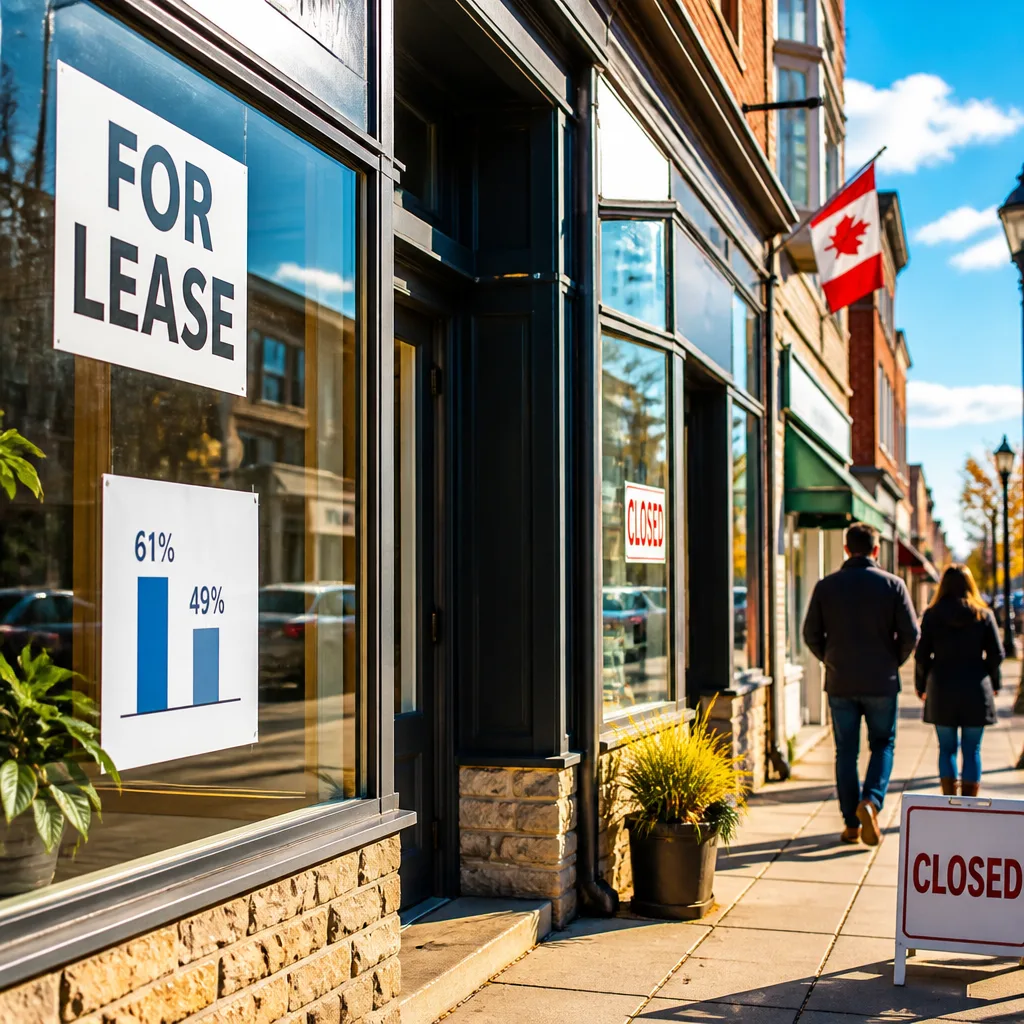
Sixty-one per cent of Canadian small-business owners reported operating without any commercial insurance in 2026, according to Zensurance’s fifth annual Small Business Confidence Index — a stark figure that follows a dramatic shift a year earlier and arrives as owner confidence weakens.
Uninsured rate stabilises after 2025 surge
The survey of 1,000 self-identified business owners, entrepreneurs and self-employed professionals conducted in June 2026 shows the uninsured rate essentially unchanged from last year’s 62.1%, after jumping from roughly 33.6% in 2024. The firm cautions the most significant change occurred in 2025 and that this year’s result represents a plateau at an elevated level rather than a continued increase.
Alongside the coverage gap, the index recorded business confidence at 49% this year, down from 58% in 2025 and 70% in 2024, signalling growing unease among small-business operators.
| Year | Uninsured rate | Business confidence |
|---|---|---|
| 2024 | ~33.6% | 70% |
| 2025 | 62.1% | 58% |
| 2026 | 61% | 49% |
Why brokers should dig beyond the headline
Zensurance, which commissioned the index, emphasises that brokers and commentators need to understand what the headline figure does and does not imply. The insurer’s release notes the 2026 result reflects a stabilisation at a high level after a concentrated jump in 2025, not a steady upward trend across both years.
"Insurance is one of the few levers owners can pull in an environment where tariffs, inflation and economic uncertainty remain outside their control," said Danish Yusuf, Zensurance's CEO and founder.
The survey also revealed troubling operational signals: nearly half of respondents said they had considered closing permanently at some point in 2026, and four in five reported operating with three months of cash reserves or less. Those figures suggest many small firms are running with thin buffers while remaining uninsured.
- Survey size and method: 1,000 respondents via Pollfish, an online panel; participants were self-selected adults aged 18 to 64 who identified as self-employed.
- Policy implications: A high uninsured rate raises systemic risk for suppliers, landlords and customers dealing with small firms and complicates recovery after losses.
- Advisory point: Brokers can use the data to prioritise outreach but should frame the trend accurately — a sharp deterioration occurred in 2025 and has since stabilised.
Consequences for the sector and market
The combination of elevated uninsured rates and falling confidence matters for more than individual firms. Small businesses account for a substantial share of employment and economic activity; high uninsured penetration increases the chance that localized losses cascade through supply chains, amplifying shocks for creditors and communities.
For brokers and insurers, the index suggests both risk and opportunity. If a meaningful portion of owners are uninsured by choice because of perceived cost, lack of trust or misunderstanding of coverages, there is room for targeted education and product design. But if affordability or accessibility are the drivers, firms in the sector and policymakers may need to consider interventions to reduce barriers.
Zensurance’s methodology note underlines the limitations of online-panel polling and a self-selected sample, which may not perfectly mirror the Canadian small-business population. Still, the numbers paint a clear picture of growing fragility among many owners — a fragility that insurance, when purchased and correctly structured, is intended to mitigate.
As the sector digests these figures, the immediate questions for brokers, lenders and regulators are practical: how to close a widespread protection gap quickly, and how to shore up an increasingly uneasy cohort of small-business operators before a shock prompts permanent exits.