
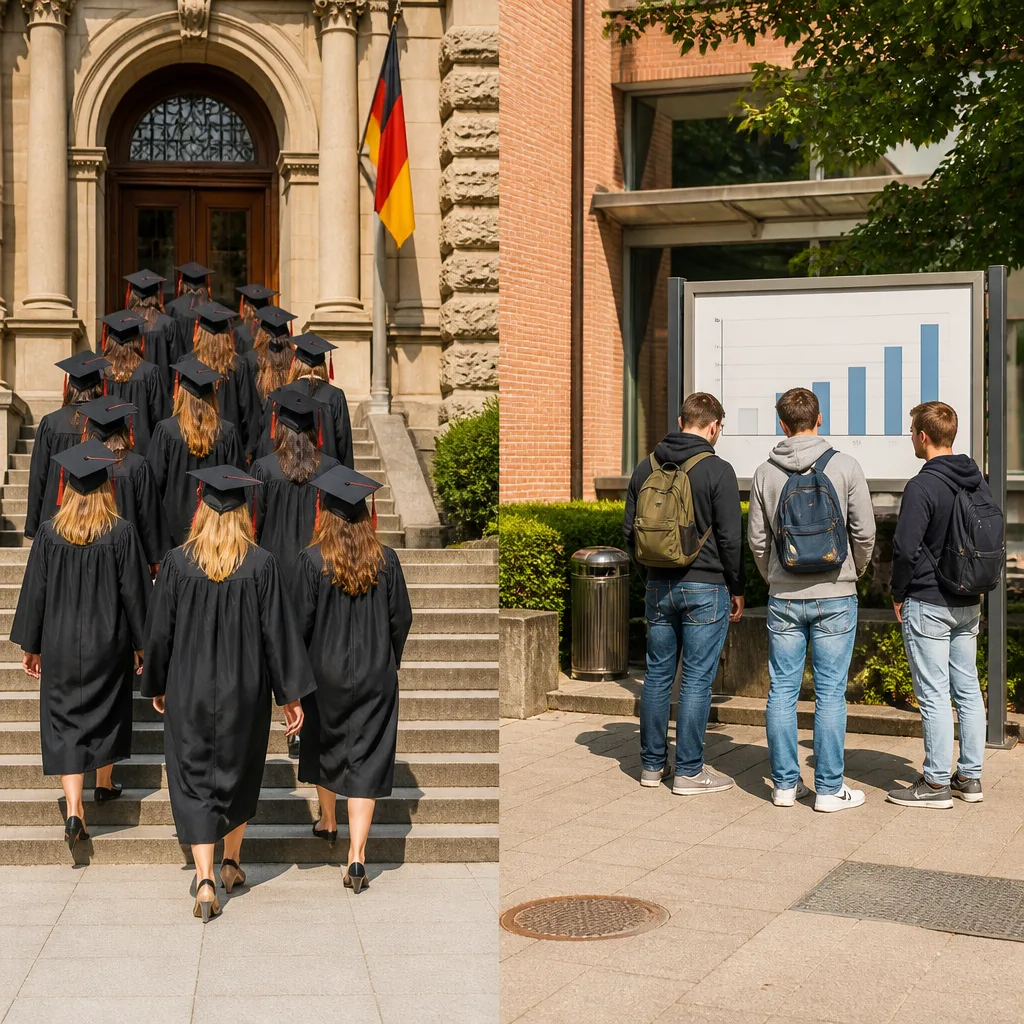
New official data from Germany shows a clear tilt in educational outcomes: young women are outperforming their male peers at both the highest levels of secondary schooling and at university, while boys are overrepresented among lower-level school leavers and those who repeat a year.
Key differences by qualification level
The Wiesbaden-based Federal Statistical Office reported that in 2024 women comprised 55 per cent of the 258,300 pupils who completed the Abitur, the general qualification for university entrance, with men accounting for the remaining 45 per cent. By contrast, among the 133,100 students who left school with a first school‑leaving certificate — typically awarded at the end of ninth grade — males made up 59 per cent, while females represented 41 per cent.
The data spotlights a widening gender gap that varies by level of qualification: women predominate at the top end of the secondary system, yet men are more prevalent among those exiting earlier with lower credentials.
Repetition, early leavers and vocational pathways
Yearly repetition is also skewed: of the students who had to repeat a year in 2024–2025, 56 per cent were male and 44 per cent were female. The office further noted that young men were more likely to leave school relatively early and subsequently not begin vocational training or pursue further education.
- Abitur graduates (2024): 55% women, 45% men (total 258,300)
- First school‑leaving qualification: 59% men, 41% women (total 133,100)
- Students repeating a year (2024–25): 56% men, 44% women
University completion rates
The gender divide continues into higher education, according to the same cohort analyses. Among students who began bachelor’s programmes in 2020, 34 per cent of women had completed their degree within eight semesters, compared with 25 per cent of men. In master’s programmes, completion after six semesters was recorded at 53 per cent for women and 48 per cent for men who started in 2020.
| Programme | Women complete on time | Men complete on time |
|---|---|---|
| Bachelor’s (8 semesters) | 34% | 25% |
| Master’s (6 semesters) | 53% | 48% |
These figures point to stronger timely completion among female students at university, and to challenges for male learners both earlier and later in the education pipeline.
Implications for policy and practice
For educators and policymakers, the patterns raise pressing questions about support for boys and young men at multiple decision points: preventing early school leaving, reducing grade repetition, and improving engagement with pathways that lead to vocational training or higher education. Equally, the data will prompt consideration of what is working to support girls and young women — including in transitions to and within university — and what can be built on or adapted elsewhere.
Although the figures are specific to Germany, the broader themes resonate internationally: gendered differences in attainment and progression have consequences for labour-market participation, skills supply and social mobility. Tracking the origins and drivers of these gaps will be central to efforts aimed at ensuring equitable outcomes for all students.
The Federal Statistical Office in Wiesbaden published these statistics on Thursday, producing the most recent snapshot of how girls and boys are faring across Germany’s education system.