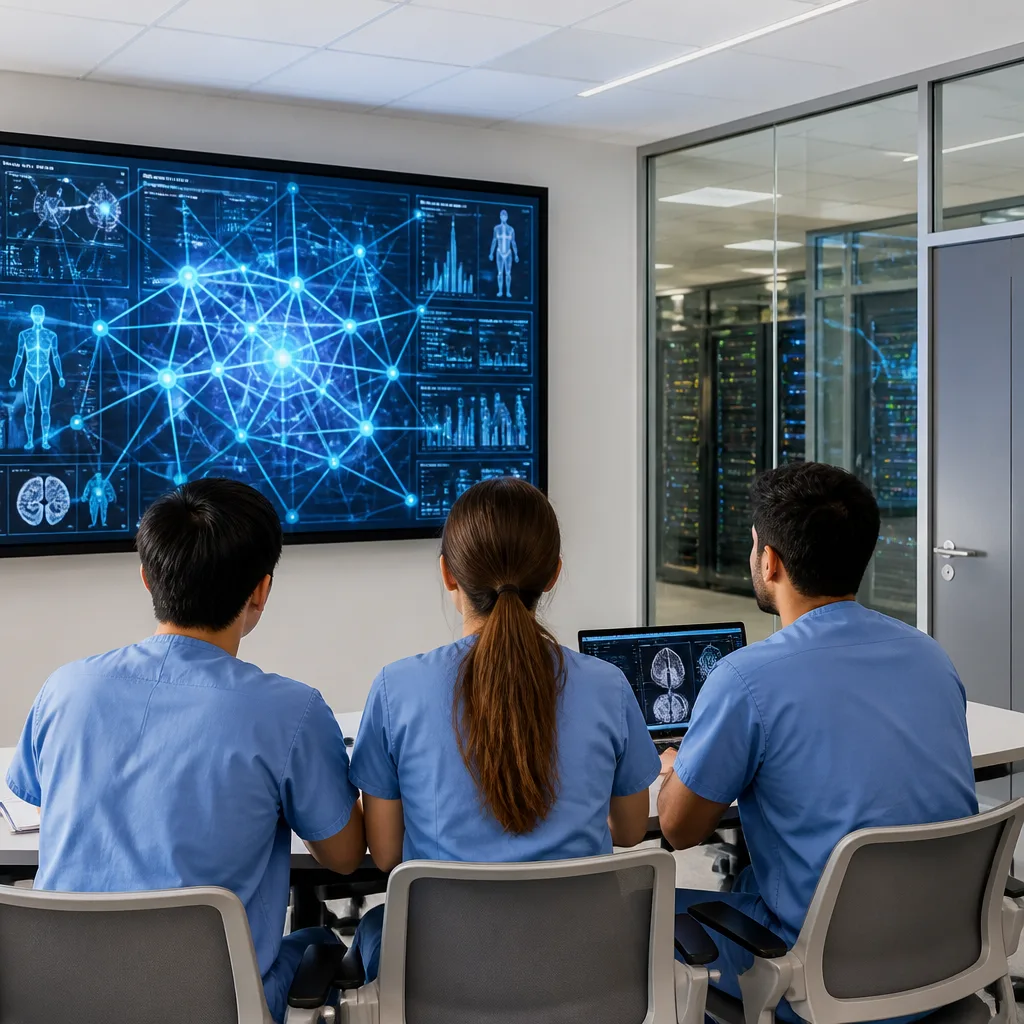
A SoftBank Group company has launched joint research with Juntendo University and medical data platform provider HEMILLIONS to adapt a domestic large language model for medical education and clinical support, organisers announced. The project, which started in June 2026, seeks to improve the clinical reasoning skills of resident physicians and streamline medical documentation while ensuring compliance with Japanese medical regulations.
Domestic model developed from scratch
SB Intuitions, the SoftBank affiliate leading the technical work, will build on its Japan‑originated large language model known as Med‑Sarashina. Project partners say the model is being developed entirely within Japan to avoid reliance on foreign foundation models — an approach they argue will better meet local regulatory requirements and the confidentiality demands of clinical data.
"Med‑Sarashina"
Juntendo University will contribute clinical insights and case material used for teaching residents. Those educational case data will be used for additional training and fine‑tuning of the domestic model, with the partners aiming to create prototype tools for diagnostic assistance and medical document generation.
Roles and responsibilities
The consortium has assigned specific responsibilities to each partner:
- SB Intuitions: develop and fine‑tune the domestic LLM for medical tasks;
- SoftBank: support validation, verification and evaluation of the model for practical use and explore business and service models for broader implementation;
- HEMILLIONS: provide a compliant medical data platform and manage the operational framework for handling sensitive clinical information.
| Partner | Primary role |
|---|---|
| SB Intuitions | Model development and fine‑tuning |
| Juntendo University | Supply of clinical education case data |
| SoftBank | Validation, evaluation, business modelling |
| HEMILLIONS | Data platform complying with the "Three‑Ministry Two‑Guideline" |
Data governance and safety
HEMILLIONS will host Med‑Sarashina on a platform designed to satisfy Japan’s safety management standards for medical information, often referenced as the "Three‑Ministry Two‑Guideline". The partners say this framework will help verify operational safeguards required to work with highly confidential patient information.
According to the project outline, the research will combine post‑training on curated medical datasets with knowledge‑graph techniques to improve the model’s clinical reasoning. SoftBank will take the lead on assessing whether the model’s outputs meet the standards required for use in clinical training and which functions could be deployed for real‑world use.
Education and implementation implications
The collaboration explicitly targets resident education: using simulated cases and didactic material to enhance trainees’ diagnostic thinking and decision‑making. Prototype tools are expected to include assistance for differential diagnosis and automated generation of medical records — tasks that, if reliable, could reduce administrative burden on residents and give educators new platforms for assessment.
But the partners also acknowledge significant hurdles before social implementation. Any clinical decision‑support tools must be validated for safety and accuracy, and institutions will need clear policies governing AI use in education and clinical care. The choice to build a domestic model signals a preference for national control over sensitive data and regulatory alignment, a consideration that has gained traction in many countries wrestling with how to adopt generative AI in health care.
For medical schools and teaching hospitals, the research could offer an early example of integrating AI into postgraduate training while keeping data governance local. Observers will watch whether the prototypes reach a level of reliability that justifies trial use in supervised educational settings and whether the tools measurably improve residents’ clinical reasoning or reduce documentation workloads.
The project does not yet outline timelines for full clinical trials or deployment, nor has it released performance metrics. The partners say they will continue verification and evaluation work with an eye to social implementation and possible commercial services in the future.
As health‑education systems worldwide consider AI’s role in training and patient care, the collaboration between a major technology firm, a medical university and a compliant data operator highlights the intertwined technical, educational and regulatory issues that will shape adoption.