A Saanich high‑school student has earned international recognition for applying artificial intelligence to a longstanding question in astrophysics. Sixteen‑year‑old Jared Qin, a student at St. Michaels University School, was named one of 10 winners of the 2026 Leaders of Today Award, selected from roughly 3,400 applications worldwide. The prize includes a $1,000 grant to further development of his AI model that detects galaxy mergers.
From classroom curiosity to global accolade
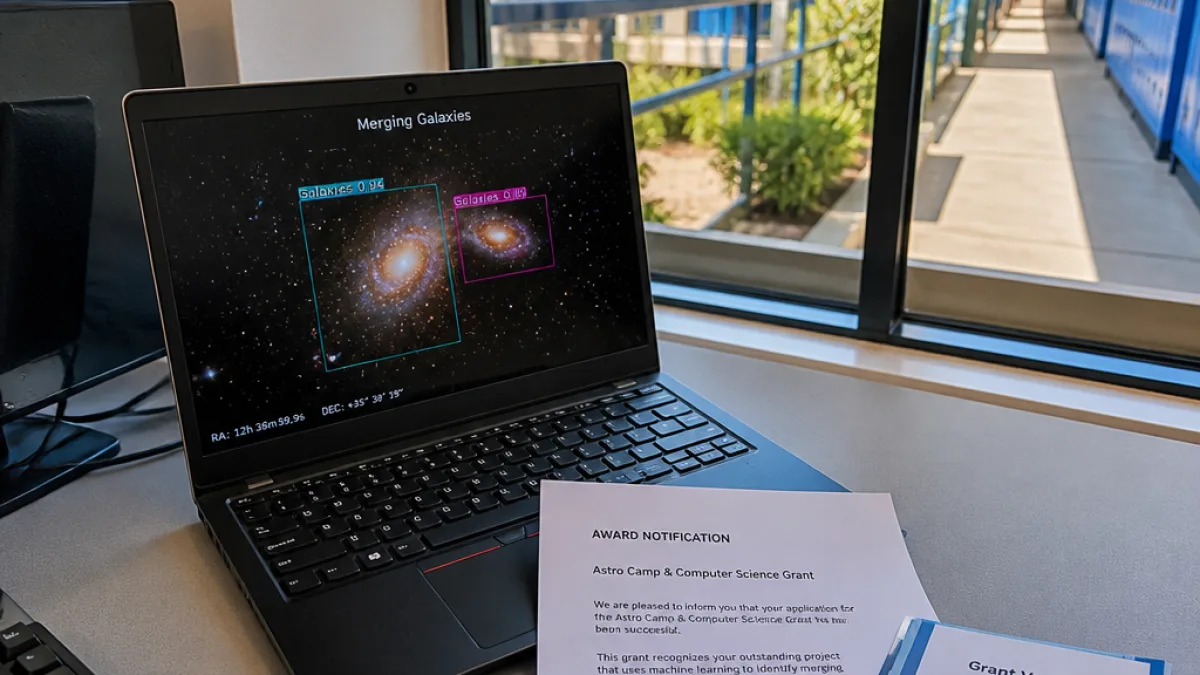
Qin’s model trains inside computer simulations of the universe where collisions between galaxies are already labelled. Once the algorithm learns to recognise the signatures of these mergers, it is applied to real telescope images to find systems previously catalogued as ordinary galaxies. Qin says the approach could reveal more galaxy mergers than researchers currently count, a possibility with ripple effects for understanding how galaxies form and evolve.
The work is timely. Recent deep‑field observations from the James Webb Space Telescope have uncovered massive galaxies and supermassive black holes at earlier times than expected, prompting debate about whether standard models are under‑estimating merger rates in the young universe. Qin argues that missed mergers would help explain how such large structures emerged so early.
“I really was just having this mindset of ‘I’m just gonna shoot my shot,’ and I had zero expectations of winning this grant,” Qin said, reflecting on his application. “It was just crazy.”
Technical constraints and the path ahead
Qin told reporters his biggest practical hurdle is hardware. The model runs on a laptop, while many high‑performance classifiers are trained on large supercomputers with extensive resources. He noted that those top‑performing systems also use different advanced deep‑learning techniques and far greater training budgets.
Despite those limits, the award judges saw potential in Qin’s approach. The grant will allow him to refine the model and possibly extend its training or data access. Qin’s description of the science is cautious but pointed: finding additional mergers could alter current interpretations of galaxy growth and the timeline of cosmic history.
- Winner: Jared Qin, 16, St. Michaels University School (Saanich)
- Award: 2026 Leaders of Today Award — one of 10 global winners
- Prize: $1,000 grant
- Competition: about 3,400 applicants worldwide
- Project: AI classifier for identifying galaxy mergers in telescope images
| Item | Detail |
|---|---|
| Age | 16 |
| Institution | St. Michaels University School, Saanich |
| Recognition | Leaders of Today Award (2026) |
| Funding | $1,000 |
Local educators and families may see this achievement as part of a growing pattern: younger students are gaining exposure to machine learning and data science, and applying those tools to research questions once reserved for graduate students and professional teams. For Saanich, this is a reminder of the region’s capacity to nurture scientific curiosity and technical skill among its youth.
As Qin continues his work, the wider astronomy community will be watching how relatively lightweight, accessible approaches might complement large‑scale, resource‑intensive efforts. If smaller, innovative classifiers can flag additional merger candidates, they could steer observational follow‑up and inform theoretical models without requiring immediate access to supercomputing facilities.
The student’s acknowledgement of the improbable nature of his win — submitting an application with little expectation of success — also underscores the value of encouraging risk‑taking in local classrooms. For Saanich residents, the story is both a point of civic pride and a practical example of how local talent intersects with global scientific debates.