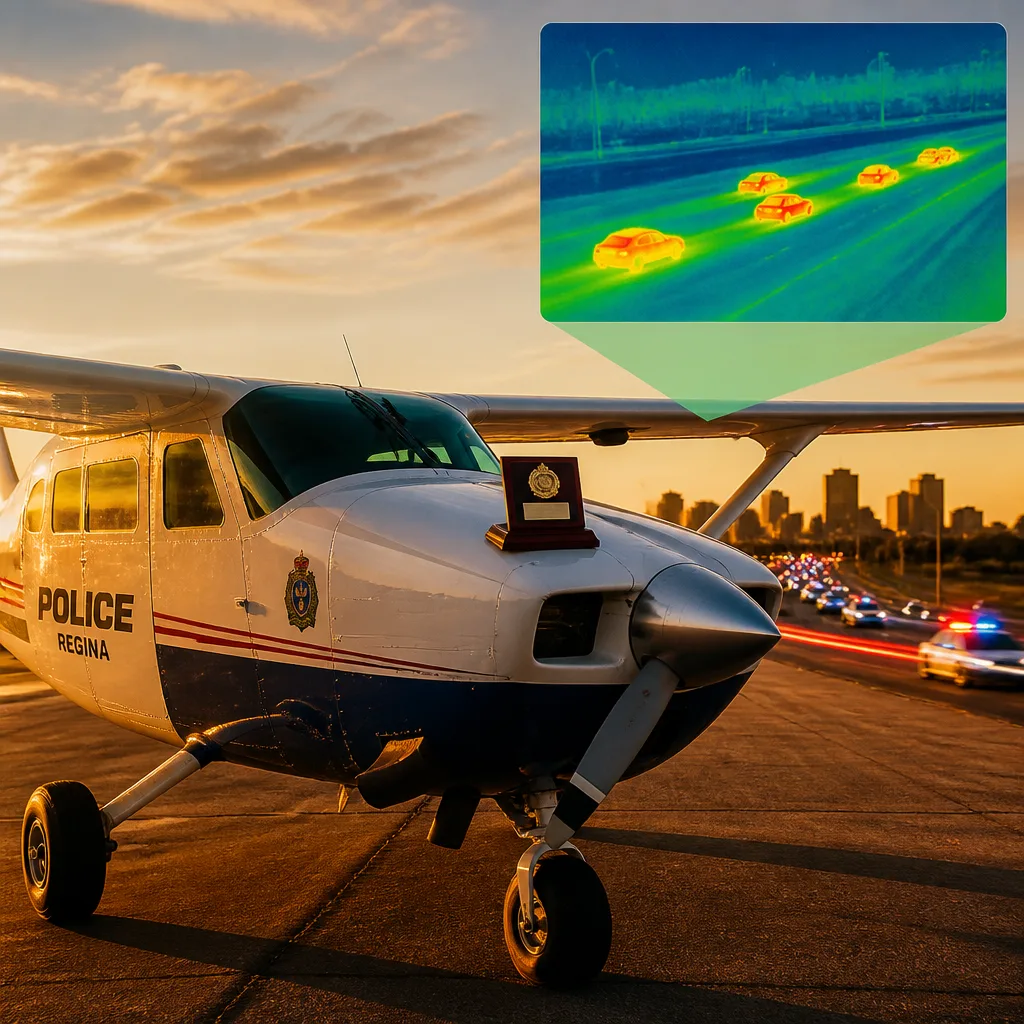
The Regina Police Service says two members of its Aerial Support Unit have been recognised internationally for operations that helped locate an unconscious missing person, support high‑speed vehicle tracking and guide officers to a vehicle connected to a homicide.
International recognition for ground‑support flights
In late July, pilot Sgt. Steve Wyatt and tactical flight officer Cst. Corrie Neufeld received the Airborne Public Safety Association’s Fixed‑Wing Operator Award, an honour that highlights a fixed‑wing pilot or crew whose work using an aircraft had a substantial effect on their agency’s on‑the‑ground policing, the Regina Police Service said in a news release on Aug. 21.
The two are part of a six‑person team that patrols Regina and surrounding areas across two shifts. In 2025 the unit responded to roughly 1,800 calls for service, the release said, with their responses contributing to the arrests of about 480 people who then faced roughly 900 Criminal Code charges.
| Metric | Reported figure |
|---|---|
| Calls for service (2025) | 1,800 |
| Arrests linked to unit response | 480 |
| Criminal Code charges following arrests | 900 |
Operations cited by the award
The department said the crew used the aircraft’s specialised infrared camera to find an unconscious missing person in a green space, directing patrol officers and paramedics to the precise location so the person could be taken to hospital and survive.
The award also acknowledged the ASU’s role in following high‑speed pursuits. Regina police described an incident in which a stolen vehicle was tracked travelling at speeds police estimated at up to 200 km/h, and another case in which the aircraft helped guide officers to an abandoned car later found to contain a homicide victim in its trunk.
"Fixed‑Wing Operator Award"
The ASU’s capabilities are part of a broader multi‑tool approach used by the service that has included planes, drones and other tactical measures such as tyre deflation devices in pursuit management, according to previous department statements cited by local media.
- Air crew used infrared imagery to locate an unconscious person and co‑ordinate medical response.
- The plane assisted in tracking a high‑speed stolen vehicle reported at speeds near 200 km/h.
- Aircraft guidance led officers to an abandoned car later linked to a homicide investigation.
Implications for policing and public safety
The recognition underscores the evolving role of airborne units in municipal policing in Canada, where fixed‑wing aircraft and airborne sensors can expand situational awareness and direct scarce ground resources more quickly than ground patrols alone. The ASU’s reported numbers — calls attended, arrests and charges laid — suggest the unit plays a measurable role in day‑to‑day enforcement and emergency response in the Regina area.
At the same time, airborne operations in pursuit contexts can raise questions about coordination, safety and oversight, particularly in incidents involving high speeds and complex tactical choices. The Regina Police Service’s public summaries emphasise the unit’s contributions to safety and evidence gathering; the award highlights peer recognition from an international body of airborne public‑safety practitioners.
Regina’s statement did not provide additional operational detail such as the precise dates of the cited incidents, or how airborne activity is integrated with provincial or federal policing partners. It noted only the award citation and the broad outcomes tied to the unit’s work during 2025.
The Airborne Public Safety Association is a professional organisation that recognises airborne public‑safety operators. The Fixed‑Wing Operator Award singled out the Regina crew for their effective use of a fixed‑wing aircraft in support of ground operations.
As municipalities across Canada continue to weigh the costs and benefits of aviation assets for policing, the ASU’s award and the outcomes cited by the Regina Police Service will likely inform local discussion about the role and value of airborne support in crime prevention and emergency response.