
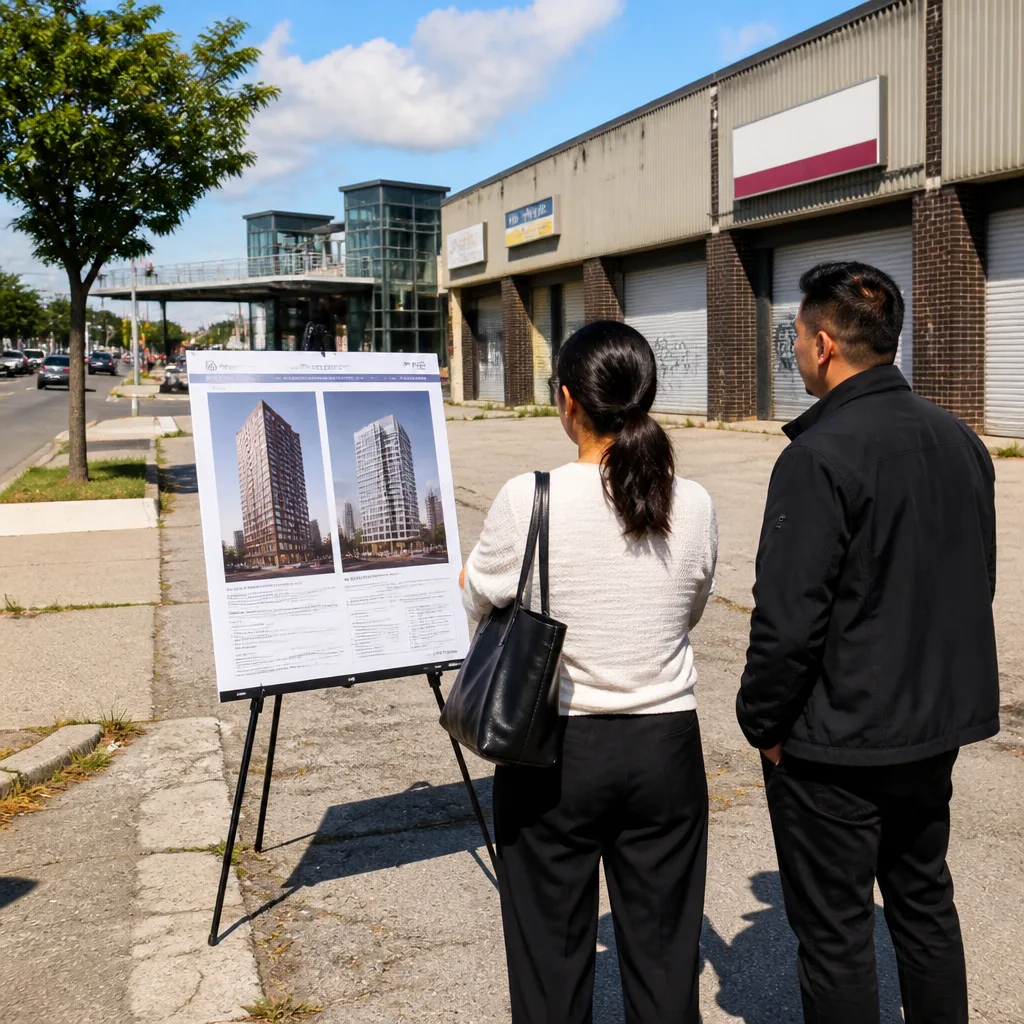
The City of Ottawa has received an application to replace an industrial plaza near the Corso Italia O‑Train stop with two residential towers that would contain a total of 543 units, ground‑floor commercial space and a new park — a proposal that is already unsettling businesses that have occupied the site for years.
Details of the proposal
The development application, posted at the corner of Breezehill Avenue and Laurel Street in Hintonburg, calls for one building of 33 storeys and another of 31 storeys. The project remains in the city’s public comment period and has not yet been approved.
| Element | Planned |
|---|---|
| Residential units | 543 |
| Tower heights | 33 & 31 storeys |
| Site | Breezehill Ave & Laurel St, near Corso Italia O‑Train |
Local businesses voice unease
Tenants who operate from the plaza say the application sign — a routine part of Ottawa’s rezoning and development process — has made the possibility of demolition feel immediate. That uncertainty is especially acute for businesses that say moving would be complex and costly.
Paul Flindall, owner of Capital Self Storage, which has been located on the property for nearly two decades, said he only recently discovered the scale of the developer’s plans. He welcomed the look of the proposal but warned of losses that accompany redevelopment.
"I think the proposal itself looks great,"
"But I think you do lose something when you lose some of these local businesses that are here."
Flindall noted that relocating a self‑storage operation is particularly difficult because it would require clearing the facility and rebuilding customer inventory at a new site — a process he questioned as feasible for his business.
Implications beyond one plaza
The clash unfolding in Hintonburg mirrors a broader national conversation about how Canadian cities densify without eroding industrial and small‑business capacity. Transit‑oriented development is central to municipal plans for increasing housing supply, yet it often collides with the livelihoods of current occupants on parcels targeted for redevelopment.
For planners and developers, placing new homes near rapid transit is attractive: it can reduce car dependence and increase housing stock in established neighbourhoods. For tenants, the calculus is different — disruption can mean loss of affordable industrial space, customer bases and the intangible community contributions small firms provide.
- Housing gain: The project would add hundreds of residences in a transit‑served location.
- Business loss risk: Longstanding tenants say relocation is costly or impractical.
- Process stage: The application is in the public comment phase and is not approved.
What comes next
As the public comment period progresses, stakeholders including nearby residents, business owners and city planners will have the opportunity to weigh in. Municipal review will consider zoning, built form, transportation impact and community benefits such as the proposed park and ground‑floor retail.
For tenants like Capital Self Storage, the future hinges on development timelines, potential relocation assistance and whether the final approval includes provisions that allow legacy businesses to remain or to transition with support. The tension highlights a policy challenge: how to increase urban housing supply while preserving the small‑business ecosystems that contribute to neighbourhood character and employment.
Whatever the eventual decision, the Hintonburg proposal offers a clear example of competing public priorities: adding hundreds of homes in a transit rich corridor, and protecting established commercial and industrial uses that serve local communities and provide jobs.