The Education Quality and Accountability Office’s latest provincial test results show modest improvements in Ontario students’ achievement across grades, but long‑standing challenges in mathematics persist.
Small increases across grades, math still a concern
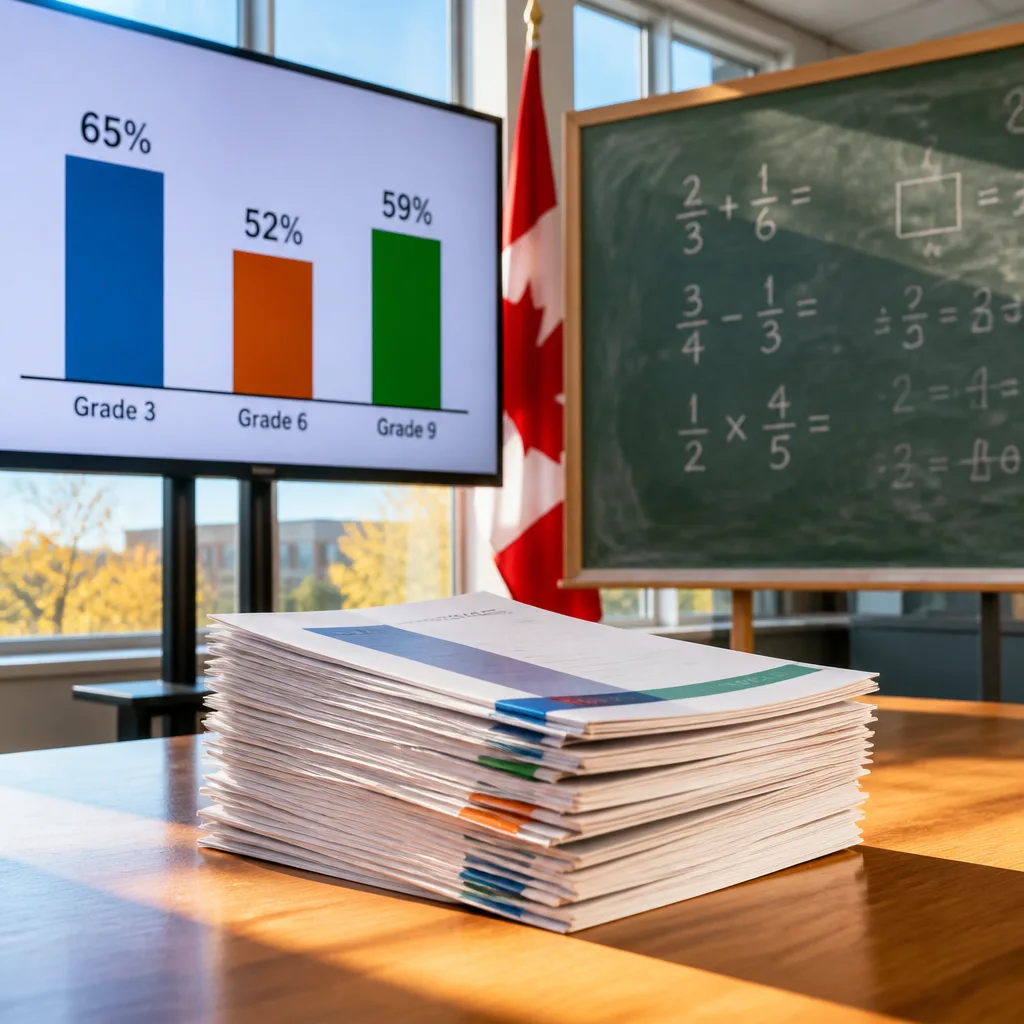
Results from the 2025–26 school year indicate a one‑point rise from the previous year in the proportion of students meeting provincial standards in English‑language schools. The figures show 65 per cent of Grade 3 students, 52 per cent of Grade 6 students and 59 per cent of Grade 9 students met the provincial standard overall.
| Grade | % meeting provincial standard |
|---|---|
| Grade 3 | 65% |
| Grade 6 | 52% |
| Grade 9 | 59% |
Reading and writing results were stronger at younger grades: in Grade 3, 75 per cent met the reading standard and 67 per cent met the writing standard. At Grade 6, 86 per cent met the reading standard and 85 per cent met the writing standard — figures that did not change from the prior year.
The Ontario Secondary School Literacy Test, generally taken in Grade 10, recorded 86 per cent of first‑time eligible students meeting the standard, a one‑point increase from the previous year.
Government reaction and broader context
Education Minister Paul Calandra said the results provide useful information about where progress is occurring and where additional focus is required.
“These results are encouraging, but they also make clear that there is more work to do. Too many students continue to struggle, achievement gaps persist and results remain uneven across the province.”
While the report notes that math scores have inched upward over time, mathematics remains an area requiring attention, particularly at Grade 6 where roughly half of students meet the provincial standard. The Grade 6 result reflects a pattern that has drawn scrutiny from successive governments due to its persistence.
Disparities and implications for schools and families
EQAO’s data also show that schools where instruction is delivered in French generally outperformed the provincial averages in English‑language schools in most categories, though the release did not provide a full breakdown of regional or demographic disparities in this summary.
Education advocates and district staff will likely view these results as a signal to sustain or recalibrate supports for students who are not meeting standards. Key areas for consideration include targeted math interventions, professional development for teachers in numeracy instruction, and efforts to address the uneven outcomes between schools and communities.
- Modest gains — All main categories in English‑language schools rose by one percentage point versus the previous year.
- Persistent math gap — Approximately half of Grade 6 students meet the math standard, underscoring a multi‑year challenge.
- Stronger literacy at younger grades — Reading and writing rates remain comparatively higher than math, especially in Grades 3 and 6.
For families, educators and policy‑makers, the results underline the reality that modest provincial improvements do not erase local or student‑level gaps. The data are intended to inform decisions about where to direct resources, interventions and supports so students who are struggling receive more tailored help.
What’s next
The EQAO data will feed into ongoing discussions within school boards and at the ministry about priorities and resource allocation. Officials and educators will be watching whether incremental year‑to‑year improvements accumulate into sustained gains, particularly in mathematics, and whether strategies to close achievement gaps produce measurable change.
Until then, the figures serve as a reminder that while some progress is visible, many students continue to fall short of provincial expectations — a reality that raises questions about what more must be done in classrooms, schools and communities across Ontario.