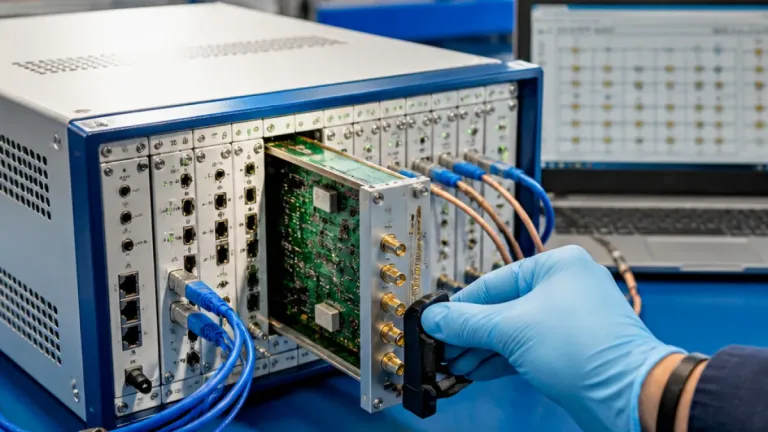

Nvidia’s role in the artificial intelligence boom is widening beyond graphics processing units. The company reported a record US$14.8 billion in data-centre networking revenue in its fiscal 2027 first quarter (ended April 26), a gain of 199 per cent year over year, underscoring how networking has become a powerful new growth engine.
Numbers show networking is no longer ancillary
Networking revenue for Nvidia climbed substantially over recent fiscal years, illustrating the rapid scaling of demand for high-performance interconnects as AI workloads grow in size and complexity. According to the company’s disclosed figures, networking sales rose from US$8.6 billion in fiscal 2024 to US$13 billion in fiscal 2025 and then to US$31.4 billion in fiscal 2026, before hitting the quarterly record in fiscal 2027.
| Period | Networking revenue (US$) |
|---|---|
| Fiscal 2024 | 8.6 billion |
| Fiscal 2025 | 13 billion |
| Fiscal 2026 | 31.4 billion |
| Fiscal 2027 Q1 | 14.8 billion (quarter) |
Market research firm IDC also placed Nvidia at the top of the data-centre Ethernet switching market for the first quarter of 2026, assigning it a 21.5 per cent share — an indicator that the firm’s networking hardware is being adopted across hyperscalers and large enterprise data centres.
Why networking matters for AI
Modern AI training and inference increasingly hinge not just on raw compute power but on how quickly data can move between processors and storage. When networks cannot keep pace, GPU utilisation falls and model training slows — imposing a practical cap on performance irrespective of how many accelerator chips are deployed.
Nvidia has layered networking products into its stack to address that bottleneck. Its NVLink interconnect is designed to connect GPUs within rack-scale systems, and its Spectrum‑X Ethernet family targets communications across larger data‑centre fabrics. Together, these technologies aim to reduce communications latency and boost throughput as clusters expand to thousands of accelerators.
- Higher GPU utilisation: faster interconnects help ensure accelerators spend more time computing and less time waiting on data.
- Scalability: Ethernet switching and rack-scale interconnects become critical as model sizes and dataset volumes grow.
- Bundled sales: Networking gives Nvidia additional products to sell alongside GPUs and systems, broadening revenue streams.
Competitive context and risk
Custom AI chips from cloud providers and specialised silicon firms present a long-term competitive challenge to Nvidia’s GPU franchise. But the company’s networking stack — and platforms such as NVLink Fusion at rack scale — could make it harder for rivals to displace Nvidia entirely, because customers often prefer integrated solutions where compute and interconnects are optimised to work together.
That does not remove all risk. Vendors building their own accelerators can design around third‑party interconnects or adopt alternative fabrics. Still, by capturing a meaningful share of Ethernet switching and offering rack-scale interconnects, Nvidia gains leverage: customers buying complete AI systems may favour the convenience and performance tuning of a single vendor’s compute-plus-networking stack.
For investors and industry watchers, the networking numbers change how Nvidia is valued. Historically judged primarily on GPU sales and data-centre compute, the company now has a fast-growing second pillar that diversifies revenue and tightens its grip on the AI infrastructure market.
Whether networking will remain a durable competitive moat depends on how well Nvidia can continue innovating at the system level and how cloud providers and chip rivals respond. For now, the financials point to a clear trend: AI’s growth is driving an appetite not just for faster processors, but for much faster ways to connect them.